Egypt travel
Gold Necklace Egyptian: Karat, Fakes and Where to Buy
Gold Necklace Egyptian buying guide: learn karat marks, spot reproductions, judge fair prices and buy safely in Cairo, Hurghada and Luxor.

By Mohamed Hassan · Senior Local Guide · 12 years
The advice you hear most often in Cairo, Hurghada and Luxor is simple. Pick a pretty chain, haggle hard, and walk away happy. That advice costs people money. A gold necklace in an Egyptian shop is priced from the metal first, not from how charming the seller is. If you don't know the day's rate, the grams and the karat, a "discount" can still sit well above the metal.
A fair price is arithmetic. Take the posted rate per gram for that karat, multiply by the weight, then add a making fee for the work. Everything else, the story about pharaohs, the "special price for you", the free mint tea, is theatre around that number. I would not discuss a price until the scale and the karat board are both in front of you.
Table of Contents
- What Egyptian Gold Necklaces Are and How Karat Sets the Price
- How to Tell Authentic Gold From Reproductions
- Egyptian Gold Necklace Styles Across Ancient Periods
- Symbols on Egyptian Necklaces and What They Mean
- Where to Buy in Cairo, Hurghada and Luxor
- Bargaining, Customs and Shipping Home
- Add a Private Shopping Stop to Your Egypt Day Trip
What Egyptian Gold Necklaces Are and How Karat Sets the Price
Most Egyptian gold necklaces are sold by weight. The price equals the day's gold rate per gram for the chosen karat, multiplied by the grams of metal, plus a making fee for the workmanship. Shops post a per-gram board in Egyptian pounds for each karat. That board moves daily, sometimes between morning and late afternoon, so check it on the day you pay and compare it with a second shop before you commit.
The three-step price
Work it in this order, and don't let the conversation jump ahead.
- Weigh the piece. Ask for the weight on a scale you can see, or for a written weight you can recheck. Hollow beads and thin wire look heavier than they are.
- Multiply grams by the rate for that karat. Use the board figure for 21K, 18K or whatever is stamped, not a blended "gold price" the seller quotes from memory.
- Add the making fee. Intricate, low-karat work carries a higher fee relative to the metal, because the labour is a bigger share of a cheaper piece. A plain chain should carry a small fee. A filigree collar should not be priced like a plain chain.
| Marking | Typical use |
|---|---|
| 22K | Traditional chains and heavier pieces |
| 21K | Most common in Egyptian markets, good balance of colour and strength |
| 18K | Modern designs, more durable for everyday wear |
| 14K | Western-style jewellery sold widely abroad |
| 9K | Budget pieces with the lowest gold content |
Gold content is what the rate is really charging you for. In trade practice, 24K is about 99.9% gold, 22K about 91.6%, 21K about 87.5%, 18K about 75%, 14K about 58.5% and 9K about 37.5%. Say the board shows a hypothetical 1,000 units per gram, used here only to show the arithmetic. Twenty grams of 21K is 20 x 1,000 x 0.875, which is 17,500 units of metal value before any making fee. If the asking price is far above that plus a modest fee, you are paying for the setting, not the gold.
24K is too soft for most chains. It bends, and clasps fail. 21K and 18K dominate what you will be offered, and they wear. 9K pieces are mostly sold for their weight of gold, not for a rich colour, so don't pay a luxury premium for a pale, low-content chain. The whole sum only works if the karat on the stamp is the karat in the metal.
How to Tell Authentic Gold From Reproductions
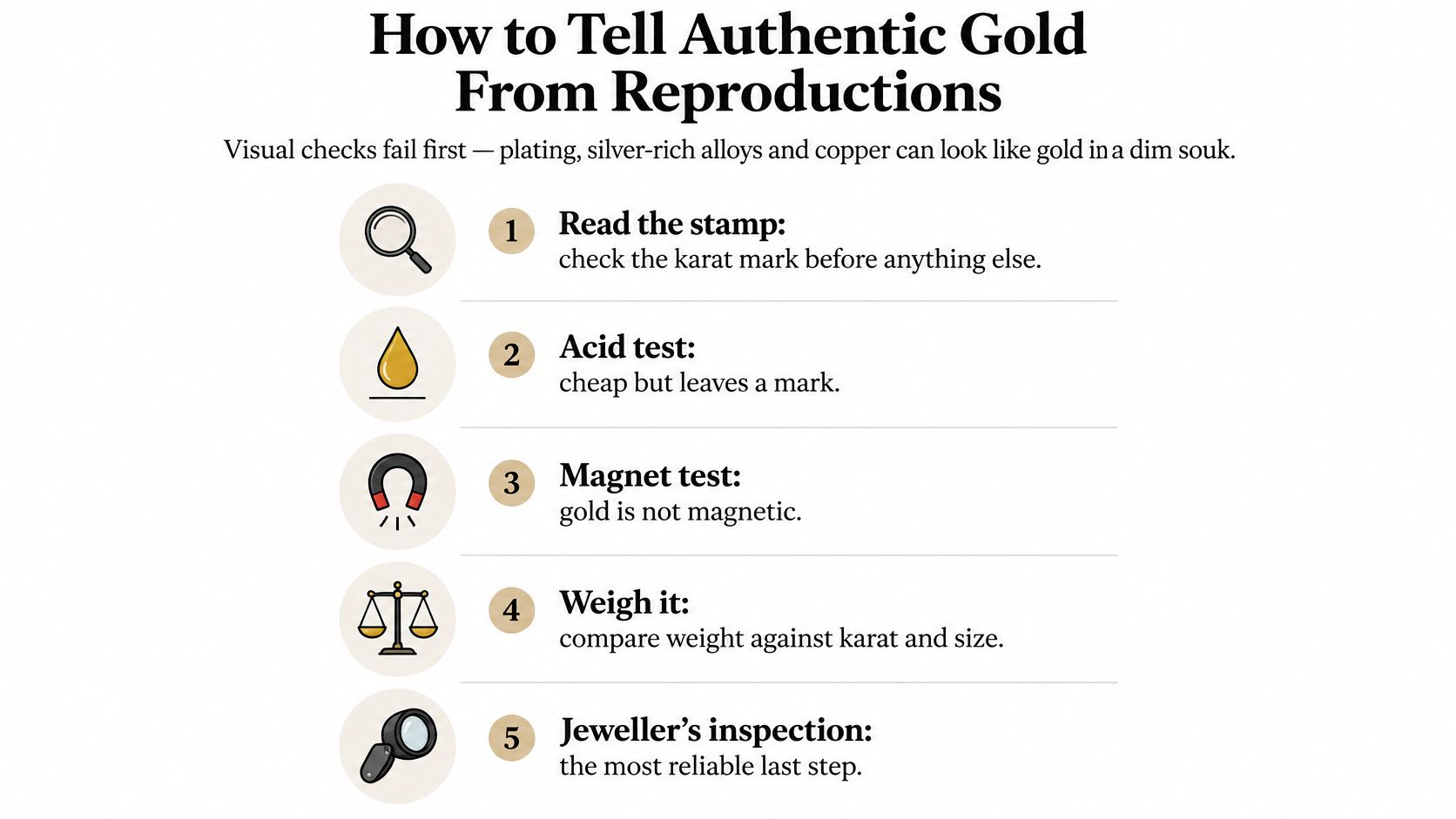
Colour fails first. In a dim souk, gold plating, a silver-rich alloy and a copper-tinted metal can all look like the same warm yellow. Ancient pieces make the same point in a sharper way. A technological study of jewellery dated mainly to the 19th to 13th centuries BCE, discussed in the Met's essay on gold in ancient Egypt, found gold concentrations ranging from 51–53% in electrum to approximately 95% in high-purity alloys. Most samples contained 2–20% silver, and copper was typically below 2% unless it was added on purpose. More silver made a paler electrum. Added copper made a reddish tone and a harder metal. That is why "it looks like Egyptian gold" is not a test.
Run checks from cheapest to most reliable, and treat each one as limited.
- Read the stamp. Look for 21K, 18K, or a fineness mark such as 750 or 875, but remember a stamp can be copied onto plating.
- Use a magnet. Gold is not magnetic, so a strong pull means base metal, although a plated piece over non-magnetic metal can still pass.
- Weigh it. Gold is dense, so a light necklace for the stated size suggests hollow construction or plating.
- Ask for a water-density check. Weight in air versus weight in water estimates density, but only if the scale and the method are honest.
- Request an XRF test. A handheld analyser reads the alloy without cutting the piece. It is the check I would insist on for anything above a modest sum.
What a refusal tells you
Ancient decoration was skilled as well as symbolic. Granules could be joined by colloidal hard soldering, using copper-mineral powder so the joint melted locally without melting the whole bead. A modern copy can mimic that look in plated brass. A shop that refuses an independent XRF reading is a warning, not a tradition. Tests are only as good as the person running them, so if the machine stays in a back room and you never see the screen, treat the result as a sales line.
Practical rule: If they won't show karat, weight and a composition reading, price the piece as fashion jewellery, not as gold.
Egyptian Gold Necklace Styles Across Ancient Periods
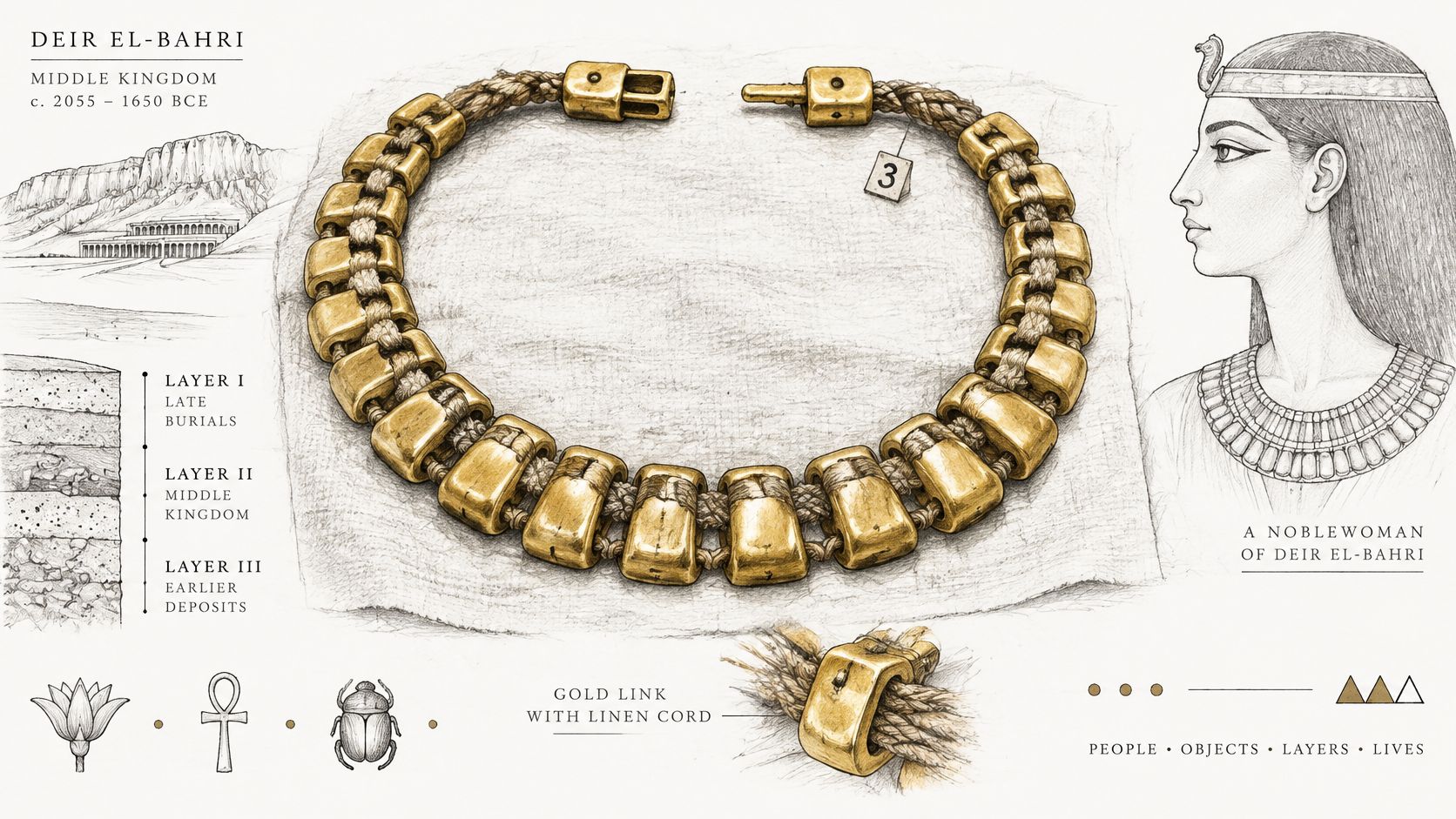
By the Middle Kingdom, roughly 2051 to 1650 BCE, a gold necklace was already a settled form of personal adornment, not a novelty. The necklace found around the mummy of Myt at Deir el-Bahri dates to approximately 2051 to 2030 BCE. It is 61 centimeters of gold on an ancient twisted-linen cord, and it was one of five pieces placed between the layers of wrapping around her head. The Metropolitan Museum of Art records that earliest surviving Egyptian gold objects reach back to the fourth millennium BCE, and that gold kept being made for everyday, temple and funerary use because it does not tarnish. Permanence and divine status sat in the same metal.
A second Middle Kingdom piece, the Necklace of Gold Ball Beads from the tomb of Wah at Thebes, dates to approximately 1981 to 1975 BCE. It is 64 centimeters long, with gold beads about 0.9 to 1.1 centimeters across. These were substantial objects meant to sit prominently at the neck, not delicate souvenirs.
What changed after the Middle Kingdom
Many necklaces from approximately 1938 to 1759 BCE stay predominantly monochromatic, and bead designs rarely use more than three colours. New Kingdom work, approximately 1539 to 1077 BCE, more often sets gold with carnelian, lapis lazuli, glazed steatite and amethyst. Court pieces of that era, including the Tutankhamun treasures, are the visual language most travellers think they are buying.
The Late Period tightens the idea into a single religious object. A necklace from Mit-Rahineh, near ancient Memphis, dates to approximately 570 to 526 BCE, in the Twenty-Sixth Dynasty. The Penn Museum describes it as 37 centimeters long and 4.4 centimeters wide, with 30 cast-gold cowrie beads, one granulated gold pomegranate bead, two barrel beads, a chalcedony bead and a cast-gold pendant of the goddess Sekhmet. Gold, a plant form, a stone and a deity sit on one short strand. Across these centuries Egyptians associated gold with the flesh of the gods, which is why it suited both status and the protection of the dead.
You are buying a visual language, not an archaeological object. A new cowrie strand can be honest design. It is not Mit-Rahineh.
Symbols on Egyptian Necklaces and What They Mean
Motifs are not interchangeable decoration, even when a stall hangs ten of them on one board. Museum evidence, including a Queensland Museum tour of an Egyptian necklace, shows distinct meanings. The Eye of Horus, the wadjet, was associated with protection and was worn widely as an amulet. The ram represented Amun, a major deity whose principal cult centre was Karnak at Thebes. Those two are not the same idea with different outlines.
Six motifs, not one "Egyptian look"
- Ankh: a sign of life, common on amulets and in scenes of gods offering life to a king. A small ankh on a modern chain is a symbol, not a royal gift.
- Scarab: regeneration, tied to the sun's daily renewal. It was an amulet across social groups, not a palace-only badge.
- Lotus: rebirth, opening with the day. It often sits beside other plant forms rather than alone.
- Cartouche: an oval that encloses a royal or divine name. A blank oval, or a name the seller cannot read, is ornament. It carries that meaning only when it names someone.
- Horus eye: protection, already noted, and the one most often sold as a generic lucky charm.
- Fantasy stacks: an ankh, a scarab, a pyramid and a random hieroglyph on one pendant. That combination is modern shop design.
Ask three questions of any motif before you pay. Is it historically attested? Is it a modern reinterpretation? Or is it a fantasy combination? Jewellery was worn across social groups and reflected status, wealth, colour and personal meaning. It was not exclusively royal, so a respectful new design does not have to copy a tomb piece. What it does have to do is tell you which of those three it is. Choose the motif for what it means to the wearer. Ask the seller whether the design copies a known object or was drawn last year. Transparent new work is fine. A claim of pharaonic authenticity on a fantasy pendant is not.
Where to Buy in Cairo, Hurghada and Luxor
Buy where the seller writes karat and weight on a receipt. Treat an unlabelled strand as fashion jewellery, however heavy it feels in the hand. Egyptian gold-jewelry demand totaled 26.1 tonnes in 2024, down 2% from 26.7 tonnes in 2023, according to the World Gold Council. That volume means busy counters, practised sales talk and markups built for visitors who won't do the gram maths.
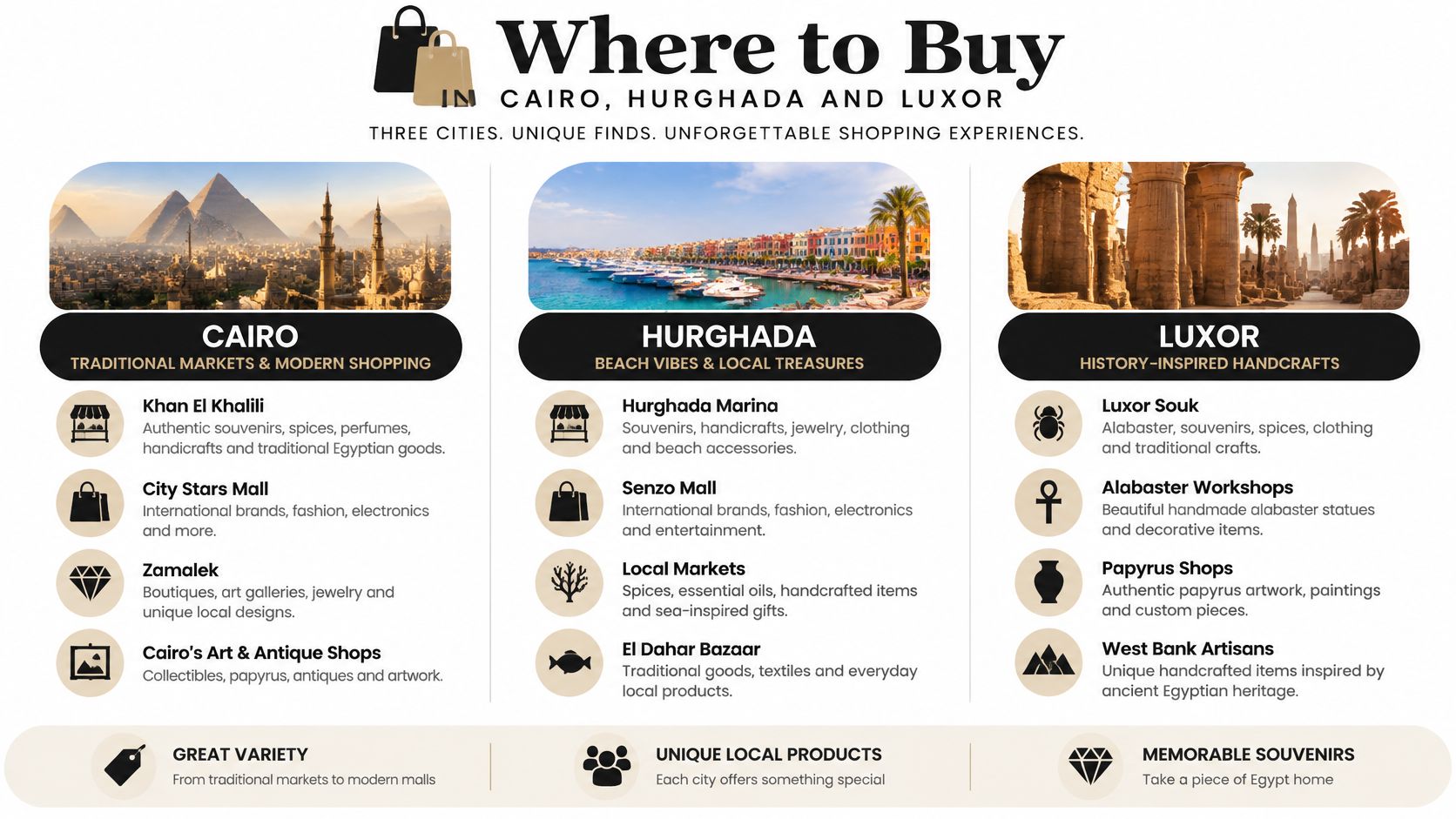
| Venue | City | Best for | Watch for |
|---|---|---|---|
| Khan el-Khalili | Cairo | Widest range of styles and the classic bazaar experience | Heavy haggling and high markups on tourist pieces |
| Licensed jewellers | Cairo | Documented karat and weight with receipts | Higher prices than the bazaar |
| Resort-area shops | Hurghada | Modern designs and convenient access | Visitor pricing and varying stamp accuracy |
| Luxor souks | Luxor | Ancient-inspired motifs and small pieces | Reproductions sold as antiques, which cannot be exported |
| Hotel boutiques | Cairo, Hurghada and Luxor hotels | Convenience close to where you stay | Typically the highest markups of all venues |
Judge every counter on the same four points: what it is best for, what to watch, whether you get paperwork, and where the price sits. Khan el-Khalili wins on range and loses on markup. A licensed Cairo jeweller costs more and is often the rational buy because the receipt names the metal. Hurghada resort shops save a taxi and charge for that convenience. Luxor is strong on small motif pieces and weak the moment someone calls a new casting "from a tomb". Hotel boutiques are the convenience tax.
If you want a sense of how these streets feel before you land, this short walk-through is worth ten minutes.
A buying routine that beats the lowest sticker
- Pick style and target weight before you enter, so charm doesn't reset the brief.
- Visit at least three shops for a comparable piece, not three different stories.
- Note price per gram against that shop's karat board.
- Ask for the day's rate, because stock and boards shift by season and by the afternoon fix.
- Choose the paperwork, even when another stall is cheaper per gram.
The lowest price per gram is not the best value if the receipt does not state the karat.
Bargaining, Customs and Shipping Home
Genuine ancient Egyptian antiquities cannot leave the country without official permission. An "antique" necklace from a souk can be confiscated at the airport, and the seller will not be there to argue. Modern gold jewellery is generally allowed. Keep the receipt that shows karat, weight and the price you paid. If you are still sorting cash, cards and what a fair rate looks like before you land, the Egypt currency guide is the practical companion to this maths.
Bargain from your number, not from theirs.
- Ask weight and karat first. Price talk before those two figures is a distraction.
- Calculate metal value from the day's board, using the same multiplication as for any other piece.
- Open at metal value plus a modest making fee. Do not open at a percentage off a fantasy asking price. That anchors you to their number.
- Walk away if they stay above the calculated value. A nearby shop usually has the same style of chain.
- Pay cash only against a receipt that you read before the notes leave your hand.
Street pressure and the trip home
Don't buy from someone who approaches you in the street. Don't accept a free tour that "just happens" to end in a gold shop, because that commission is already in the price. Never leave a necklace on a stall while you go to a cash machine.
On the way home, declare purchases and check your own country's jewellery allowance and duty before you fly, because those rules differ and a surprise at your airport is expensive. For anything you don't want in cabin baggage, use a tracked and insured courier. An informal parcel counter at a resort is not insurance. If a piece is modern, stamped and receipted, it travels as jewellery. If someone is selling it as ancient, leave it in the case.
Add a Private Shopping Stop to Your Egypt Day Trip
Group-tour shopping stops often carry a commission that shows up in the gram price, and the coach tends to visit the same two counters every week. A private day is different because you choose the stop, the time and the budget, and nobody is paid to steer you. That is the advantage, not a fancier car.
Book a private day from Cairo, Luxor or Hurghada with an English-speaking local guide, and ask in advance for one jeweller stop. Agree the time and a spending cap before the morning starts. A Cairo city tour can absorb a short gold stop without swallowing the Pyramids, but only if the stop is planned, not improvised at the gate.
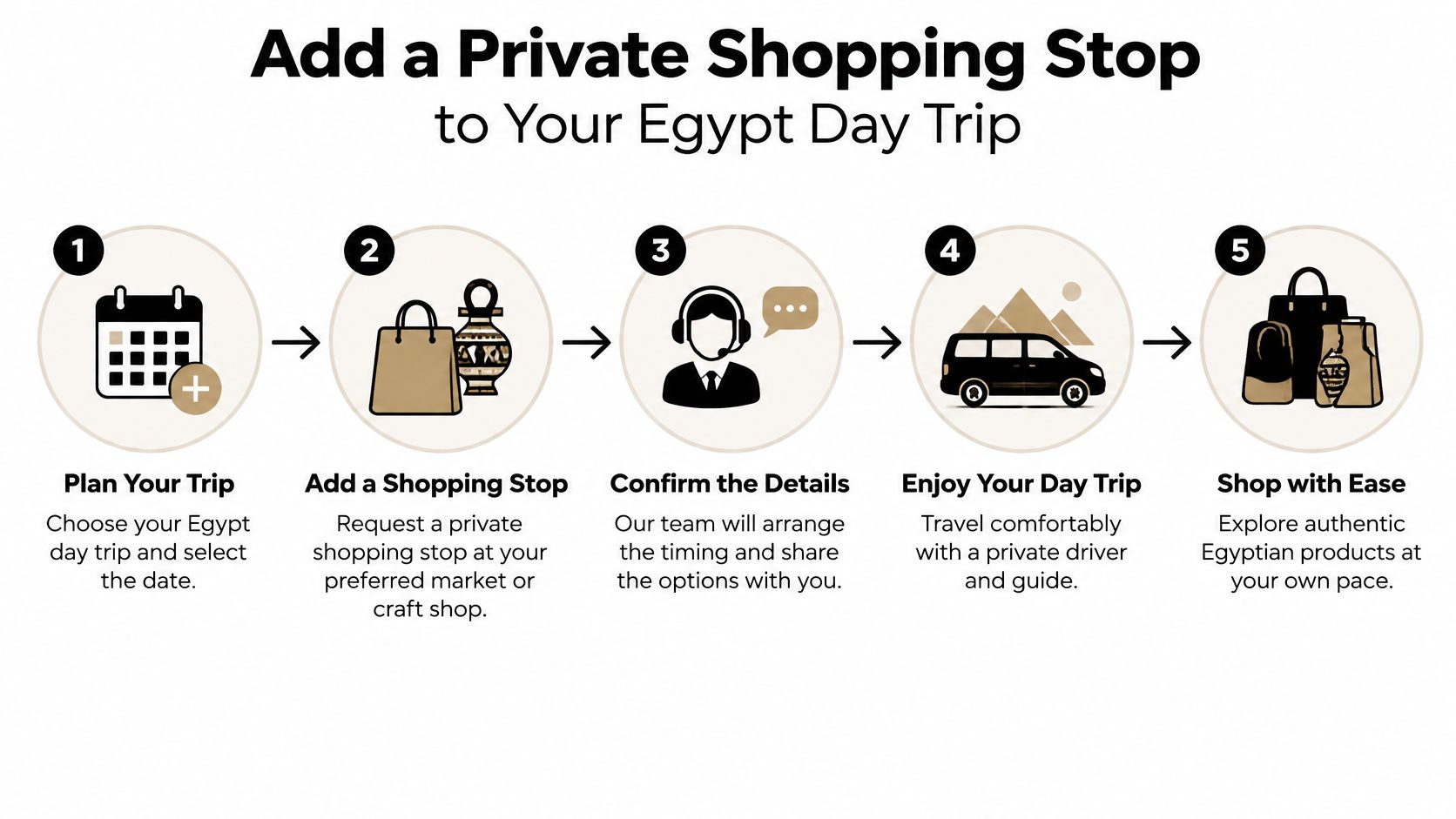
How the stop should run
- Share budget and style the day before. "Something Egyptian" is not a brief. "An 18K chain near 15 grams, or a small wadjet, receipt required" is.
- Confirm the shop's habits. Ask how they mark karat and whether a receipt names weight. If the guide cannot answer, pick another shop.
- Keep it to about 30 to 45 minutes. Sites are why you came. A gold counter expands to fill whatever time you give it.
- Compare price per gram with the karat board before you nod. The guide can translate. The arithmetic is still yours.
- Pay on the day and keep the receipt with your travel documents, not in a hotel safe you will forget.
A good guide advises on streets, closing times and which counters test metal. The purchase decision stays with you. I would not let a guide, a driver or a hotel desk "handle the price" out of earshot. Decide whether a stop fits the day at all. If the itinerary is already tight, skip the gold and buy nothing rather than buy badly. If it does fit, confirm the receipt and karat policy before you book the day, not in the shop doorway.
Oh Yes Tours pairs you directly with English-speaking local guides for private days in Cairo, Luxor and Hurghada, so a planned jeweller stop stays short, receipt-first and on your budget. You pay on the day in cash, with free cancellation up to 48 hours before. If a gold necklace is on your Egypt list, arrange the stop with Oh Yes Tours before you fly.