Egypt travel
Tutankhamun Treasures: A Traveler's Guide for 2026
Planning to see the Tutankhamun treasures? Our 2026 guide explains the key artifacts, where they are now (GEM vs. Tahrir), and how to plan your visit.

By Mohamed Hassan · Senior Local Guide · 12 years
Last week, I watched a family walk into the Tutankhamun galleries expecting one famous gold face and a quick photo stop. An hour later, they were still standing in front of a case of smaller burial objects, suddenly understanding that the true marvel isn't one masterpiece. It's the scale of the whole royal world buried with him.
Table of Contents
- The Day the World Rediscovered a Golden King
- The Most Important Treasures of Tutankhamun Explained
- Where to See Tutankhamun's Treasures Today
- Planning Your Visit to the Grand Egyptian Museum
- Beyond the Glass Case How a Private Guide Unlocks the Story
- Sample Tutankhamun Focused Private Tour Itineraries
- Your Tutankhamun Questions Answered
The Day the World Rediscovered a Golden King
In Cairo, I often tell visitors that Tutankhamun's fame didn't begin with the mask. It began with a doorway and a staircase, found in November 1922, when Howard Carter discovered the sealed entrance to the tomb, as noted by the British Museum's overview of Tutankhamun's discovery.
That moment mattered because this was not another broken, half-emptied royal burial. Tutankhamun's tomb is historically important because it is the only pharaoh's tomb from Egypt's New Kingdom that was found substantially intact, which gave scholars an unusually complete picture of royal burial practice instead of scattered leftovers from looting.
The excavation then became patient, technical work, not a single dramatic reveal. Carter's team spent a decade documenting and removing an astonishing 5,398 objects, including furniture, clothing, ritual items, jewelry, and funerary equipment. The burial also preserved evidence that robbers entered twice soon after burial, yet the mummy and most goods survived.
Practical rule: If you go to see the Tutankhamun treasures only for “the gold,” you'll miss why Egyptologists still treat this tomb as foundational.
That's the key for modern travelers. The treasures are famous, but the power of the tomb comes from completeness. You aren't looking at isolated luxury pieces. You're looking at a preserved royal funeral, almost paused in time.
The Most Important Treasures of Tutankhamun Explained
Some visitors want a checklist. I prefer a viewing order. If you understand what each object was meant to do, the galleries stop feeling like a parade of valuables and start reading like a carefully engineered afterlife package.
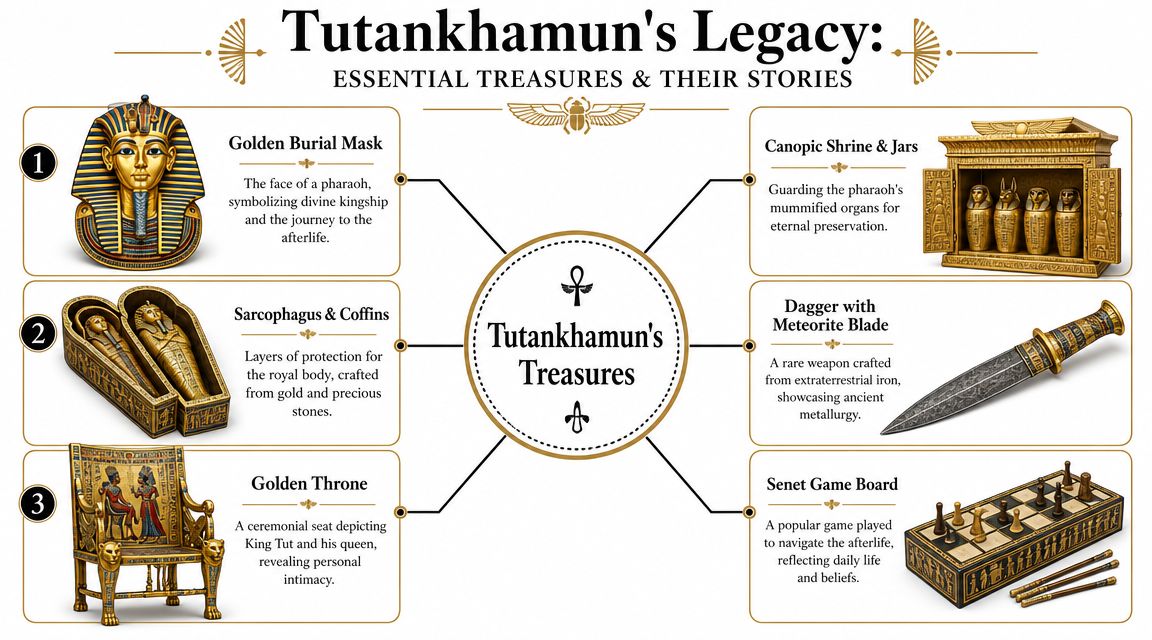
Start with the coffin set, not the souvenir icons
The strongest place to begin is the nested burial system. The innermost coffin was made of 110.4 kilograms of solid gold, while the outer two coffins were gilded wood with inlay, and the mummy was accompanied by 143 items on or within the wrappings, including amulets, jewelry, sandals, and two daggers, according to the Wikipedia overview of the Tomb of Tutankhamun. That tells you immediately that this wasn't random wealth piled into a room. It was design, sequence, and ritual.
Here are the objects I tell travelers to focus on first:
The burial mask
This is the object everyone knows before arriving in Egypt. In person, what matters most isn't celebrity value. It's function. The mask turns the king into an eternal, divine presence. Don't rush it. Stand still and look at the calm expression before you look for decorative detail.The sarcophagus and coffins
These make more sense when viewed as layers of protection. The craftsmanship is the point, but so is the logic. The Egyptians didn't think in terms of one final container. They built security, symbolism, and sacred wrapping in stages.The canopic equipment
Many travelers pass this too quickly. Don't. The organs had to be preserved for eternity, and the canopic assemblage shows how seriously the afterlife was planned. It adds ritual depth that the flashy objects alone can't give you.
The objects that make the tomb feel human
Once the burial core is clear, the rest of the Tutankhamun treasures open up beautifully.
The Golden Throne
This is one of the most revealing pieces because it feels intimate, not merely royal. Visitors expecting stiffness are often surprised by how personal the scene appears. It humanizes a king who is often reduced to a symbol.The daggers and small burial items
The two daggers found with the mummy usually catch people off guard. So do the sandals and amulets. Small objects matter here because they show that burial equipment wasn't just ceremonial display. It was a complete package for protection, identity, and passage.The game board and domestic-style pieces
These are often the emotional turn in the room. Furniture, personal goods, and leisure objects pull the king back toward daily life. That's when children usually stop asking, “Where is the treasure?” and start asking, “Did he really use this?”
When a gallery mixes the majestic with the ordinary, ancient Egypt stops feeling remote.
A practical warning from guiding people through these displays every week. What does not work is treating the room like a speed-run of famous objects. The labels can slow you down in the right way, but only if you choose a handful of objects and stay with them long enough to notice purpose, not just materials.
If you only remember five things, make them these: the mask, the coffin set, the throne, the canopic group, and the objects attached directly to the mummy. Together, they explain kingship, protection, domestic life, ritual, and belief.
Where to See Tutankhamun's Treasures Today
For years, visitors came to Cairo assuming one simple answer. Go to the Egyptian Museum in Tahrir Square. That answer is no longer enough.
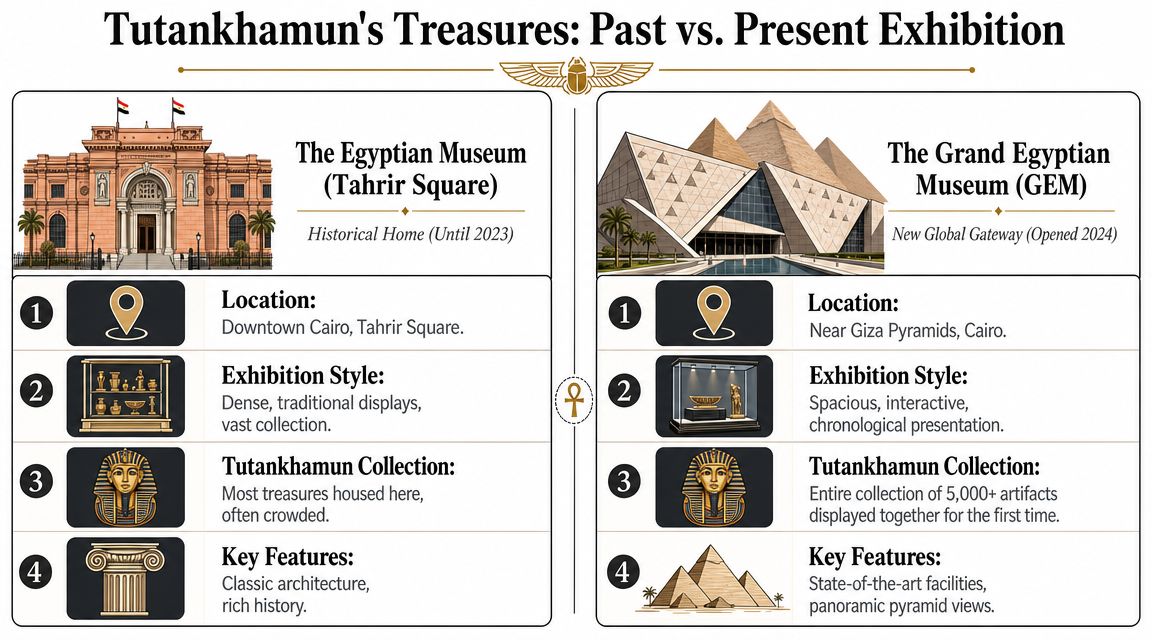
Tahrir gives atmosphere, GEM gives context
The old museum in Tahrir still has enormous emotional pull. It's central, historic, and unforgettable in its own dense, old-school way. Many serious travelers still want to see it because the building itself carries the memory of a century of Egyptology.
But when people ask where to see the Tutankhamun treasures properly today, I send them to the Grand Egyptian Museum. The reason is straightforward. Recent interpretation around the collection has shifted toward presenting the tomb as a full archaeological assemblage rather than only a few iconic objects, and the Insight Vacations article on Tutankhamun at the Grand Egyptian Museum captures that change well.
That difference matters on the ground. Tahrir can feel like history stored in cases. GEM is built to help visitors understand sequence, context, and relationship between objects.
For orientation before you go, I usually tell travelers to review the broader spread of Cairo attractions and museum-area planning so they don't treat GEM as an isolated stop.
A short visual preview helps many visitors understand the scale and layout before arrival.
What works for different travelers
The true trade-off is not old versus new. It's atmosphere versus clarity.
| Museum choice | Best for | What works | What doesn't |
|---|---|---|---|
| Egyptian Museum in Tahrir | Travelers who love historic museum atmosphere | Dense discovery feeling, classic Cairo location | Harder for first-time visitors to read the Tutankhamun story in a clean sequence |
| Grand Egyptian Museum | First-time visitors, families, photography-minded travelers, serious Egypt fans | More coherent presentation, more space, easier pacing | It's large, so unplanned visits can become tiring |
If your trip allows only one museum and your focus is Tutankhamun, choose GEM. If you have time and enjoy museum culture itself, pair GEM with Tahrir on a separate day. Doing both in one day usually exhausts people and flattens the experience.
Planning Your Visit to the Grand Egyptian Museum
The Grand Egyptian Museum rewards planning more than improvisation. It's spacious, but that doesn't mean casual. Travelers who arrive without a route often spend too much energy in the entrance sequence and then hit the Tutankhamun galleries already tired.
How to structure the day
My preferred rhythm is simple:
Book ahead
Don't rely on last-minute decisions if Tutankhamun is your priority. Ticketing, entry procedures, and museum operations can change, so advance booking saves stress.Arrive with one main goal
If your day is about Tutankhamun, commit to that. You can enjoy the broader museum, but don't dilute the visit by trying to “conquer” the whole building.Walk steadily, not fast
This sounds obvious, but it matters. Some galleries invite lingering. Others are best used as transit. Save your concentration for the objects that need it most.Keep your second site light
Pairing GEM with a sunset viewpoint, a relaxed lunch, or a short Giza stop works better than packing the rest of the day with more indoor history.
For practical orientation around the city before choosing transport, this interactive Cairo map page is useful for understanding how museum logistics fit with Giza and central Cairo.
Small decisions that improve the visit
What works best is visiting on a calmer day and leaving room in your schedule. Late visits often feel gentler than the busiest arrival windows, especially for travelers who dislike crowd pressure. Families with children also do better when they build in snack and rest time rather than trying to maintain museum discipline for hours.
A few field-tested tips:
Wear proper shoes
Museum floors and long galleries punish flimsy footwear. This is one of the most common mistakes I see from travelers coming straight from hotel style to museum reality.Check photography rules on the day
Policies can change. Don't assume what was allowed last season is allowed now.Use the benches strategically
Rest before the rooms you care most about, not after you're already exhausted.
The best museum visits have a rhythm. Ten focused minutes in front of one object beats an hour of distracted walking.
If you have mobility concerns, build in extra time and don't feel pressured to match anyone else's pace. The treasures don't reward rushing.
Beyond the Glass Case How a Private Guide Unlocks the Story
I've watched this happen many times. A traveler stands in front of a famous object, admires it, takes a photo, reads half a label, and moves on. They leave saying the museum was beautiful. They're right, but they often miss the story that makes the beauty memorable.
What travelers miss on their own
The hardest part of the Tutankhamun galleries isn't finding the masterpieces. It's understanding why one object matters more than another.
A strong guide changes the visit in very practical ways:
They set priorities early
Not every case deserves the same amount of time. Good guiding protects your energy for the pieces that carry the strongest meaning.They connect separate objects into one burial logic
Without that thread, travelers often remember isolated highlights instead of the full funerary system.They notice small details fast
A hand gesture on a throne scene, the relationship between protective objects, the difference between royal image and personal item. These are easy to miss and hard to recover once you've walked on.
There's also a pacing issue. Self-guided visitors often spend too long in the first rooms, then start skimming. Guided visits are usually stronger because someone else manages sequence, fatigue, and focus.
When private guiding is worth it
Private guiding isn't necessary for everyone. If you're a patient museum reader, love labels, and have half a day to spare, you can do very well independently.
It becomes worth the extra cost when one of these is true:
You care more about interpretation than box-ticking
This is the biggest dividing line. Private visits are for travelers who want meaning, not just access.You're short on time
A guide helps you avoid wrong turns, indecision, and museum fatigue.You're traveling with mixed interests
Couples, families, and small groups often don't move at the same speed. A private guide can adapt in real time.You want a calmer day
Large tours often rush the group or flatten discussion into memorized lines.
I also tell travelers to look carefully at how a company structures private trips. Direct local booking often feels smoother than dealing with a chain of resellers. This article on why a private Egypt tour can work better makes that argument from the traveler's point of view.
One note on pricing. Since rates vary by date, group size, transport style, and language needs, I'd avoid trusting any “standard” museum price you see online unless it clearly spells out what's included. The cheapest option rarely gives the best Tutankhamun experience. For this museum, clarity and pacing matter more than shaving off a little cost.
A private guide doesn't add more objects to the room. They add structure, attention, and the confidence to slow down where it matters.
Sample Tutankhamun Focused Private Tour Itineraries
Many travelers know they want to see the Tutankhamun treasures but struggle to build the day around them. The best plan depends on one question. Are you trying to fit Tutankhamun into Cairo, or are you building Cairo around Tutankhamun?
Two ways to build the trip
Here's the structure I recommend most often.
| Tour Name | Duration | Key Sights | Starting Price |
|---|---|---|---|
| Cairo in a Day | Full day | Grand Egyptian Museum, lunch break, Giza Plateau exterior focus or a short pyramid-area visit | From €159/person |
| Pharaoh's Immersion | 3 days | Grand Egyptian Museum, Saqqara, Egyptian Museum in Tahrir, deeper Cairo heritage stops | From €499/person |
The Cairo in a Day version works for travelers on a short stopover, cruise extension, or packed Egypt schedule. The museum takes the prime morning or early session while your concentration is high, then the afternoon shifts to the Giza side. That pairing works because the two experiences complement each other. One gives you burial objects and royal belief. The other gives you monumental setting.
The Pharaoh's Immersion plan is better for people who don't want to flatten ancient Egypt into one exhausting day. Saqqara adds architectural depth, Tahrir adds museum history, and GEM gives the polished Tutankhamun narrative. That combination creates contrast, which serious travelers usually remember better than a single blockbuster stop.
A few honest trade-offs:
Short itinerary advantage
Better for energy, easier for families, less mentally demanding.Short itinerary limitation
You'll leave with strong impressions but less broader context.Multi-day advantage
More room for comparison, more time to absorb, less pressure.Multi-day limitation
It suits travelers who enjoy sustained historical travel. Not everyone does.
If Tutankhamun is the emotional center of your Egypt trip, give him the longer itinerary. If he's one major highlight among several, the day plan is usually enough.
Your Tutankhamun Questions Answered
Travelers usually ask the same few questions, and they're good ones.
Are all the treasures on display
Not always in the way people imagine. This is one reason the phrase Tutankhamun treasures can mislead. Past exhibitions showed only selections from the tomb, and the range varied widely, from 55 objects at the National Gallery of Art to 150 artefacts in later touring displays, while the full tomb assemblage was catalogued at 5,398 objects, as outlined by the National Gallery of Art's discussion of Tutankhamun exhibitions. The important practical point is that GEM is the first venue designed to present the vast majority of that story together.
Are the objects real
The major attraction of seeing Tutankhamun in Cairo is precisely that you're engaging with the actual archaeological assemblage. Travelers sometimes worry that blockbuster presentation means theme-park replicas. That's not the value of the visit. The value is authenticity plus context.
Can you still visit Tutankhamun's tomb in Luxor
Yes, travelers can still visit Tutankhamun's actual tomb in the Valley of the Kings. It's a different experience from the museum. In Luxor, you see the burial place itself. In Cairo, you understand the material world that once filled it. If you love Egyptology, the two visits complement each other beautifully.
What surprises most people
Usually, it's not the gold. It's the number of objects connected to ordinary life, care of the body, ritual preparation, and protection. People expect treasure in the narrow sense. They leave thinking about organization, belief, craft, and the human side of burial.
Should you choose GEM or Luxor if you only have one
If your priority is the treasures themselves, choose GEM. If your priority is standing in the Valley of the Kings and feeling the geography of royal burial, choose Luxor. History lovers eventually do both. First-time travelers with limited time usually get more visual and interpretive value from GEM.
The best approach is simple. Don't ask only, “Where is the gold?” Ask, “Where will the story make sense to me?”
If you want that story explained properly on the ground, Oh Yes Tours can pair you directly with a local Egypt guide for an unhurried Cairo day built around the Grand Egyptian Museum, the pyramids, or a deeper multi-day history itinerary. It's a practical way to see Egypt without the reseller layer, with real local knowledge and the freedom to move at your own pace. Egypt? Oh Yes!