Egypt travel
Visit Tombs in the Valley of the Kings: Your 2026 Guide
Planning a visit to the Tombs in the Valley of the Kings? Our 2026 guide covers open tombs, tickets, hours, & planning tips from a local expert.

By Mohamed Hassan · Senior Local Guide · 12 years
You arrive at the Valley of the Kings full of excitement, then the practical questions hit all at once. Which tombs are worth your energy? Which ones need separate tickets? Which famous names are memorable underground, and which ones sound better in a brochure than they feel in real life?
That confusion is normal. The site is vast in meaning, but limited in what any one visitor can comfortably see in a morning. The difference between a rushed, overheated visit and a satisfying one usually comes down to one thing. Choosing the right tombs before you start walking.
Table of Contents
- Your First Visit to the Valley of the Kings
- Understanding the Royal Necropolis Layout and History
- A Profile of the Most Famous Tombs
- How to Get Tickets and Which Tombs Are Open
- Building Your Perfect Itinerary for the Valley
- Visitor Rules Accessibility and Photography Policies
- Why a Private Egyptologist Guide Transforms Your Visit
Your First Visit to the Valley of the Kings
Most first visits begin the same way. You step out into bright Luxor sun, look at the bare cliffs, and wonder how a place so austere can hold so much history below ground. Then you realize the harder truth. The challenge isn't finding the Valley. It's deciding how to use your limited time once you're there.
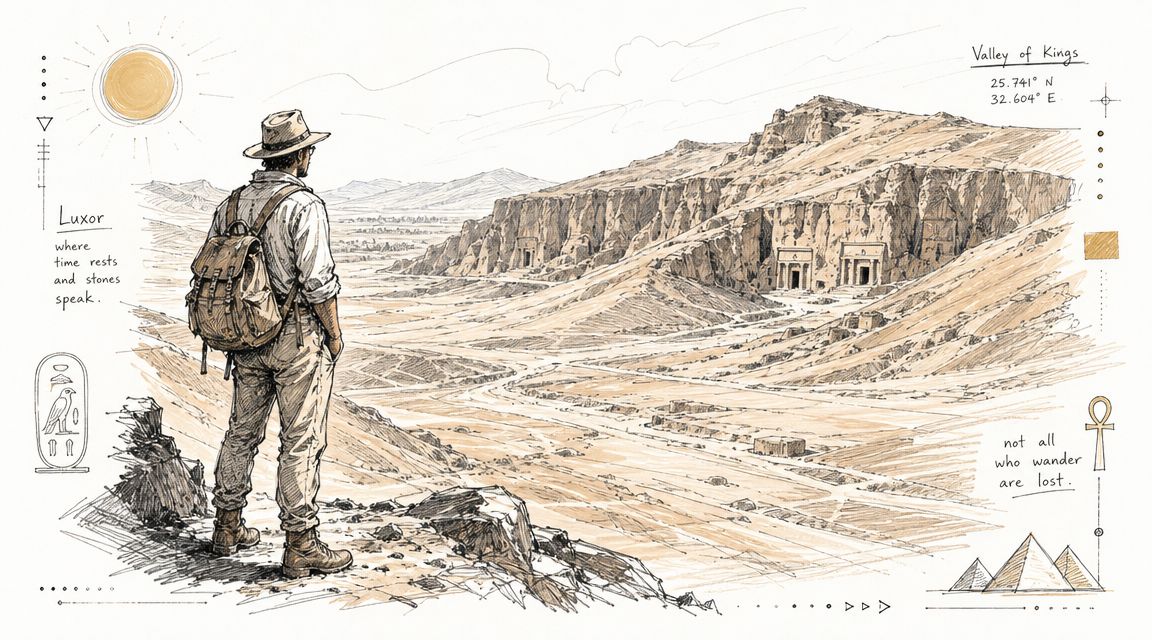
The Valley of the Kings is not one tomb. It's a royal burial field with 65 known tombs and chambers in the numbered KV system, and archaeologists have tracked discoveries from KV1 to KV64. It served as a primary burial ground for roughly 540 years, from about 1539 BC to 1075 BC, as outlined in this Valley of the Kings overview.
That scale is exactly why so many visitors make poor choices when they arrive without a plan. They hear a few famous names, buy whatever extra ticket sounds most impressive, then discover too late that one tomb is tiny, another is physically demanding, and a third would've suited them much better.
What first-time visitors usually get wrong
Some people try to treat all tombs as equal. They aren't.
Others assume the most famous tomb must be the best visual experience. Often it isn't.
A smarter approach is to decide what kind of morning you want:
- A light visit: a few tombs, less stair strain, strong visual reward
- A serious history visit: one premium tomb plus standard-ticket contrasts
- A family visit: short underground stretches with high visual payoff
- A careful photography-focused visit: slower pacing and selective choices
Practical rule: Don't ask, "What are the best tombs?" Ask, "Which tombs are best for me today?"
The people who enjoy the tombs in the Valley of the Kings most aren't always the ones who see the most. They're the ones who match their route to their energy, interest, and tolerance for heat, stairs, and crowds.
Understanding the Royal Necropolis Layout and History
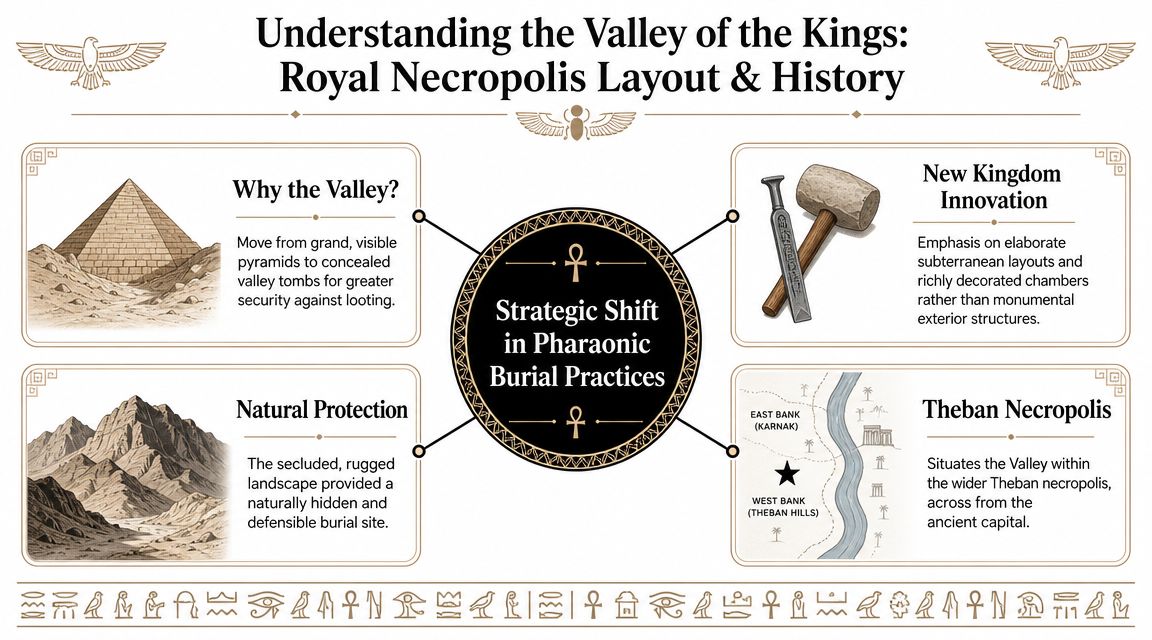
The valley makes more sense when you stop thinking of it as a sightseeing stop and start thinking of it as a burial system. These tombs weren't scattered randomly through the hills. They formed a royal necropolis, part of the wider Theban sacred area on the west bank.
Why this valley mattered
By the New Kingdom, royal burial design had shifted toward hidden rock-cut tombs rather than giant freestanding monuments. What visitors feel today as silence and isolation was part of the point. The natural environment itself helped create a protected setting for the dead and for the rituals tied to kingship and the afterlife.
The valley also rewards a different kind of looking. Above ground, it can seem stark. Below ground, the world changes completely. Corridors narrow, ceilings lower, painted texts and divine figures appear, and the mountain becomes architecture.
The most common mistake is judging the valley by what you see from the path. The real site is underground.
East Valley and West Valley
Most visitors spend their time in the East Valley, where the better-known public tombs are concentrated. That's the practical center of a first visit and where nearly all standard itineraries unfold.
The West Valley matters historically, but it doesn't function for most travelers like the main visitor zone. This is one reason broad articles can be misleading. They describe the whole necropolis, but your actual morning depends on the subset you can access and enjoy comfortably.
A quick way to understand the valley is this:
| Area | What it means for visitors |
|---|---|
| East Valley | Main visiting area, best known tombs, easiest place to build a practical route |
| West Valley | More specialized interest, less central to a standard first-time plan |
The historical frame matters because it changes how you read the tombs. You're not entering isolated chambers. You're entering royal statements about legitimacy, divine protection, and the king's journey beyond death.
That is also why decoration varies so much. Some tombs feel concentrated and intimate. Others unfold in long, formal sequences. Some are all about painted impact. Others impress through planning and scale.
A Profile of the Most Famous Tombs
By the time visitors reach their second or third tomb, a pattern appears. One family wants the tomb with the strongest colors. A history enthusiast asks for the most important king. A photographer wants a chamber that makes an immediate impression without a long queue. Those are three different choices, and the valley rewards each of them differently.
That is why the famous tombs need to be judged by visit value, not fame alone.
The valley includes tombs of very different scale and character, from modest burials to sprawling complexes. The Theban Mapping Project's Valley overview is still the best quick reference for understanding how uneven the necropolis really is. If you want to place the valley within a bigger West Bank day, this guide to Luxor attractions on the West Bank and beyond helps you see what pairs well with it.
Tutankhamun and the power of story
KV62 is the tomb nearly every first-time visitor asks about. That interest is understandable. Tutankhamun carries the strongest story in the valley, and many travelers want to stand in the burial chamber they have known since childhood.
The practical trade-off is simple. Tutankhamun matters more for what happened there and what was found there than for sheer visual impact underground. I still recommend it to travelers who care about archaeological history or who know they would regret skipping it. I do not recommend building your whole visit around it if your main goal is painted decoration.
Families often do well here because the tomb is easy to explain. Serious art lovers often leave wanting more.
Seti I for visitors who care about workmanship
KV17, the tomb of Seti I, is the one I mention when someone tells me, "I want to see the best tomb, not just the most famous one."
Its reputation rests on quality. The cutting is refined, the decoration feels deliberate, and the chambers give you that rare sense that almost every surface was handled with unusual care. Visitors who notice line, proportion, and finish usually respond to Seti I immediately.
There is a real trade-off, of course. It costs extra, and not every traveler needs that splurge. If the budget allows for one premium add-on and the traveler values artistry over celebrity, this is usually the stronger choice.
Ramesses V and VI for broad appeal
KV9 is one of the easiest tombs to recommend because it works for almost every kind of visitor.
The ceiling catches casual visitors straight away. Enthusiasts stay for the density of the decorative program and the way the chambers unfold. If someone in your group has limited patience for long explanations, KV9 is often the tomb that wins them over fastest.
For a mixed group, this is often the safest pick. It gives a strong return without asking too much background knowledge from the visitor.
KV5 and the limits of headline facts
KV5 attracts attention because it is the largest known tomb in the valley, with a huge number of chambers, as noted by the Theban Mapping Project's Valley overview. On paper, that sounds like an obvious priority.
In practice, first-time visitors often overrate size. Archaeologists value KV5 because it adds so much to our understanding of royal family burial, spatial planning, and the complexity of the necropolis. Travelers usually remember something else. They remember color, atmosphere, and whether a tomb felt clear and satisfying in the moment.
That distinction matters. Historical importance, visual impact, and first-visit enjoyment do not always point to the same tomb. If you choose with that in mind, the valley becomes far less overwhelming.
How to Get Tickets and Which Tombs Are Open
You arrive at the ticket window with a shortlist in mind, then find out one tomb needs a separate ticket, another is resting, and the list you saved on your phone is already out of date. I see this happen all the time in Luxor, especially with first-time visitors who did their homework but planned too rigidly.
The valley works best if you plan in layers. Buy the standard entry with a clear idea of which included tombs would suit your group. Then decide whether one premium tomb is worth the extra cost for your interests, your budget, and your stamina in the heat.
How the ticket system really works
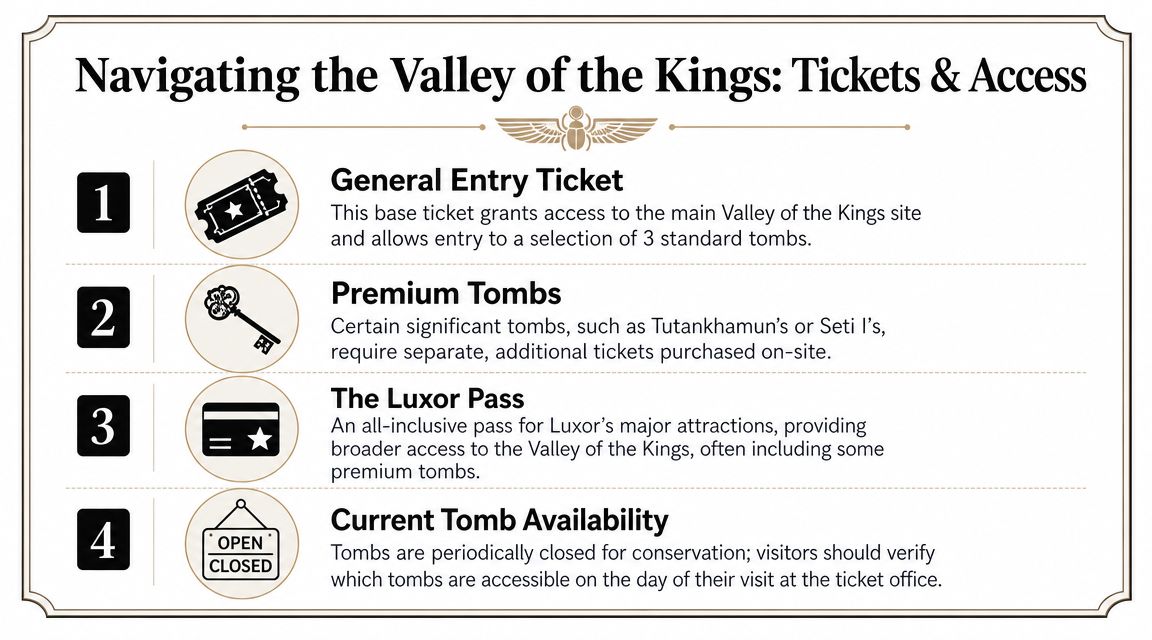
The base ticket gives entry to a set number of standard tombs from the ones open that day. The headline tombs do not always come with it. High-demand or fragile tombs such as KV17 (Seti I) and KV62 (Tutankhamun) usually require separate paid entry, and prices can vary by tomb and current site policy, as outlined in this practical guide to Valley of the Kings ticket access.
That matters because the extra charge is not only about fame. It also reflects conservation pressure, visitor demand, and the simple fact that some spaces cannot handle heavy foot traffic all day.
The best buying strategy is usually straightforward:
- Start with the standard ticket: choose included tombs that give your group variety
- Add one premium tomb with purpose: pick it for decoration, historical interest, or name recognition, not all three at once
- Leave room for a change of mind: if the sun is already draining the group, another stair-heavy add-on may not be the smart choice
For travelers sorting out transport, timing, and how to combine the valley with other West Bank stops, these Luxor day tours and West Bank options give a realistic sense of how people structure the day.
A short video can also help you get your bearings before you arrive.
What changes from one visit to another
The open list rotates regularly. Conservation teams close tombs for rest, maintenance, or crowd management, and this is normal at the valley.
So do not build your morning around one exact standard-ticket lineup you saw weeks earlier. Check close to your visit date, then check again once you are in Luxor if that tomb matters to you. Hotels, local guides, and site staff often have the most current practical picture.
A useful rule for first visits is simple. Build a plan around categories, not around one fixed trio. Choose one tomb with strong color, one with broad appeal for the whole group, and one that matches your special interest. If a closure forces a swap, your day still works.
Buy for value, not bragging rights. For a first visit, one premium tomb is usually enough.
If you want the local reality, here it is. Travelers often overpay for celebrity and underuse the standard ticket. A well-chosen mix of included tombs can give families, enthusiasts, and photographers a better morning than chasing every famous name on the map.
Building Your Perfect Itinerary for the Valley
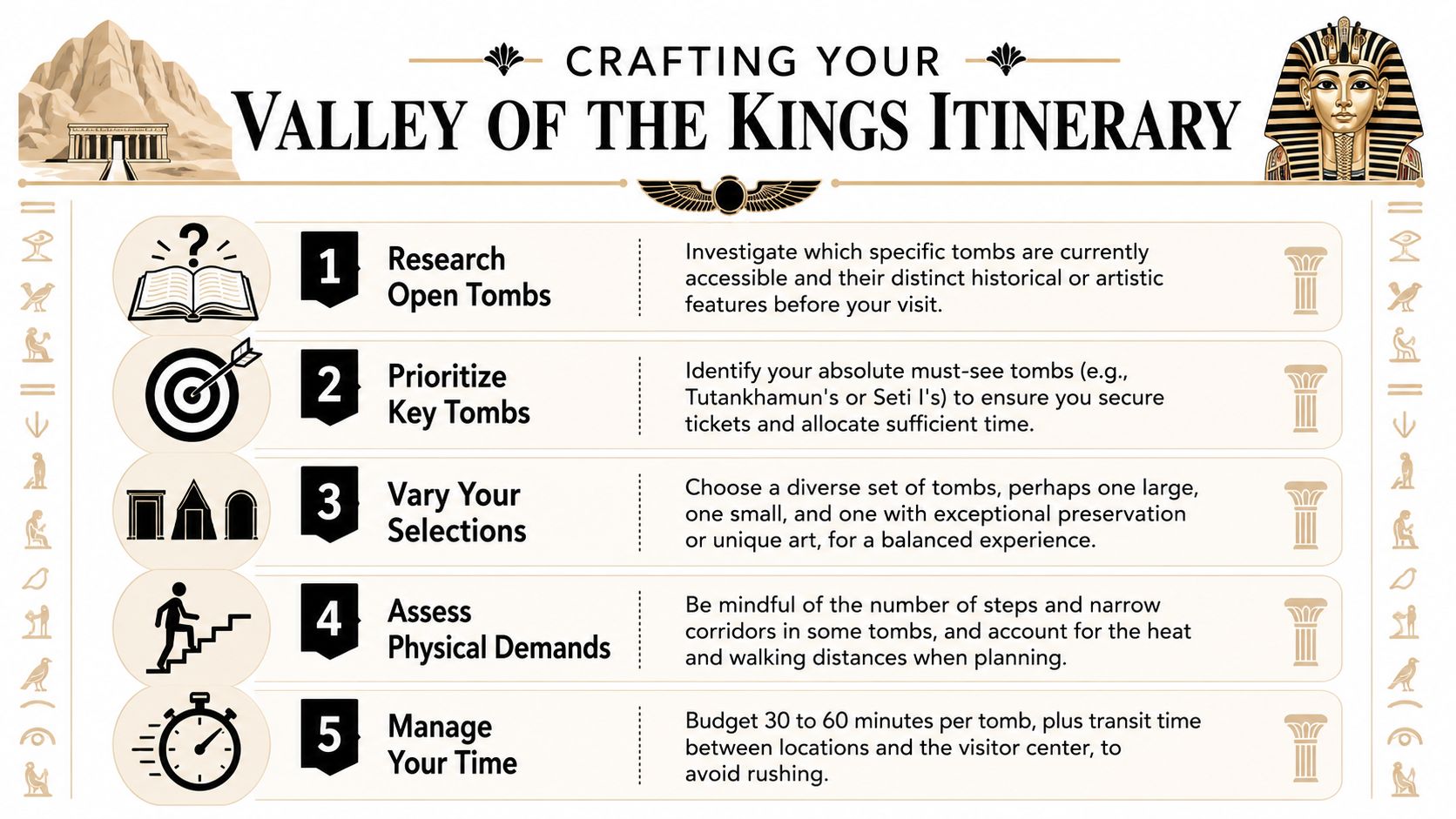
Here, most travelers need honest guidance. Plenty of articles tell you which tombs exist. Far fewer help you build a combination that works for your body, your budget, and your attention span.
That matters because the site has over sixty tombs plus around twenty unfinished pits, and it is split into East and West areas. Visitor value depends heavily on choosing the right subset. It also matters because guides can't enter the tombs with you, so visitors need context before they go in, as the official overview of the Valley of the Kings visitor experience makes clear.
A gentle plan for families and slower travelers
If you're traveling with children, older parents, or anyone who doesn't enjoy repeated stair climbs, keep the ambition modest. The best family mornings aren't the ones with the highest tomb count. They're the ones where nobody melts down underground.
Choose standard-ticket tombs that offer quick visual reward and avoid an overpacked route. Keep pauses between tombs. Let one strong chamber carry the day instead of chasing every famous name.
Best fit for this style:
- Visually clear tombs: spaces that impress quickly without requiring long explanation
- Fewer entries: less in-and-out stair fatigue
- One standout memory: often better than a scattered blur of five sites
A stronger plan for history enthusiasts
If you care about chronology, art programs, reuse, and differences between royal tomb design choices, build contrast into your morning. Don't choose three similar tombs just because they're all famous.
A stronger combination usually includes:
- one premium tomb for exceptional artistic or historical status
- one standard tomb with broad visual readability
- one tomb that shows a different design mood or decorative emphasis
This gives you comparison, and comparison is where the valley becomes intellectually satisfying.
The valley opens up once you stop ranking tombs and start contrasting them.
A smart plan for photographers and detail hunters
Photography-minded visitors often make the opposite mistake. They move too fast. They try to collect tombs rather than study surfaces.
If detail matters to you, fewer tombs usually works better. You need time for ceilings, wall edges, color transitions, and the visual rhythm of a corridor. You also need patience for changing access rules and for whatever restrictions apply on the day.
Here is the trade-off table I usually suggest:
| Traveler type | Best strategy | Main trade-off |
|---|---|---|
| Families | Fewer tombs, easier pacing | Less total coverage |
| History enthusiasts | Mixed ticket strategy, contrast-based route | More planning needed |
| Photographers | Slow, selective visit | You may see fewer famous names |
| General first-timers | Balanced standard set plus one premium | Requires choosing what to skip |
The best itineraries for the tombs in the Valley of the Kings always involve one hard decision. What are you willing to skip so that what you do see sinks in?
Visitor Rules Accessibility and Photography Policies
Visitors usually focus on history before they arrive, then discover that practical rules shape the day just as much as archaeology does. The tomb itself may be extraordinary, but your experience can still go wrong if you're dressed for the wrong conditions, carrying the wrong expectations, or relying on outdated information.
What catches visitors off guard
The biggest surprise for many people is that access isn't fixed. Tombs open and close for conservation, and that can alter your ideal plan at short notice. One useful example is the tomb of Seti I, identified by an independent travel source as the longest in the valley and noted as having reopened to the public after a long closure in this article on current Valley tomb access.
That changing access has a practical consequence. The best tomb plan on paper may not be the best tomb plan on the day.
A few visitor rules and realities matter more than people expect:
- Guides stay outside the tombs: get your explanation before entering
- Conservation rules come first: don't assume every chamber is available
- Photography policies can vary: check locally before relying on old advice
- Inside conditions differ sharply: one tomb may feel easy, the next steep and enclosed
How to make the visit easier on your body
Accessibility at the valley is partial, not complete. Getting around the main visitor area is one thing. Managing tomb interiors is another.
Be realistic about these points:
- Stairs are a significant challenge: even visitors comfortable on level ground can struggle inside tombs
- Heat increases gradually: the descent can feel manageable until the climb back out
- Footwear matters more than fashion: stable shoes beat sandals with poor grip
- Pacing matters: rest between tombs instead of trying to recover after you've overdone it
A simple local habit helps. Brief first, enter second. Since your guide can't accompany you inside, stop outside each tomb, understand what you're about to see, then go in slowly and look with purpose.
Why a Private Egyptologist Guide Transforms Your Visit
The Valley of the Kings punishes vague planning. That's the truth. It rewards visitors who arrive knowing which tombs match their interests, which premium tickets are worth their money, and how much walking, heat, and stair work they can handle.
A private Egyptologist guide changes that immediately. Instead of hearing a few names and guessing, you get a route built around your pace. Families need a lighter sequence. Enthusiasts need comparison and context. Older travelers often need honest advice about where effort is justified and where it isn't.
The guide's value isn't only historical knowledge. It's timing, selection, and judgment. Since licensed guides can't enter the tombs with you, the briefing outside each entrance becomes essential. A good guide tells you what to notice, what not to miss on the ceiling or walls, and why this tomb matters before you go underground.
That kind of preparation turns the visit from a checklist into an experience. If you're weighing private touring versus a standard rushed outing, this short read on why a private Egypt tour is often the better choice explains the difference clearly.
If you want help planning the right Valley of the Kings route for your time, energy, and interests, Oh Yes Tours can match you directly with a local private guide in Egypt. No middleman, no inflated reseller layer, just practical advice and unhurried touring from people who work here. Egypt? Oh Yes!