Egypt travel
Sphinx Mysteries: Age, Chambers & an Unbiased Guide 2026
Unravel the Sphinx mysteries. We explore the age debates, erosion controversy, and alleged hidden chambers with a balanced view from a local Egyptian guide.

By Mohamed Hassan · Senior Local Guide · 12 years
You're probably here because the Great Sphinx does something to people before they even arrive. They've seen the photos, heard the stories about hidden chambers and lost records, and now they want a straight answer. Is it really older than the pyramids? Did sand bury it for centuries? Are there secret rooms underneath it?
I hear these questions all the time on the Giza Plateau. Some travelers want the scholarly answer. Others want the fun mystery. Most want both. That's the right way to approach the Sphinx. Respect the wonder, but stay honest about the evidence.
The best part is that the actual story is already dramatic. This is a limestone monument carved at Giza, weathered by time, buried and uncovered more than once, repaired in different eras, and still not fully explained in every detail. That's why sphinx mysteries endure. Not because every wild theory is credible, but because even the careful archaeological story still leaves room for awe.
Table of Contents
- The Silent Guardian of Giza
- The Official Story Who Built the Great Sphinx
- A History Written in Sand and Stone
- The Great Sphinx Water Erosion Debate
- Hidden Chambers and Lost Halls of Records
- Seeing the Sphinx for Yourself with Oh Yes Tours
- What We Know and What Remains a Mystery
The Silent Guardian of Giza
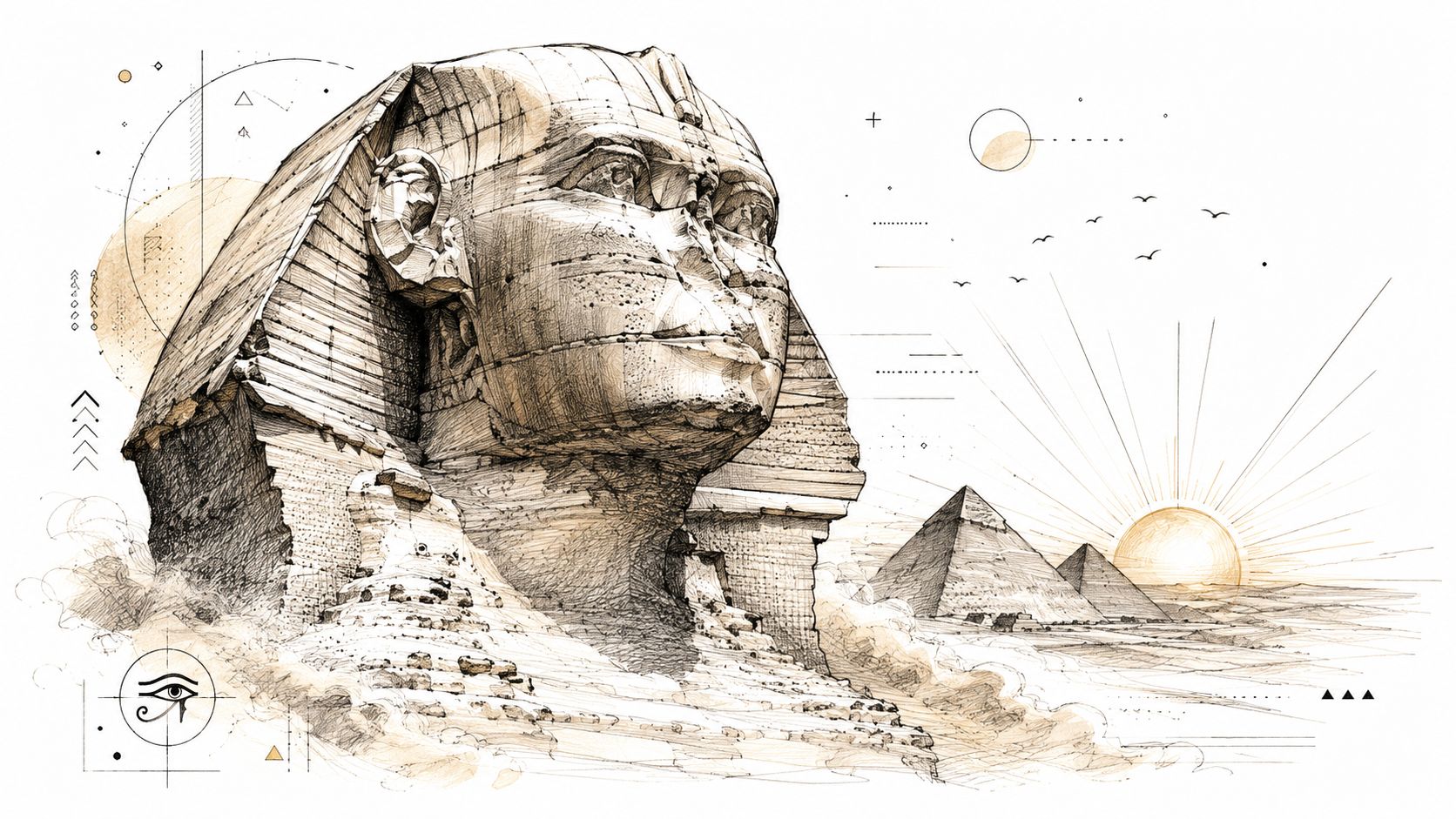
You walk down toward the enclosure, the buses and camera chatter still behind you, and the scale snaps into focus. Photographs flatten the Sphinx. From the viewing area, it reads very differently. The body spreads out of the limestone bedrock, low and wide, with the head rising above it in a way that feels less like a separate statue and more like the plateau itself shaped into a guardian.
That first impression matters. The Sphinx does not feel like an ornament beside the pyramids. It feels anchored, weathered, and stubbornly present.
On my tours, the opening questions are usually practical and direct. Who carved it. Why the head seems small compared with the body. Whether anything sits beneath it. Those questions make sense when you are standing in front of a monument that looks both familiar and hard to explain. If you are planning a full day on the plateau, it helps to place the Sphinx among the other Cairo attractions around Giza and beyond before you arrive.
Why the mystery stays with people
The Sphinx holds two truths at once. Archaeologists can say a great deal about its setting, material, repairs, and likely period. At the same time, parts of its story remain debated, especially by visitors who notice the worn body, the restored sections, and the damaged face before they hear any formal explanation.
That is why the mystery feels personal to so many visitors. Standing there, people are not reacting to an abstract theory. They are reacting to stone, damage, scale, and silence.
People often expect the archaeological explanation to make the Sphinx feel smaller. In practice, the opposite happens. Once you notice the quarry cuts, repair blocks, and weathered surfaces, the monument becomes more interesting.
What visitors often misread at first glance
A few corrections help before the bigger debates start:
- The Sphinx is a worked monument with a long afterlife. Restoration is part of its history, not a side note.
- The mystery is real, but it is not a blank space. There is a strong mainstream interpretation supported by context and excavation history.
- The best clues are not all hidden. Many of them sit in plain view on the body, the enclosure walls, and the masonry around it.
Start there. Keep your curiosity, but keep your feet on the stone.
The Official Story Who Built the Great Sphinx
You arrive at Giza, look from the pyramids down toward the enclosure, and the question comes quickly: who ordered this monument cut from the bedrock? The answer you will hear from archaeologists, site guides, and museum labels is fairly consistent. The Great Sphinx is generally dated to the Old Kingdom and usually attributed to King Khafre.
That view rests on context more than on one dramatic inscription. No surviving text says, in plain words, that Khafre commissioned the Sphinx. What scholars do have is the monument's position within the Giza plateau, its relationship to nearby structures, and the wider pattern of 4th Dynasty royal building at the site. In practice, that is why Khafre remains the standard attribution.
Why Khafre remains the main attribution
Visitors often focus on the face first. I understand that. It is human, damaged, and easy to argue about. But the stronger case starts with the ground plan around it.
The Sphinx sits within the architectural setting usually connected with Khafre's pyramid complex. That does not settle every debate, but it gives the mainstream view its footing. Egyptologists are not treating the monument as a stray object with no context. They are reading it as part of a royal program on the Giza plateau.
A few points make that interpretation hold up:
- Setting: The Sphinx belongs to the Giza ceremonial and funerary zone, among major Old Kingdom monuments.
- Association: Its enclosure, nearby temple remains, and overall placement fit the broader complex usually linked with Khafre.
- Method: The attribution comes from converging archaeological clues, not from guesswork based on the face alone.
Why people still ask about other builders
At the site, travelers usually raise the same alternatives. Some ask whether Khufu could have built it. Others ask whether it must be older than the pyramids. Those questions are common because the Sphinx looks weathered, incomplete, and harder to read than the pyramids themselves.
The trade-off is simple. The mainstream case for Khafre is stronger because it fits the archaeological setting. The weaker point is that the monument lacks a direct surviving builder's inscription. That gap leaves room for speculation, and speculation always travels well.
Practical rule: With ancient Egypt, the best-supported answer often comes from several clues lining up together, not from one perfect piece of proof.
The baseline worth keeping in mind
If you want a sensible starting point before getting into the bigger controversies, use this one. The official view places the Sphinx in the Old Kingdom and usually identifies Khafre as the ruler behind it.
That does not remove the mystery. It gives the mystery a solid floor.
A History Written in Sand and Stone
Arrive at Giza early, and one thing becomes clear fast. The Sphinx does not read like a monument that sat untouched in open desert for 4,500 years. It reads like a monument that was buried, exposed, patched, admired, neglected, and repaired again.
That long afterlife matters as much as the original carving. Travelers often come looking for one clean origin story. The stone gives a messier and more interesting answer.
Buried, remembered, restored
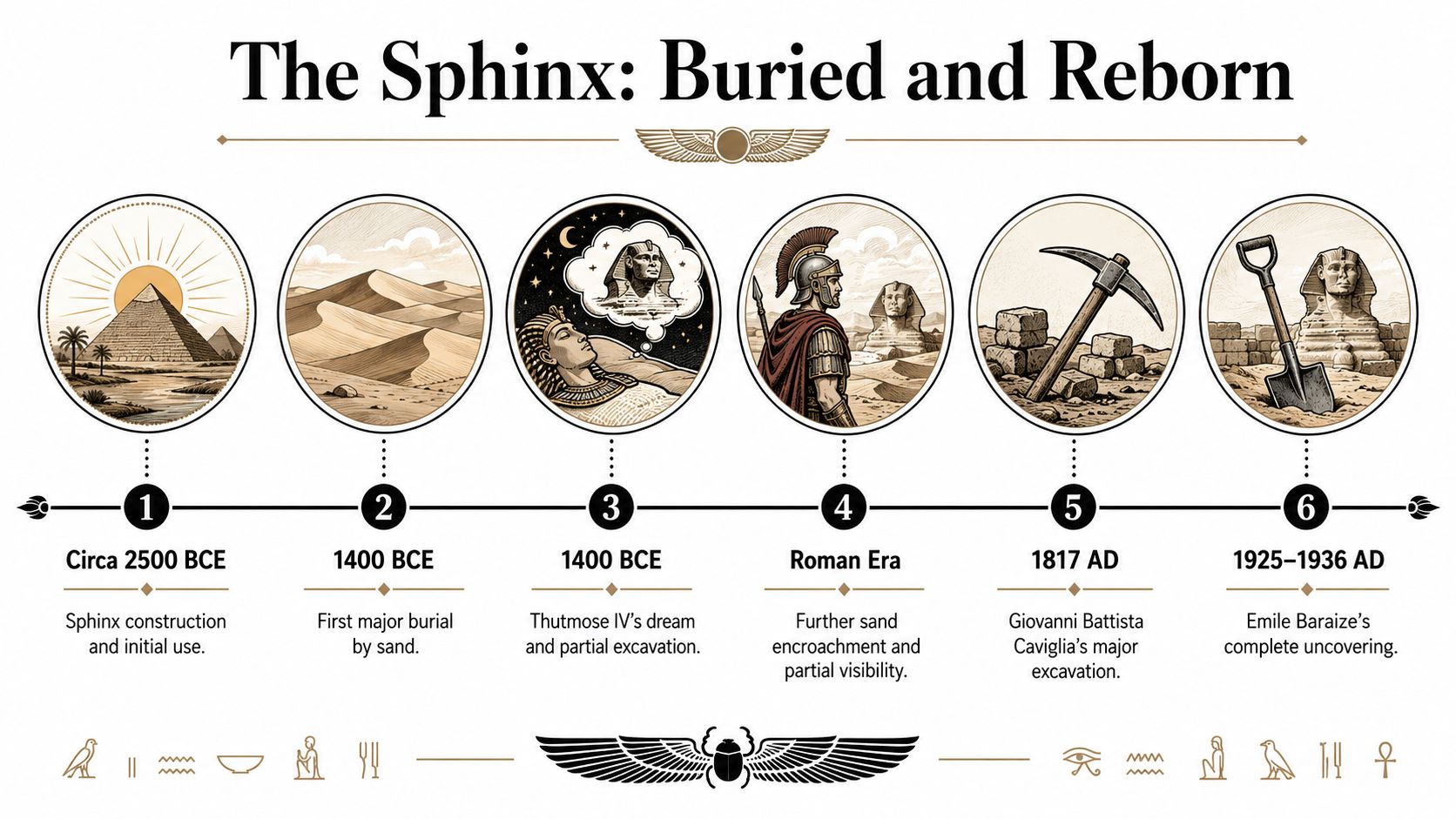
For much of its history, the Sphinx was not fully visible. Sand repeatedly swallowed the body and left only parts exposed for long stretches. That helps explain why the monument survived in fragments of visibility rather than in one continuous, fully seen state.
Later Egyptians already treated it as an ancient monument. By the time of Thutmose IV, the Sphinx was old enough to inspire restoration, royal attention, and sacred meaning. The famous Dream Stela between its paws belongs to that long memory of the monument, not to its original construction. That distinction is easy to miss on a quick visit, but it matters.
What visitors see today includes both the original limestone mass and many later attempts to protect it.
ARCE's mapping project makes that plain. Their work identified several repair phases, including masonry that likely belongs to different historical periods, from pharaonic restoration to later Roman work, as described in ARCE's Sphinx mapping project summary.
A monument with layers
The Sphinx is best understood as a layered archaeological object.
| Layer of history | What it tells us |
|---|---|
| Original carving | The monument began as part of the royal world of ancient Giza |
| Sand burial | Periods of burial hid parts of it and also helped preserve parts of it |
| Ancient restoration | Egyptians themselves saw it as old, important, and worth repairing |
| Later masonry repairs | The form visible now includes interventions from more than one era |
That creates a real trade-off for anyone trying to read the monument closely. Repairs help keep the Sphinx standing, but each phase also makes the first surface harder to isolate with complete confidence. At the same time, those repairs are evidence. They show how later societies valued the statue, how they tried to hold its vulnerable stone together, and how long the Sphinx remained part of Egypt's living memory.
What to notice on site
I usually tell visitors to spend less time hunting for a single dramatic secret and more time reading the surface.
Start with the body, not the face.
The body and enclosure show the monument's history more clearly than the head does. Look for changes in stone texture, blocks that do not match the core limestone, and repaired areas that feel almost patchwork. Those are not distractions from the mystery. They are part of the answer.
Three details are especially useful on site:
- The contrast between the core rock and added stonework. You can often spot where later repair meets older material.
- The enclosure walls around the Sphinx. They preserve part of the monument's environmental history and sit at the center of later arguments about weathering.
- The uneven visual character of the statue. The Sphinx feels ancient because it is ancient, but it also feels composite because many hands worked on it after the first carving.
That is why the Sphinx leaves such a strong impression in person. You are not looking at one moment frozen in stone. You are looking at a monument that carried its importance through centuries of damage, burial, repair, and return.
The Great Sphinx Water Erosion Debate
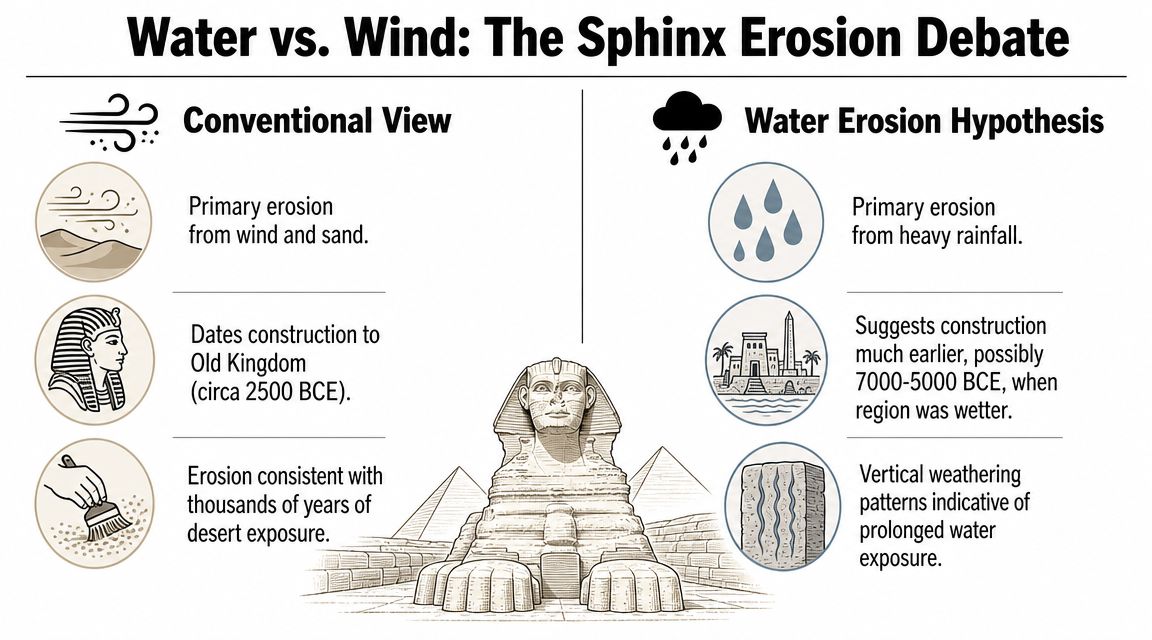
Of all sphinx mysteries, this is the one travelers ask about most after hidden chambers. The argument is simple to state and difficult to settle emotionally because it touches the biggest possible question. Could the Sphinx be much older than the standard Old Kingdom date?
The alternative position focuses on weathering. Supporters of the water erosion hypothesis argue that some patterns on the Sphinx and its enclosure look more consistent with substantial rainfall than with desert exposure alone. That's why they propose a date earlier than the 4th Dynasty.
The argument that attracts people
It's easy to see why this theory spreads. It offers a dramatic revision. If rain shaped the weathering, then perhaps the monument belongs to a much earlier climatic period. For many visitors, that feels more exciting than the official timeline.
But excitement isn't evidence. The problem is that surface appearance alone can mislead, especially on a monument that has been exposed, buried, repaired, and rebuilt.
Here's the embedded video many travelers watch before visiting:
The mainstream reply
A more grounded reading looks at geology and archaeology together. A documentary summary notes that Mark Lehner's interpretation links erosion patterns to intermittent wet periods dissolving salt deposits in limestone, causing softer stone to crumble and harder layers to flake under desert wind, while also stressing that there is no ancient text giving an exact construction date or purpose, in this documentary coverage of the Sphinx evidence. That is a more cautious position, and caution usually serves you better at Giza than grand claims.
Another useful check comes from physics rather than Egyptology alone. TechExplorist reports on a laboratory study showing that aerodynamic or fluid erosion on clay mounds with a hard cap can create a Sphinx-like head-and-body shape, which provides a physical model for testing weathering ideas without proving the Great Sphinx itself formed naturally, as summarized in this report on the erosion experiment.
What works in serious analysis
The practical lesson is straightforward. Morphology alone isn't enough. A shape that looks suggestive doesn't settle an archaeological dispute.
The most reliable approach weighs several categories at once:
- Stone behavior: softer and harder limestone layers weather differently.
- Quarry context: the monument sits within a carved architectural setting, not as an isolated natural outcrop.
- Repair history: later rebuilding changes how surfaces look.
- Archaeological fit: the mainstream date still matches the broader Giza complex better than a lost-civilization scenario.
A good theory has to explain not just one striking feature, but the whole site.
That doesn't make the erosion debate useless. It makes it valuable in the right way. It pushes people to ask better questions about stone, climate, and restoration. It just doesn't overturn the mainstream case on its own.
Hidden Chambers and Lost Halls of Records
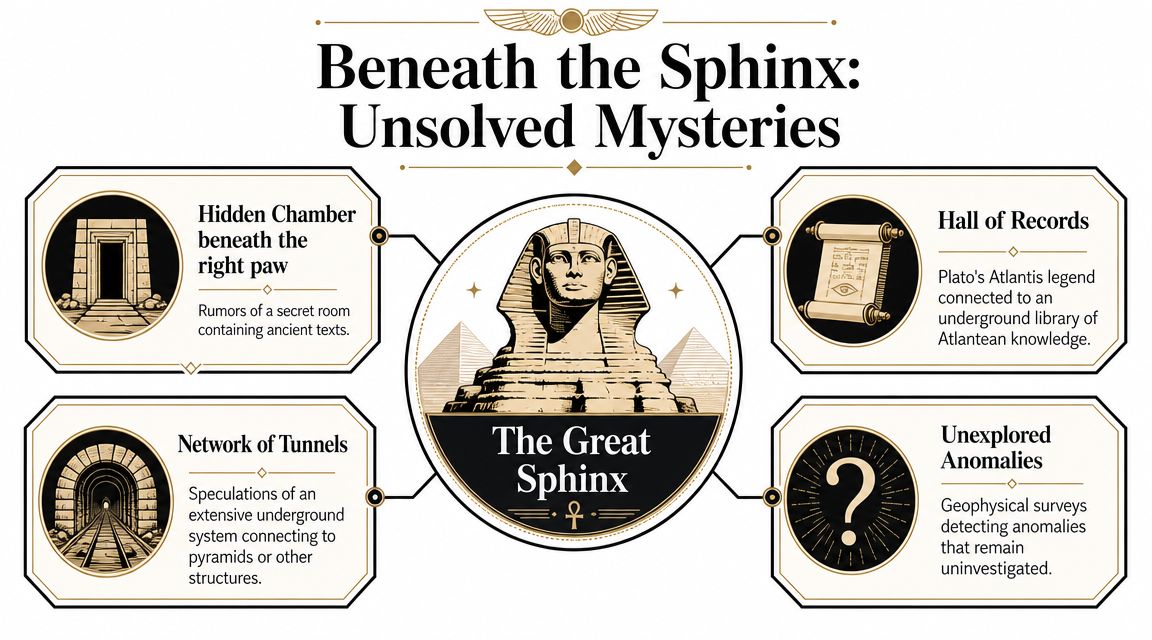
If the erosion debate is the most famous scholarly controversy, the chamber question is the most persistent public one. People arrive already asking whether there's a secret room under the paws, a tunnel system beneath the plateau, or a buried archive sometimes called the Hall of Records.
That idea survives because it combines two irresistible themes. Ancient Egypt and forbidden knowledge. Once those meet, rumor becomes very hard to kill.
Why the chamber story won't disappear
The Sphinx feels like the kind of monument that ought to conceal something. Its paws, its enclosure, and the surrounding bedrock all invite speculation. Visitors often combine that instinct with internet stories and arrive convinced that archaeologists are hiding a discovery.
Modern surveys don't support that conclusion. The best evidence-based position is more restrained. As noted in the documentary source already cited earlier, there is no definitive proof of hidden chambers despite numerous surveys, and modern archaeological work has focused on separating evidence from speculation.
If you're also visiting the plateau more broadly, many chamber stories get bundled together with pyramid myths on it. It helps to separate them from the actual experience of seeing the Cairo pyramids and Giza complex in context.
What surveys can and can't tell us
Geophysical work can detect anomalies. That word sounds dramatic, but it doesn't mean treasure room. An anomaly may be a natural void, a fissure, a change in density, or an area that deserves more study. It is not automatically a man-made hall.
A sensible way to read these claims is:
- Anomaly does not mean chamber. It means something differs from surrounding material.
- Void does not mean library. Limestone can contain natural cavities.
- Repeated surveying matters. If a major man-made chamber had been clearly established, the evidence would look much stronger by now.
The trade-off between mystery and evidence
This is one place where popular storytelling often fails travelers. It treats uncertainty as proof. In archaeology, uncertainty means exactly that. We don't know everything, but we also don't get to fill the gaps however we like.
Field advice: If someone claims a hidden hall has been found, ask what kind of survey found it, what the anomaly actually was, and whether excavation confirmed it.
That simple filter removes most bad claims in seconds.
The hidden chamber topic is still worth discussing because it teaches a useful habit. At Giza, ask what has been detected, what has been interpreted, and what has been proven. Those are not the same thing.
Seeing the Sphinx for Yourself with Oh Yes Tours
After all the debate, many visitors still want the practical answer. What's the best way to see the Sphinx well, ask good questions, and avoid turning the visit into a rushed photo stop?
The first rule is simple. Go when your attention is still fresh. The Sphinx rewards patience more than speed. If you arrive after a long, chaotic morning and treat it as the last item on a checklist, you'll remember the crowd more than the monument.
What makes a good visit
A good Sphinx visit usually comes down to pacing and viewpoint.
- Early access helps. The lower light is softer, the stone reads better in photos, and it's easier to stand still long enough to notice details.
- Context matters. The Sphinx makes more sense when you connect it mentally to the plateau around it, not as a random stop after the pyramids.
- Questions improve the experience. This site is full of half-answers and misconceptions. A guide who can separate strong evidence from tourist myth changes everything.
Some travelers prefer independent wandering. That can work if you've done your homework and don't mind missing nuance. Others want a private guide because they'd rather ask every odd question that comes to mind without being hurried along.
Group tour versus private tour
This is the true trade-off, and it's worth stating plainly.
| Option | Works well for | Main drawback |
|---|---|---|
| Group visit | Travelers focused on a quick overview | Little time for questions |
| Private guide | Curious visitors who want depth and flexibility | Costs more than the cheapest shared option |
| Full Cairo day trip | Red Sea travelers short on planning time | It's a long day if you dislike early starts |
For many Red Sea visitors, the practical choice is a Cairo day trip with flights handled in advance. One example is a Cairo Day Trip from Hurghada by Flight from €499, which appeals to travelers who want logistics bundled rather than pieced together. If you're comparing formats, it helps to browse private Cairo tours and day-trip options and decide whether your priority is budget, comfort, or flexibility.
What I tell travelers before they go
Bring water. Wear stable shoes. Don't expect the Sphinx to be “done” in five minutes. The monument is strongest when you give it a little time and let the enclosure, repairs, and surrounding plateau start to make sense together.
A few practical habits make the visit better:
- Ask one serious question. Not just “who broke the nose,” but something like how restoration affects what we think we're seeing.
- Take your wide photos first. Then stop photographing for a moment and look at the stone.
- Keep your expectations realistic. You're visiting a protected archaeological site, not entering a mystery movie set.
That's usually the difference between a quick tick-box stop and a visit people remember for years.
What We Know and What Remains a Mystery
The strongest version of the Sphinx story is also the most balanced one. We know the Great Sphinx is an ancient limestone monument at Giza, widely placed by mainstream Egyptology in the 4th Dynasty and usually linked with Khafre. We know it spent long periods buried by sand. We know later people restored it, rebuilt parts of it, and treated it as a monument already old in their own time.
We also know that some of the biggest popular claims go beyond the evidence. The water erosion debate raises real questions about weathering, but it doesn't by itself dislodge the broader archaeological case. Hidden chamber stories remain appealing, but repeated surveys have not produced definitive proof of a secret library or lost hall beneath the Sphinx.
The line between debate and fantasy
This is the line I always encourage travelers to keep in mind:
- Known with confidence: the Sphinx belongs to ancient Giza and has a long history of burial and repair.
- Still debated: the finer points of dating, attribution, erosion history, and how its original form looked in detail.
- Not established: sweeping claims about a lost civilization, proven secret chambers, or a confirmed Hall of Records.
That line doesn't make the monument smaller. It makes it sharper. Real mystery survives best when you stop asking it to carry ideas that the evidence can't support.
The Sphinx doesn't need invented secrets to be remarkable. Its actual history is strange enough.
Why it still matters
The reason people stay fascinated by sphinx mysteries isn't just that some questions remain open. It's that the monument sits at the meeting point of archaeology, geology, restoration, and imagination. Few places make visitors feel that collision so strongly.
If you come in person, you'll see something the online arguments often miss. The mystery is not only under the ground or back in prehistory. It's right there on the surface, in weathered limestone, patched masonry, and a face that still refuses to become ordinary.
If you want to experience the Sphinx with local guides who live and work in Egypt, take a look at Oh Yes Tours. They arrange private Egypt trips without the usual middleman layer, with English-speaking local guides, flexible planning, pay-on-the-day cash options, and free cancellation up to 48 hours before. If your idea of a good Egypt day is unhurried, practical, and full of real answers, they're a smart place to start. Egypt? Oh Yes!