Egypt travel
Pyramids from Cairo: A 2026 Local's Guide to Visiting
Planning your trip to the pyramids from Cairo? Our 2026 guide covers Giza, Saqqara & Dahshur with real prices, transport, itineraries & local tips.

By Mohamed Hassan · Senior Local Guide · 12 years

You're in Cairo, you've looked out from a hotel balcony or a rooftop restaurant, and there they are. Not perfectly clear, not floating in a postcard sky, but sitting on the horizon through the haze like something too old to belong to the modern city. That's usually the moment people start asking the wrong question.
They ask, “How do I get to the pyramids?” What they really mean is, “How do I do this without wasting a day in traffic, standing in the wrong ticket line, or ending up with a rushed visit that barely goes beyond a selfie stop?”
That matters, because the Great Pyramid of Giza, built for Pharaoh Khufu around 2600 BCE, is the oldest surviving Wonder of the Ancient World. Its original height was 481 feet (146.5 meters), and it remained the tallest man-made structure on earth for nearly 4,000 years, which is why seeing it properly feels very different from ticking off a landmark on a list, as summarized in the historical overview of the Great Pyramid of Giza.
Most visitors only plan for Giza. That's the usual mistake. If you're starting from Cairo, you can shape the day in very different ways. Some travelers should stick to Giza only. Others should combine Giza, Saqqara, and Dahshur and treat the whole outing as one connected ancient area, not three random stops. If you want to understand what works, this guide is for that.
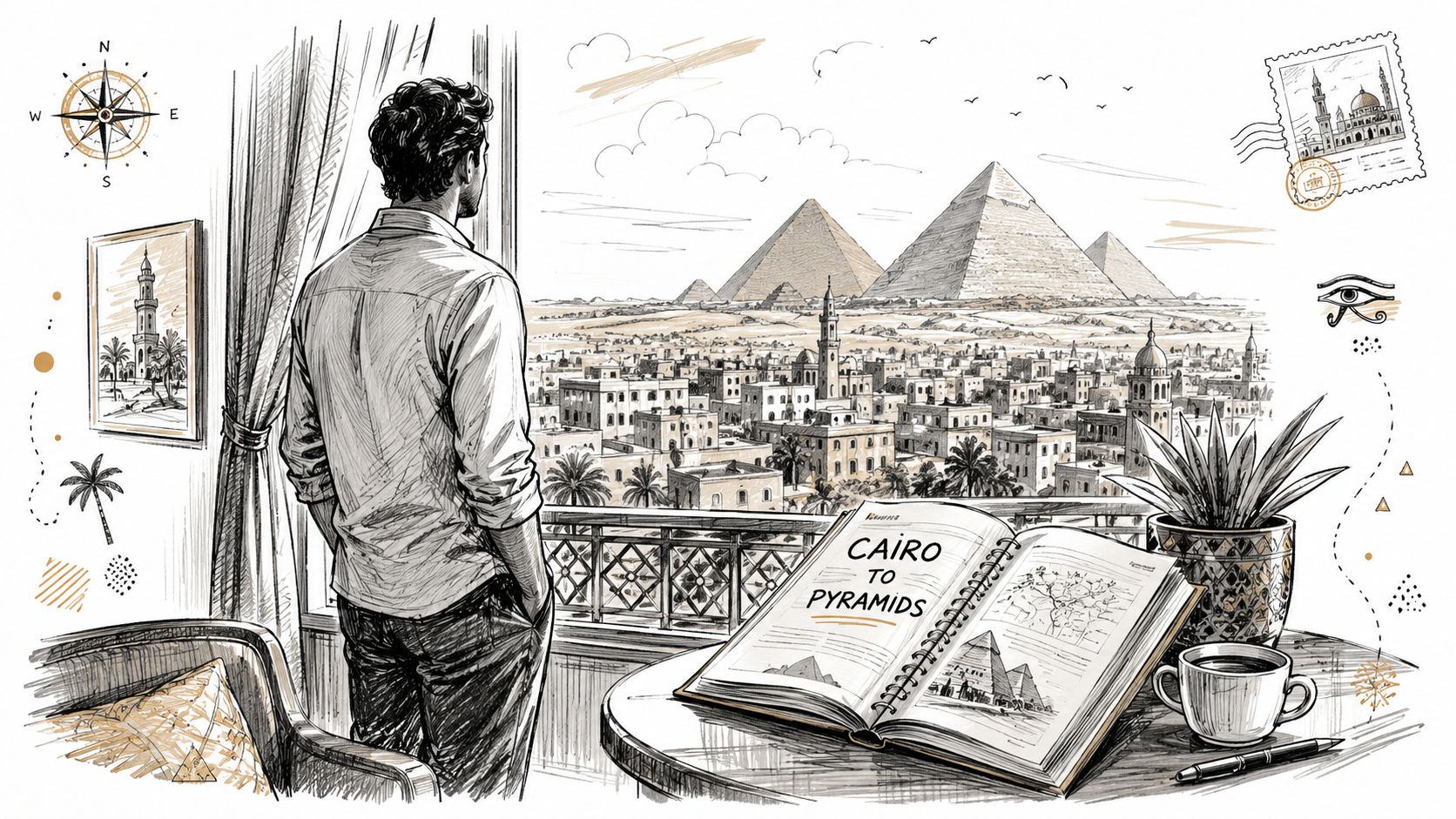
If you want to get your bearings before you book anything, this Cairo map from Oh Yes Tours helps you visualize how these sites sit in relation to the city.
Table of Contents
- From Your Cairo Hotel to the Ancient Pyramids
- Giza Saqqara and Dahshur What Is the Difference
- How to Get to the Pyramids from Cairo
- Private Tour vs Group Tour vs Going It Alone
- Sample Pyramid Itineraries and Realistic Timelines
- Pyramid Tickets Costs Scams and Safety Tips
- Conclusion Making Your Pyramid Dream a Reality
- Frequently Asked Questions About Visiting the Pyramids
From Your Cairo Hotel to the Ancient Pyramids
From most parts of Cairo, a pyramid day starts with a simple choice that has bigger consequences than people expect. You can treat the pyramids as a quick outing, or you can treat them as a full history day. The first approach is easy to book and easy to regret. The second takes a bit more thought, but it gives you a much clearer sense of ancient Egypt than a rushed Giza-only stop.
I've seen this many times with travelers staying in Downtown, Zamalek, Garden City, Giza, or near the newer hotels. In the morning they're excited, by midday they're tired, and by afternoon they're either saying, “That was smoother than I expected,” or, “I wish we had done this differently.” Usually the difference comes down to pacing, transport, and whether they understood the trade-off between iconic views and historical depth before they left the hotel.
The first decision that actually matters
If this is your first visit to Egypt and you only have part of a day, Giza makes sense. It gives you the famous skyline, the big visual impact, and the feeling of standing in front of something almost impossible in scale.
If you have a full day and real interest in archaeology, staying only at Giza is often too narrow. Saqqara and Dahshur change the day from “I saw the pyramids” to “I understood how pyramid building developed.”
Go to Giza for the shock of scale. Add Saqqara and Dahshur for the story.
What works from Cairo
A good pyramid day from Cairo usually has three qualities:
- An early enough departure: Cairo traffic changes the mood of the whole outing. Leave too late and every stop feels compressed.
- A clear site order: Don't improvise your route once you're already in the car.
- Realistic expectations: Entering sites, walking under the sun, buying separate tickets, and moving between locations all take time.
Some travelers want a polished itinerary. Others want flexibility and only need a driver plus practical advice. Both approaches can work. What doesn't work well is trying to “wing it” while also covering multiple sites spread across the necropolis.
Giza Saqqara and Dahshur What Is the Difference
The easiest way to choose between these sites is not by asking which one is “best.” Ask what kind of day you want.
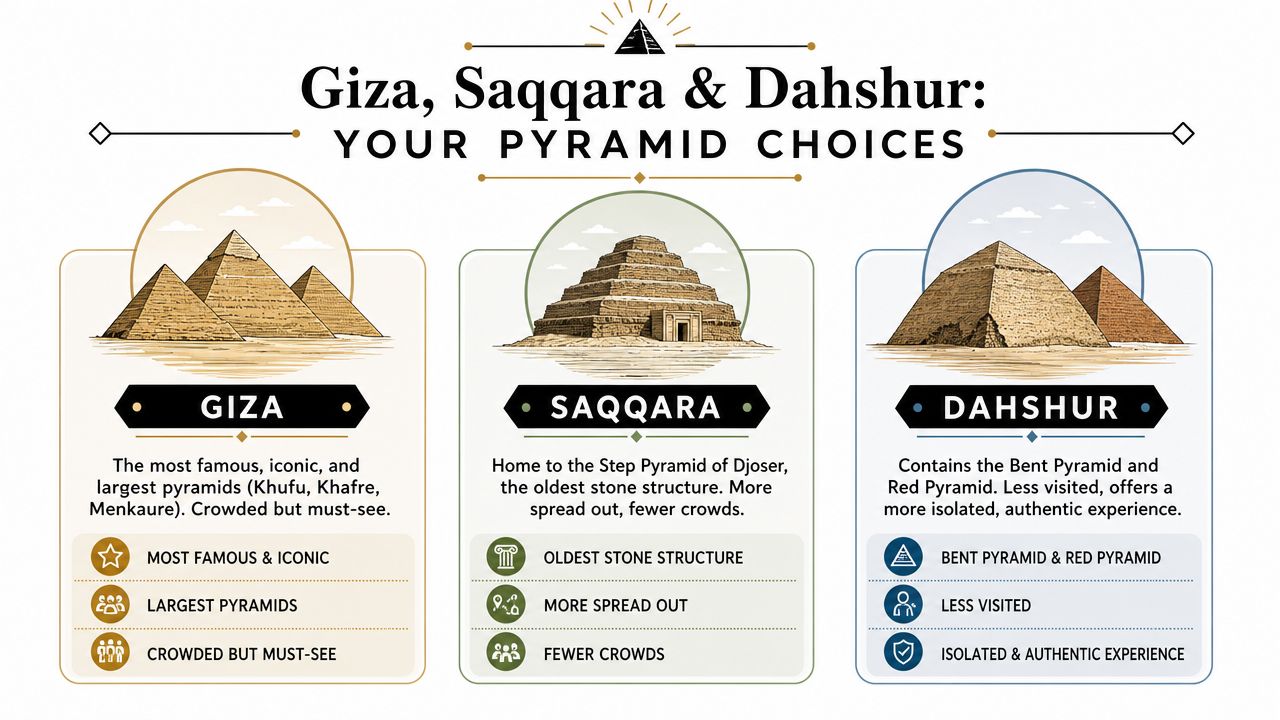
The pyramid fields near Cairo belong to a much larger ancient burial area. The Giza pyramids formed part of a royal necropolis for three Fourth Dynasty pharaohs, and the wider Memphis pyramid zone, including Giza, Saqqara, and Dahshur, was recognized as a UNESCO World Heritage site in 1979, as noted in Britannica's overview of the Pyramids of Giza. That's why combining these places makes sense. They are connected historically, not just geographically.
Choose by experience not by fame
Giza is the site for first impact. Most travelers should start here if it's their first time in Egypt. The scale is immediate, the setting is famous, and the visit feels monumental even if you only stay a few hours. The downside is simple. It's the busiest and most commercial feeling of the three.
Saqqara is for people who want context. The area is more spread out, and the experience tends to feel less compressed. You don't get the same single dramatic skyline as Giza, but you do get a stronger sense that you're inside a very large necropolis rather than at one headline attraction.
A short visual overview can help before you choose your route:
Dahshur is where the day becomes more interesting for repeat visitors, architecture fans, and travelers who hate crowds. It feels quieter and more isolated. If Giza is the grand stage, Dahshur feels closer to an open-air engineering story.
When to combine them
Not everyone should do all three in one day.
| Traveler type | What usually fits |
|---|---|
| Short-stay visitor | Giza only |
| First-time visitor with a full day | Giza and Saqqara |
| History-focused traveler | Giza, Saqqara, and Dahshur |
| Repeat visitor | Saqqara and Dahshur, with or without Giza |
A few practical truths help:
- Giza is for icons: If the trip would feel incomplete without the classic pyramid view, don't skip it.
- Saqqara adds meaning: The day feels less touristy and more historical.
- Dahshur rewards patience: It's not about spectacle in the same way. It's about atmosphere and architectural evolution.
If you only collect famous landmarks, Giza is enough. If you want the ancient landscape to make sense, add at least one more site.
How to Get to the Pyramids from Cairo
Transport changes everything on a pyramid day. The sites are reachable from Cairo, but “reachable” and “smooth” are not the same thing. A route that sounds simple on a map can turn annoying once you add hotel pickup delays, city traffic, site entrances, and the fact that Saqqara and Dahshur work much better with wheels than on-the-spot improvisation.
Private car or private driver
This is the easiest option if you want to combine sites.
A private car works well because it solves three common problems at once. You don't need to renegotiate transport after every stop, you don't have to explain your route repeatedly, and you can leave a site when you're done instead of when a bus schedule tells you to go. That matters most on a Giza plus Saqqara plus Dahshur day.
This option fits couples, families, retirees, and anyone who values energy conservation. Walking ancient sites is one thing. Fighting for your next ride in the sun is another.
Uber or Careem
For pyramids from Cairo on a simpler itinerary, ride-hailing is often fine. It works best for a straightforward trip to Giza and back, especially if you don't mind handling your own entry, route decisions, and timing.
Where it gets weaker is on multi-stop days. You can call another car between sites, but that introduces delays and uncertainty. It's manageable, not elegant.
What works well with Uber or Careem
- One main destination: Giza is the easiest fit.
- Travelers comfortable with apps: You already know how to set pickup points and message drivers.
- Flexible plans: You don't need every minute optimized.
Where it starts to struggle
- Site hopping: Saqqara and Dahshur are less convenient as a chain of separate app rides.
- Return pickup confusion: Large visitor areas can be awkward meeting points.
- Heat and fatigue: Small delays feel bigger after a long morning outdoors.
Street taxi and public transport
A street taxi can work, but it's rarely the low-stress option. If you know Cairo well, speak enough Arabic to handle route and fare discussions, and don't mind negotiation, it's possible. For most visitors, it adds friction where you don't need friction.
Public transport is the cheapest in principle, but for a visitor trying to see major archaeological sites without turning the day into a navigation exercise, it's the least practical choice. It asks too much of your time and attention, especially if your plan includes more than Giza.
The practical comparison
| Option | Convenience | Flexibility | Hassle level | Best for |
|---|---|---|---|---|
| Private driver | High | High | Low | Multi-site day |
| Uber or Careem | Medium to high | Medium | Medium | Giza-focused day |
| Street taxi | Medium | Medium | High | Confident independent travelers |
| Public transport | Low | Low | High | Very budget-focused travelers |
Practical rule: If you want to see all three sites in one day, arrange the car for the full outing, not one leg at a time.
There's also a difference between getting there and arriving in a good mood. That sounds small, but it isn't. By the time you reach your second site, the wrong transport choice has already shaped the rest of the day.
Private Tour vs Group Tour vs Going It Alone
This is a key fork in the road. Transport is only part of the equation. The bigger question is how much of the day you want to manage yourself.
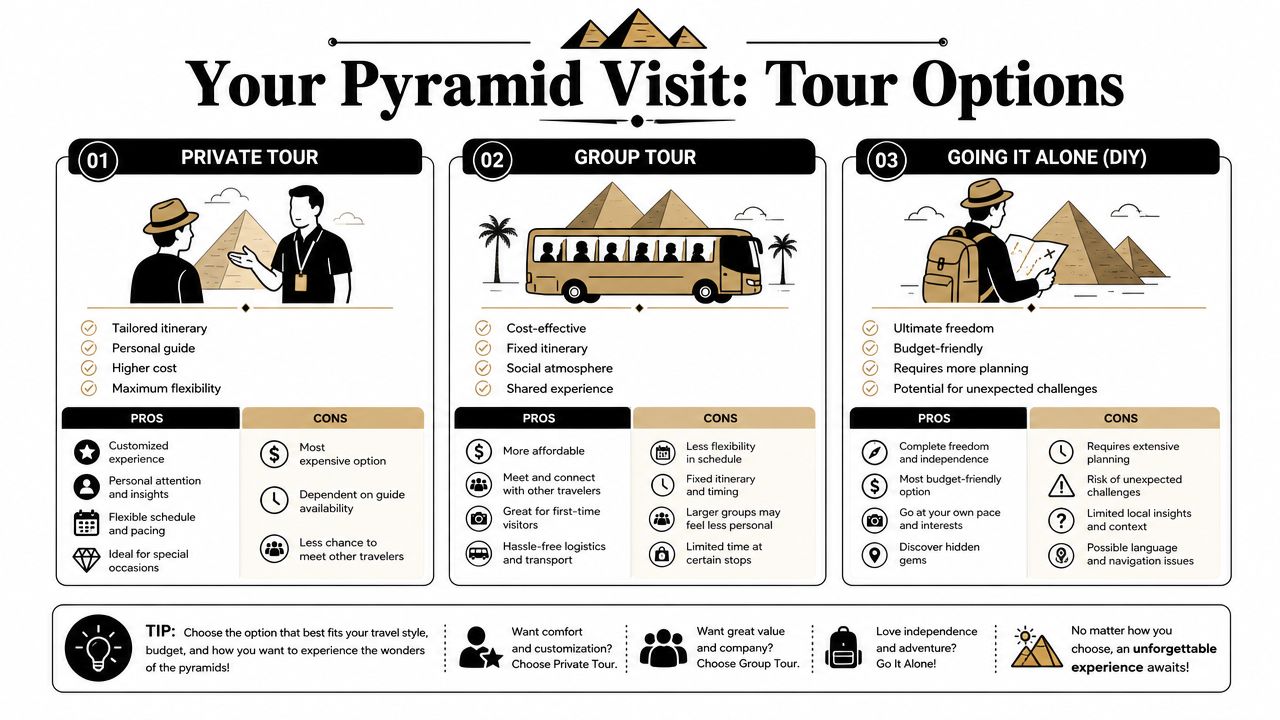
Some travelers enjoy doing everything independently. Others want someone else to handle the route, timing, and practical friction. Both are valid. The issue is that the pyramid fields expose the weak points of each approach very quickly.
What DIY gets right
Going on your own gives you freedom. You can linger, skip things, stay quiet, or change your plan without asking anyone's permission.
That freedom is real, but so is the workload. You handle timing, transport, entry decisions, and the on-site social friction that catches first-timers off guard. If you enjoy that kind of travel, DIY can be satisfying. If you only think you enjoy it, the day can become more tiring than it needs to be.
Where group tours fall short
Group tours solve logistics, but they often flatten the experience. You move at the speed of the bus, not at the speed of your interest. If one person wants photos, another wants shade, and another wants a restroom break, everyone waits.
The bigger problem is pacing. The Great Pyramid is not a monument that benefits from a rushed explanation. Engineering estimates put it at roughly 2.3 million limestone blocks, with an average block mass of about 2.5 tons, according to the EBSCO research summary on the Great Pyramid. That kind of scale deserves time and context. A fast-moving group visit rarely gives you enough of either.
Why private usually wins
Private tours sit in the middle. You keep the structure, but you lose most of the group-tour drag.
A good private setup gives you:
- A route built around your day: Giza only, Giza plus Saqqara, or the full circuit.
- A pace that fits your energy: Families move differently from retired couples. Both deserve realistic pacing.
- Space for questions: That's where these sites become memorable.
- Less wasted effort: No repeated fare discussions, no guessing where to go next.
One option travelers often compare is private Cairo tours from Oh Yes Tours, which focus on direct booking with local guides and drivers rather than large bus-style packages. That model suits travelers who want structure without the group-tour rhythm.
A private guide doesn't change the stones. It changes how much of the place you actually understand before you leave it.
If you're very budget-focused and confident, DIY can work. If your priority is the lowest upfront cost, group tours can work. But if you care about time, comfort, and getting beyond a surface-level visit, private usually gives the strongest value for a pyramid day from Cairo.
Sample Pyramid Itineraries and Realistic Timelines
The biggest planning mistake isn't choosing the wrong site. It's choosing the right sites and giving them the wrong amount of time. A day that looks reasonable on paper can feel cramped once you add traffic, walking, ticket lines, security checks, rest breaks, and lunch.
If you want help structuring a broader Egypt plan around Cairo, this Egypt itinerary planning page is useful for seeing how a pyramid day fits into a longer trip.
The Giza Express
This is the right plan for travelers with limited time, arrival-day energy, or no desire to turn the visit into a marathon. You focus on the Giza Plateau and keep the day clean.
A realistic version includes hotel pickup from Cairo, the main Giza visit, time for viewpoints and photos, and a return before the day starts dragging. This works well for couples on a short stay and for families with children who may lose interest if the outing gets too long.
Best fit
- First-time visitors
- Travelers with one free half-day
- Anyone who wants the iconic experience without adding archaeological depth elsewhere
The Archaeologists Day
This is the strongest single-day compromise for many visitors. Giza gives you the famous opening, then Saqqara gives the trip substance. You leave with both the visual memory and a stronger sense of historical development.
The day works best when you don't linger too long at every single photo stop in Giza. If you spend all your energy there, Saqqara arrives too late and feels like an afterthought. It shouldn't. It's the part that often stays with people longer.
A practical flow looks like this:
| Phase | Focus |
|---|---|
| Morning | Depart Cairo and visit Giza |
| Midday | Move south and break for lunch |
| Afternoon | Explore Saqqara at a steadier pace |
| Late day | Return to Cairo before exhaustion takes over |
The Complete Chronicle
This is for travelers who already know they want more than a headline attraction. Giza, Saqqara, and Dahshur in one day can absolutely work, but only if you accept that the day is about range, not lingering forever at each stop.
What doesn't work is pretending you can do the full circuit casually after a late breakfast. You need an early start, efficient routing, and enough stamina for a proper full day outside.
This itinerary makes sense if
- You're history-focused: You care about the development of pyramid design, not just the postcard image.
- You have a private car or organized transport: Multi-stop improvisation burns time.
- You're comfortable with a long day: It's rewarding, but not lazy.
This itinerary does not make sense if
- You dislike heat and walking: The day can feel punishing.
- You want a very slow pace: You'll resent the transitions.
- You're unsure about your energy level: Better to do Giza plus one extra site well.
The full circuit is memorable when you travel with intention. It's frustrating when you chase too much and rush the parts that needed quiet time.
For most first-time visitors with a full day, Giza plus Saqqara is the sweet spot. For repeat visitors, or for people who read about ancient Egypt before they ever booked the flight, the full three-site route often feels worth it.
Pyramid Tickets Costs Scams and Safety Tips
The fastest way to start the day badly is to arrive without understanding what your main entry does and does not include. The second fastest is to confuse helpful local hustle with official access. Around the pyramids, those are two very different things.
What to pay for and what to skip
One detail catches many visitors by surprise. The general Giza entry fee, noted in one travel reference as around 200 Egyptian pounds, does not include entry inside the Great Pyramid. Going inside the Great Pyramid requires a separate ticket of roughly 400 Egyptian pounds, as discussed in this travel video about Giza ticket add-ons.
That matters because many people budget for “the pyramids” as one simple ticket, then discover the add-on only when they're already there.
A useful way to think about spending on the day is this:
- Mandatory costs: Your site entrance and transport.
- Optional costs: Entering selected monuments, camel or horse rides, drinks, snacks, tips, and any extras you choose on-site.
Don't assume every optional extra is worth paying for. Some are memorable. Some are just impulse purchases under pressure.
The hassle points to expect
At the main sites, you may meet people who offer photo help, shortcut access, animal rides, or “special” assistance. Some are harmless. Some become pushy once you engage.
The safest habit is simple. If you don't want the interaction, don't start the negotiation.
Common situations to handle carefully
- Unofficial “guiding” offers: If someone approaches you before you've asked for help, treat it cautiously.
- Animal ride pressure: Agree on every detail before getting on anything, or don't do it.
- Photo setup offers: A quick photo can suddenly become a demand for a tip.
- Authority theater: A confident voice and a gesture toward a restricted area do not make someone an official.
If someone says, “Just come, I'll show you,” stop and decide before you move your feet.
What to carry on the day
Your packing list should be boring and functional. The desert sites don't reward overthinking. They reward preparation.
| Item | Why it matters |
|---|---|
| Water | The sites are exposed and dry |
| Sun protection | Shade is limited |
| Comfortable shoes | Ground conditions vary |
| Cash in small amounts | Useful for tickets, tips, and minor purchases |
| Phone fully charged | Needed for navigation, photos, and ride-hailing |
Safety is mostly about judgment, not fear. Stay aware, keep your valuables simple and close, and don't let anyone rush you into a decision. Travelers who move calmly and confidently usually have the smoothest day.
Conclusion Making Your Pyramid Dream a Reality
A pyramid trip from Cairo doesn't need to feel chaotic. Most of the stress comes from bad sequencing, vague expectations, and trying to save effort in the wrong places. Choose the right scope for your day, sort the transport before you leave the hotel, and be honest about whether you want a quick icon visit or a deeper archaeological route.
For many travelers, the most satisfying balance is simple. Giza for the scale and impact, then Saqqara or Saqqara plus Dahshur if you want the wider story. That's where the day stops feeling like a checklist and starts feeling like Egypt.

If you prefer your travel days unhurried, clear, and built around real on-the-ground timing, a private setup usually gives the best return on your energy. It lets you spend your attention on the sites themselves instead of on route problems and avoidable friction.
Frequently Asked Questions About Visiting the Pyramids
Some questions come up on almost every Cairo booking call. They usually have less to do with history and more to do with comfort, confidence, and whether the day will feel manageable.
Quick Answers to Common Pyramid Questions
| Question | Answer |
|---|---|
| Can I do Giza, Saqqara, and Dahshur in one day from Cairo? | Yes, but only if you start early and accept that it will be a full day. It works much better with a dedicated car than with improvised transport between sites. |
| Is Giza enough for a first-time visitor? | Sometimes, yes. If your time is short, Giza alone gives you the classic experience. If you have a full day and real interest in ancient Egypt, adding Saqqara usually gives the trip much more depth. |
| Is it safe to visit independently? | For most travelers, yes, with normal city-and-tourist-site awareness. The bigger issue usually isn't danger. It's hassle, pressure selling, and avoidable confusion. |
| Can I use a ride-hailing app for the way back to Cairo? | Usually yes, especially from Giza. It's less seamless on a multi-site day, where a dedicated driver tends to be more practical. |
A few extra points are worth knowing.
Travelers with limited mobility should plan carefully. The exterior viewing areas are much easier than interior monument access, and the ground can be uneven. If accessibility matters for your group, it's much better to tailor the route than to discover the limitations on the spot.
Solo female travelers regularly visit these sites, but the smoother choice is usually a pre-arranged car or tour rather than building the day through repeated on-site negotiations. That reduces hassle more than anything else.
Morning is usually the easiest time for comfort and pacing. You arrive with more energy, the light is good, and you avoid turning the final site of the day into a tired formality.
Families should be realistic about attention span. Children often enjoy Giza's big visual drama more than a long, information-heavy circuit. If parents want the wider historical route, the day works better when breaks are built in and no one tries to force every stop.
If you want a Cairo pyramid day that's organized by people who work on the ground in Egypt, take a look at Oh Yes Tours. You can compare private options, ask directly about Giza, Saqqara, and Dahshur combinations, and build a day that fits your pace instead of squeezing into a generic template. Egypt? Oh Yes!