Egypt travel
Nile River Cruises 2026: A Local Guide's Honest Advice
Planning Nile river cruises? Get a local guide's real advice on boat types, itineraries, costs, and booking. Find your perfect Egypt cruise for 2026.

By Mohamed Hassan · Senior Local Guide · 12 years
Most advice about Nile river cruises gets one thing wrong. It treats them as if they're all the same trip with different wallpaper.
They aren't.
I've guided travelers through Upper Egypt long enough to know that the right cruise can feel effortless, atmospheric, and deeply memorable. The wrong one can leave you wondering why you spent good money on a boat that mostly sat docked while you rushed through temples half-awake. That's why I never start with "Which is the best Nile cruise?" I start with "What kind of traveler are you, and what do you want the Nile to do for you?"
A Nile cruise works because the river itself shaped Egypt. The Nile stretches around 7,088 km and its basin covers 11 countries, but modern cruise tourism depends on the regulated Egyptian stretch, where the Aswan High Dam helped create a more stable, year-round flow for travel and tourism, as noted in Wikipedia's overview of the Nile. In plain terms, this river isn't a scenic extra. It's the historical road through the heart of Upper Egypt.
If you want to understand Luxor, Edfu, Kom Ombo, and Aswan as part of one connected story, cruising still makes the most sense. But only if you choose with open eyes.
Table of Contents
- Welcome to the Real Nile
- Choosing Your Ship Luxury Liners, Dahabiyas, and Feluccas
- Decoding Nile Cruise Itineraries 3, 4, and 7 Nights
- Your Onshore Guide to Temples and Tombs
- How Much Do Nile Cruises Cost in 2026?
- Finding Your Perfect Fit A Cruise for Every Traveler
- Nile Cruise Logistics Visas, Safety, and What to Pack
- Booking Your Cruise A Checklist and the Private Guide Advantage
Welcome to the Real Nile
A Nile journey isn't just a brochure photo of a sunset and a polished deck chair. It's early light over the west bank, temple stone warming under the sun, and the quiet logic of traveling by river through a region that has linked Egyptian life for millennia.
What many travelers miss is that a cruise here isn't designed like an ocean holiday. It's designed around sites. The river is the connector. The temples are the reason.
That's why I tell people to stop comparing Nile river cruises as if they're choosing between interchangeable hotel packages. You are really choosing your pace, your atmosphere, and how much structure you can tolerate. Some travelers want everything bundled and predictable. Others want space, slower sailing, and fewer people. Both can work. Both can disappoint, too, if your expectations are wrong.
Why the cruise still makes sense
Upper Egypt rewards river travel because the major ancient stops sit in a practical corridor. You don't spend your energy constantly unpacking, checking in, and driving long overland transfers between each temple town. You sleep once, move with your room, and wake near the next chapter of the story.
That convenience matters more than people think. It changes your energy on day three and day four, when the difference between "interesting trip" and "I need a holiday after my holiday" becomes very real.
Many travelers don't need the fanciest boat. They need the cruise style that matches how they like to travel.
What honest planning looks like
An honest guide will tell you that Nile river cruises are not about endless sailing and onboard spectacle. They're about using the river intelligently. If that sounds appealing, you're already thinking about this the right way.
If what you want is mostly scenery and lots of time under sail, then you need to be more selective, especially about boat type and itinerary length. That's where most booking mistakes happen.
Choosing Your Ship Luxury Liners, Dahabiyas, and Feluccas
The boat you choose changes the whole character of the trip. Not a little. Completely.
A standard cruise ship on the Nile is much smaller than an ocean liner. Cruise specialists describe the average vessel as about 72 m long with around 100 guests, which is why these boats are better judged like a boutique hotel with transport than like a floating resort, according to QuirkyCruise's Nile river cruise guide. That's the right mental model.
Nile Cruise Boat Types Compared
| Feature | Luxury Cruise Ship | Dahabiya Sailboat | Felucca Sailboat |
|---|---|---|---|
| Atmosphere | Hotel-style, structured, social | Quiet, intimate, slower | Simple, adventurous, traditional |
| Group size feel | Larger shared experience | Small-group and personal | Very small and basic |
| Cabins | Private cabins with standard comforts | Fewer cabins, more character | Usually very basic sleeping setup |
| Facilities | Dining room, sun deck, often pool | Limited facilities, more charm than infrastructure | Minimal amenities |
| Best for | First-time visitors, comfort seekers, families | Couples, repeat visitors, travelers who hate crowds | Budget travelers, backpacker-style adventurers |
| Pace | Efficient and fixed | Slower and more atmospheric | Weather and simplicity shape the trip |
| Site access style | Usually bundled excursions | More curated and intimate | Often paired with simpler logistics |
| Price level | Mid-range to premium | Premium | Budget to lower mid-range |
Luxury cruise ships
This is the classic choice. You have a cabin, regular meals, a sun deck, and a schedule that keeps everything moving. For many first-time visitors, it works well because the logistics are simple and the route is proven.
What doesn't work is booking one of these boats while secretly hoping for a romantic, quiet sailing experience. On many standard departures, the rhythm feels more like a touring hotel than a sailing journey. That's not a flaw if you know it in advance. It becomes a flaw when the marketing suggests something else.
Dahabiyas
A dahabiya is usually where I point travelers who care about mood, silence, and space. These boats feel closer to the Nile people imagine before they arrive. You notice the banks more. The journey feels less industrial. The evenings tend to be calmer.
The downside is simple. Less infrastructure, fewer cabins, and usually a higher price for that intimacy. If you love efficiency and lots of facilities, a dahabiya may feel too quiet. If you want fewer crowds and a more elegant rhythm, it's often the most satisfying choice.
Practical rule: Choose the boat for the feeling you want on board, not just the photos of the cabin.
Feluccas
A felucca is the most traditional and least cushioned option. It can be wonderful for the right traveler. Fresh air, simple living, direct contact with the river, no illusion of luxury.
It can also be uncomfortable if you're not realistic about what "simple" means. Felucca trips suit people who prioritize atmosphere over convenience. I don't recommend them to travelers who need privacy, structured sightseeing, or hotel-level comfort.
What experienced travelers get right
The smartest bookings usually come from people who ask these questions first:
- Do I want comfort or character most? A luxury ship gives you consistency. A dahabiya gives you atmosphere.
- How much company do I enjoy? Some travelers like meeting others over dinner. Others want fewer voices around them.
- Am I paying for the boat or for the sites? If the temples are your priority, you may not need the highest cabin category.
- Will basic travel charm me or annoy me? Be honest here. It saves disappointment.
Decoding Nile Cruise Itineraries 3, 4, and 7 Nights
The itinerary matters just as much as the ship. Sometimes more.
The classic product in Egypt is a 4 or 5-night cruise focused on the Luxor-Aswan stretch, because this route connects the major ancient sites efficiently. Travel guidance also notes that demand is strongly seasonal, with December and January as the busiest months and travelers often advised to book 10 to 12 months ahead for the best cabins and dates, as explained in Egipto Exclusivo's Nile travel guide.
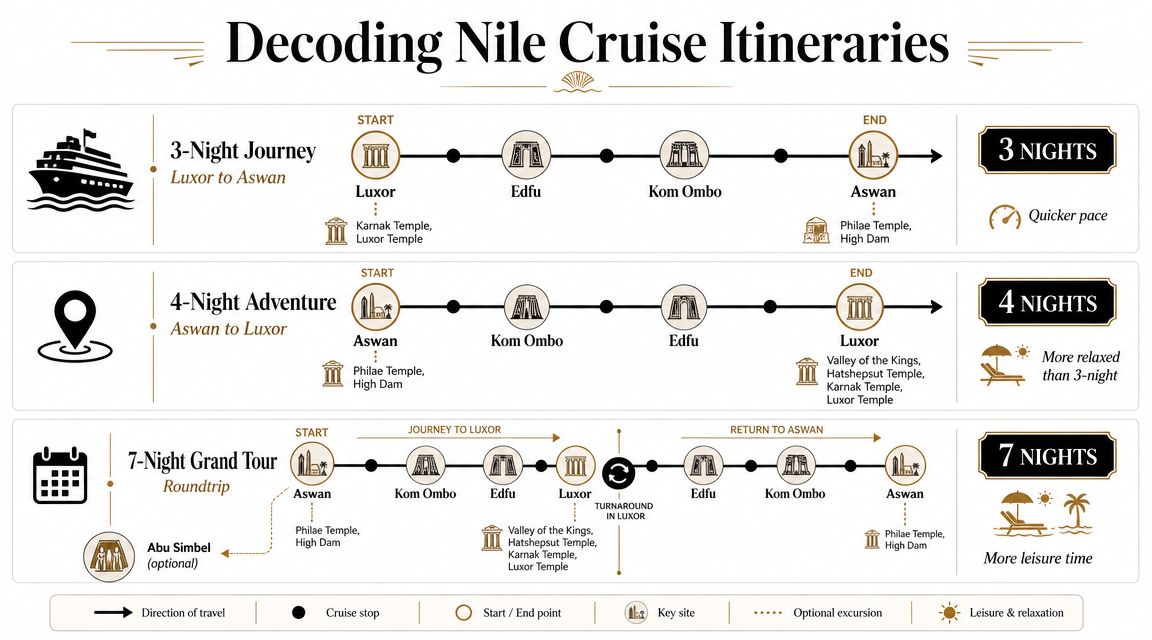
If you're comparing departures, don't just read the headline length. Read the route and the pacing. A short itinerary can be efficient. It can also feel rushed.
The common formats
3 nights usually suit travelers who are tight on time and willing to move fast. You still cover the famous corridor, but the trip has less breathing room. Early starts matter more, and there is less margin if anything runs late.
4 nights is the format I recommend most often. It usually gives a better balance between movement and sightseeing. You still stay on the main route, but the trip feels less compressed.
7 nights are for travelers who want a round trip or a more extended rhythm. These can be rewarding, but only if you want the extra deck time and slower repetition of the river mood. More nights don't automatically mean better value for every person.
For travelers mapping options side by side, a practical Egypt itinerary planner for cruise combinations can help you compare how a cruise fits into a wider Cairo, Luxor, or Red Sea trip.
What a typical 4-night rhythm feels like
A classic 4-night trip often follows a pattern like this:
- Arrival and embarkation in one of the main Upper Egypt cities.
- Major temple visits begin early, while the light and temperature are still manageable.
- Sailing windows happen between site clusters, often with lunch or rest onboard.
- Intermediate stops such as Edfu and Kom Ombo break the journey.
- Final days focus on the dense concentration of headline sites at the other end of the route.
This is why the route works so well. The archaeology is concentrated enough to make the journey feel coherent.
What brochures often hide
Many travelers imagine long scenic stretches under constant sail. In reality, itinerary design on the Nile is much tighter and more functional. Some sailings cover what they need to cover, then remain docked while excursions happen. That isn't automatically bad. If your priority is temple access, it can be completely sensible.
Book the itinerary for its rhythm, not just its duration.
The travelers who are happiest are usually the ones who ask two simple questions before paying: How much time will I spend sailing? And how packed are the excursion days?
Your Onshore Guide to Temples and Tombs
A Nile cruise is only as good as its shore days. The cabin matters. The meals matter. But the lasting memory lives on land, in the temples, tombs, and the moments between them.
I've watched travelers go quiet at Karnak, not because they're tired, but because scale finally defeats imagination. That's when the Nile cruise makes sense. You stop seeing the trip as a package and start seeing it as a moving route through one civilization's greatest corridor.
For travelers who want a closer look at the major monuments around Luxor, this guide to Luxor attractions and temple highlights is useful before you decide how much time to spend on each stop.
Karnak and Luxor
Karnak is about scale and accumulation. You don't visit it once and feel you've "done" it. The columns, open courts, and changing light make it one of those places where pacing matters almost as much as explanation. A guide who knows when to pause is worth more here than a guide who talks nonstop.
Luxor Temple has a different energy. It sits more intimately in the city, and it often lands better later in the day when the stone starts changing color. If someone says the temples all blur together, they usually had a rushed visit.
Valley of the Kings and Hatshepsut
The Valley of the Kings is where travelers often underestimate their own fatigue. It can look manageable on paper, but once you add heat, steps, timing, and decision-making, people either rush or burn out. My advice is to choose carefully and go in with focus.
Hatshepsut's temple is one of the easiest places to appreciate from a distance before you even begin the visit. It has presence. You feel its design in the cliff setting immediately.
Go into the Valley with a plan. Wandering without one usually means spending energy in the wrong places.
A short visual overview helps before arrival:
Edfu, Kom Ombo, and Philae
Edfu often surprises people because it feels so intact. Even travelers who don't think of themselves as "temple people" tend to respond well there. It reads clearly.
Kom Ombo is easier to absorb quickly, but timing matters. When several boats arrive around the same window, the mood changes fast. If your arrangements allow even slight flexibility, use it.
Philae is one of the most graceful stops in Upper Egypt. The approach helps. Arriving by boat changes the psychology of the visit. It feels separated, almost staged by the river itself.
Abu Simbel and whether it's worth the effort
Abu Simbel is the add-on people ask me about most. My honest answer is simple. If ancient Egypt is your main reason for coming, many travelers feel it is worth the effort. If you're already feeling overloaded and want a gentler trip, it may become one excursion too many.
What matters isn't whether it's famous. It is. What matters is whether you want one more major commitment in a trip that already starts early and moves steadily.
How Much Do Nile Cruises Cost in 2026?
Prices confuse people because offers that look similar on the surface can include very different things. One quote may cover meals and shared guiding but leave drinks, tips, and optional visits outside. Another may look expensive until you see that transfers and more structured sightseeing are already built in.
For planning, a realistic entry point for a multi-day Nile cruise with this publisher is from €699. Beyond that, the price usually shifts based on boat type, cabin level, season, and whether you're joining a standard departure or arranging something more customized.
What usually changes the price
The biggest cost drivers tend to be:
- Boat category. Standard ships usually sit below premium ships and dahabiyas.
- Cabin position. Higher decks or stronger room categories often cost more.
- Season. Winter demand is stronger, so availability gets tighter.
- Guiding style. Shared excursions and private guiding are not the same product.
- Extras beyond the core route. Add-ons can change the actual trip cost quickly.
A practical way to budget
Instead of hunting for the lowest headline rate, build your budget around four separate buckets:
| Budget item | Usually handled how |
|---|---|
| Cruise cabin and meals | Often included in the base cruise fare |
| Temple excursions | Sometimes bundled, sometimes selectable |
| Personal spending | Commonly separate, especially drinks and tips |
| Optional extras | Usually paid on top if chosen |
That last line matters. Some travelers compare two offers and assume one is overpriced, when really one has included more of the trip.
What to ask before you compare prices
Use these questions every time:
- Are the excursions included, or are they optional?
- Are transfers included on both ends?
- Are drinks part of the package, or charged separately?
- Is the guide shared with a larger group, or not?
- What optional visits are commonly offered at extra cost?
A cheap cruise can become expensive once the missing pieces are added back in. A more expensive cruise can be the better buy if it removes hassle and gives you better pacing.
Finding Your Perfect Fit A Cruise for Every Traveler
The best Nile cruise isn't the most expensive one. It's the one that matches how you handle structure, comfort, and site intensity.
One of the clearest trade-offs on the Nile is convenience versus flexibility. The boat gives you easy logistics and often bundled guiding, but the schedule is rigid and you can't stay longer whenever a site captures you, as discussed in The Telegraph's Nile cruising guide.
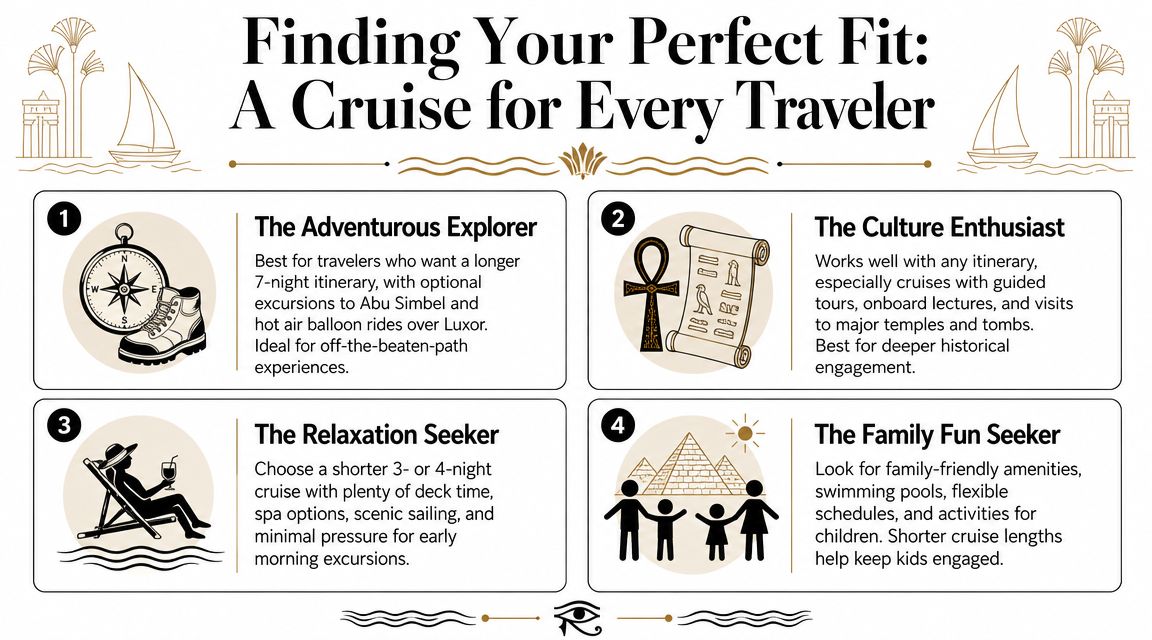
Couples who want romance, not crowds
For couples, especially on a honeymoon or anniversary trip, the first question isn't "luxury or not?" It's "private-feeling or not?" Those are different things.
A dahabiya often suits couples better than a larger ship if atmosphere matters more than facilities. If the couple wants a pool, standard comforts, and easier logistics, a polished cruise ship can still be the better choice. But I tell couples not to pay premium money for a big boat if what they really want is calm.
Families who need ease
Families usually do best when the cruise removes friction. Predictable meals, simple transfers, and a cabin setup that doesn't create stress all help. Children don't care whether the woodwork in the lounge is handmade. They care whether the day is too long and whether there is space to reset.
For many families, a standard cruise ship is the safer choice than a smaller sailing boat. It gives structure. That matters when you're managing energy levels across different ages.
Retirees and history-focused travelers
This group often benefits most from being selective, not ambitious. A comfortable ship, a sensible pace, and thoughtful guiding beat an overstuffed program every time.
Some travelers in this category enjoy premium or boutique boats because lower onboard density can make the trip feel calmer. Others care far more about the guide than the vessel. That's often the smarter instinct.
If history is your priority, spend for better guiding before you spend for a shinier corridor.
Solo travelers and independent-minded travelers
Solo travelers often ask whether they should skip the cruise and do Upper Egypt overland with private transfers. Sometimes that's the right answer, especially if flexibility is your top value.
But solo travelers who enjoy some built-in structure, easy transport, and meeting others can still do very well on a cruise. The trick is to avoid paying for onboard style you don't care about. Put your budget where your trip lives.
Nile Cruise Logistics Visas, Safety, and What to Pack
Once you've chosen the style of trip you want, the rest becomes straightforward. Most mistakes at this stage aren't dramatic. They're small planning misses that make the journey less comfortable than it needs to be.
Timing and availability
For comfort during temple visits, cooler months are generally easier on most travelers. Upper Egypt can be demanding in the heat, especially on days with early starts and exposed archaeological sites.
If you're considering niche products for a future trip, there is a wider variety being marketed for 2026/2027, including dahabiya sailings and longer Cairo-to-Aswan options. But these longer and more expensive departures remain niche and may face cancellation if demand is weak, according to Egypt Tours Portal's overview of 2026 and 2027 Nile cruise options. I tell travelers to treat those longer itineraries as special-interest products, not the default safe choice.
Visas and entry basics
Visa rules depend on nationality, and it's always worth checking the latest requirements before you fly. A simple starting point is this Egypt visa guide for travelers, especially if you're trying to work out what to prepare before departure.
Bring printed and digital copies of your booking details, passport information, and travel insurance. Phones fail at the worst moments. Paper still saves trips.
What to pack for the Nile
You don't need to overpack. You need to pack for sun, walking, dust, and temple etiquette.
- Comfortable shoes: Temple floors, ramps, and uneven ground punish bad footwear quickly.
- Sun protection: Hat, sunglasses, and sunscreen are not optional on excursion days.
- Light clothing: Breathable fabrics make a bigger difference than people expect.
- A modest layer: Useful for cultural comfort and cooler evenings on deck.
- Small cash: Handy for personal purchases and day-to-day convenience.
- Any personal medication: Bring what you need with you, not as an afterthought.
Safety and common-sense comfort
Most travelers do well when they use normal travel judgment. Stay hydrated. Listen to your guide on timing. Don't turn every stop into a negotiation contest. And don't assume a busy day on paper will feel easy in real conditions.
Accessibility is where honest planning matters most. Some sites are manageable with care. Others involve steps, distances, and surfaces that can be tiring. If mobility is a concern, say it before booking, not after boarding. A good plan can solve a lot. Silence cannot.
Booking Your Cruise A Checklist and the Private Guide Advantage
Before you pay for any Nile cruise, confirm the exact product. Not the marketing summary. The actual product.
Many standard cruises sail for only a few hours before docking and function partly as a floating hotel, which can surprise travelers expecting a more scenic sailing experience. The primary trade-off is time sailing versus time at sites, as described in The Urge To Wander's review of the Nile cruise reality.
That single point explains why some travelers love their cruise and others feel let down. They booked two different expectations into the same boat.
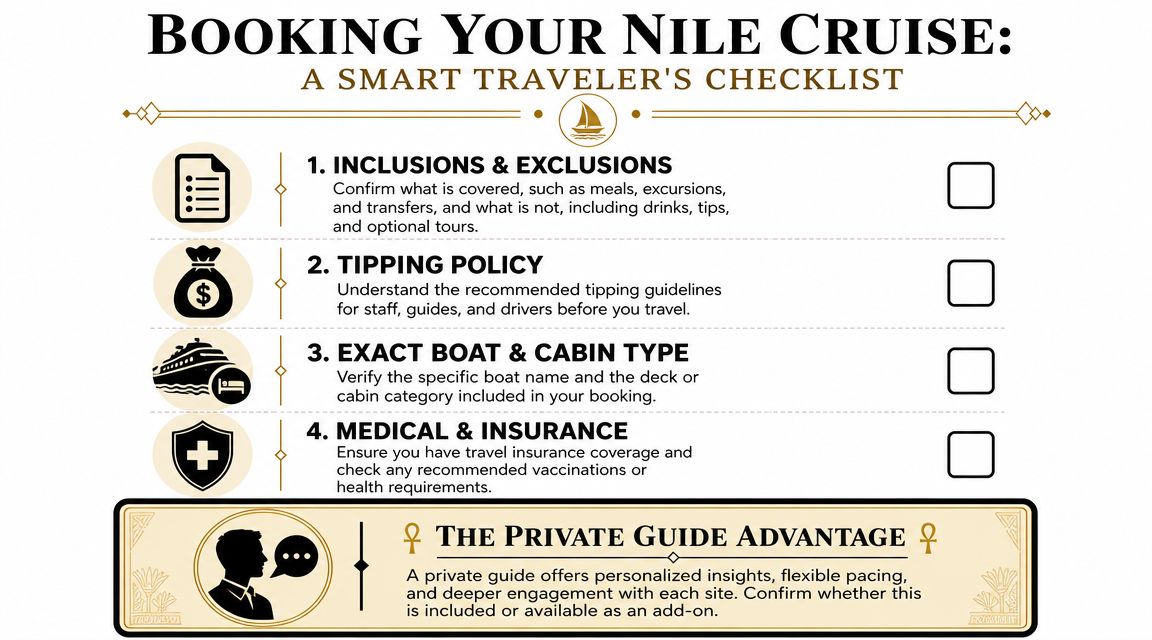
The booking checklist I would use myself
- Exact boat name: Don't accept "or similar" unless you're comfortable with substitutions.
- Cabin category: Mid-deck, lower deck, and upgraded categories can feel very different.
- Excursion model: Confirm whether tours are bundled, optional, shared, or private.
- Transfer details: Ask who meets you, where, and what happens if timings shift.
- Meals and drinks: "Full board" doesn't always mean everything you consume is included.
- Cancellation terms: Read them before you need them.
- Physical demands: Confirm walking levels, especially for older travelers or families.
Why private guidance changes the trip
This is the part many people only understand after they've done one cruise the standard way.
When the boat is mostly the transport and sleeping base, the quality of your time ashore becomes the primary differentiator. A private guide can adjust pace, help you focus on the sites you care about most, and stop the day from feeling like a loud conveyor belt. That doesn't mean everyone needs private guiding. Some travelers are perfectly happy in a shared setup.
But if you're spending serious money and care deeply about ancient Egypt, privacy on land often matters more than polish on water.
The boat gets you there. The guide decides whether the day feels personal or processed.
If you want a Nile cruise arranged directly with people who live and work in Egypt, Oh Yes Tours is a smart place to start. You book with local guides, not a reseller layer, and that usually means clearer advice, fairer pricing, and a trip built around what you want to see. Egypt? Oh Yes!