Egypt travel
Marsa Alam Diving: An Insider's Guide for 2026
Planning a trip for Marsa Alam diving? Get a local guide's advice on Elphinstone, Fury Shoals, liveaboards vs. day trips, pricing, and safety for 2026.

By Mohamed Hassan · Senior Local Guide · 12 years

You're probably in the same spot as many certified divers who contact us in the Red Sea. You've dived enough to know the difference between a destination that looks good on Instagram and one that works underwater. You've heard the big names, probably compared Sharm, Hurghada, maybe even a liveaboard route, and now Marsa Alam keeps showing up.
That usually means you want fewer compromises. Better reefs. Less traffic on the water. A trip built around diving first, not nightlife with a dive boat attached.
That's exactly where Marsa Alam stands apart. It isn't the easiest Red Sea destination to understand from generic travel pages because the primary question isn't “is Marsa Alam good for diving?” It is. The key question is whether it suits your certification level, your appetite for current and depth, and the kind of holiday you want around the dives. If you're still deciding what else to do in the area between dive days, this overview of Marsa Alam attractions and excursions helps put the wider destination in context.
Table of Contents
- Your Ultimate Guide to Diving in Marsa Alam
- Why Choose Marsa Alam Over Other Red Sea Resorts
- Marsa Alam's Signature Dive Sites and Who They Are For
- Liveaboard vs Land Based The Two Ways to Dive Marsa Alam
- How to Plan Your Marsa Alam Diving Trip
- Choosing a Safe and Reputable Dive Operator
- Diver's Checklist and Conservation Best Practices
- Marsa Alam Diving FAQs
Your Ultimate Guide to Diving in Marsa Alam
A lot of divers arrive in Egypt thinking all Red Sea diving works the same. It doesn't. We see this all the time with guests who've done northern Red Sea diving before and expect Marsa Alam to be just a quieter version of the same thing. Then they get here and realize the whole rhythm is different.
Marsa Alam grew as a dive-led destination, not as a classic mass-tourism beach strip. That matters because the diving style, resort layout, and daily routine still reflect it. You're not choosing between a beach club and a dive center tucked in the corner. In many parts of Marsa Alam, the reef is the reason the resort exists.
For the serious recreational diver, that changes the holiday completely. You can build days around house reef entries, shore dives, selected boat trips, and rest periods that support diving well. It feels calmer, and for many divers it feels more purposeful.
Marsa Alam suits divers who want the trip to revolve around water time, not around shopping streets and packed marinas.
It also rewards honesty. Not every famous site is for every diver. Some bookings go wrong because people chase names. The better trips happen when divers match site choice to skill, confidence, and what kind of underwater experience they enjoy. If you love easy marine life encounters, your ideal Marsa Alam trip can look very different from someone chasing exposed offshore walls.
Why Choose Marsa Alam Over Other Red Sea Resorts
A diver checks in after a week in Hurghada and asks for “the best site.” We usually stop that conversation there and ask a better question. Best for what level, what sea conditions, and what kind of diving day?
That is where Marsa Alam separates itself from the northern Red Sea resorts. It works especially well for divers who want the trip built around reef time, marine life, and site choice that matches their actual experience.
That does not make Sharm or Hurghada weaker destinations. They offer easier nightlife, more hotels, more non-diving entertainment, and often more flexibility for mixed groups. Marsa Alam is the better fit for travelers who are happy to trade some of that convenience for quieter operations, better shore and house reef routines, and access to sites that reward patience more than speed.
Better matched to skill-based diving holidays
Marsa Alam is one of the few Red Sea bases where the trip can be shaped very differently for an Open Water diver, a newly certified Advanced diver, and a diver with solid current experience. That matters more than many visitors expect.
In Hurghada and Sharm, people often book around boat availability and resort convenience first. In Marsa Alam, the smarter approach is to book around the diving profile you want. House reefs and sheltered bays suit newer divers who need repetition and confidence. Offshore sites and exposed reefs suit divers who are comfortable with drift procedures, changing current, and stricter entry timing.
We see too many guests chase famous names before they are ready for them. Marsa Alam rewards the opposite approach. Honest site selection usually leads to a better week underwater.
Marine encounters feel less manufactured
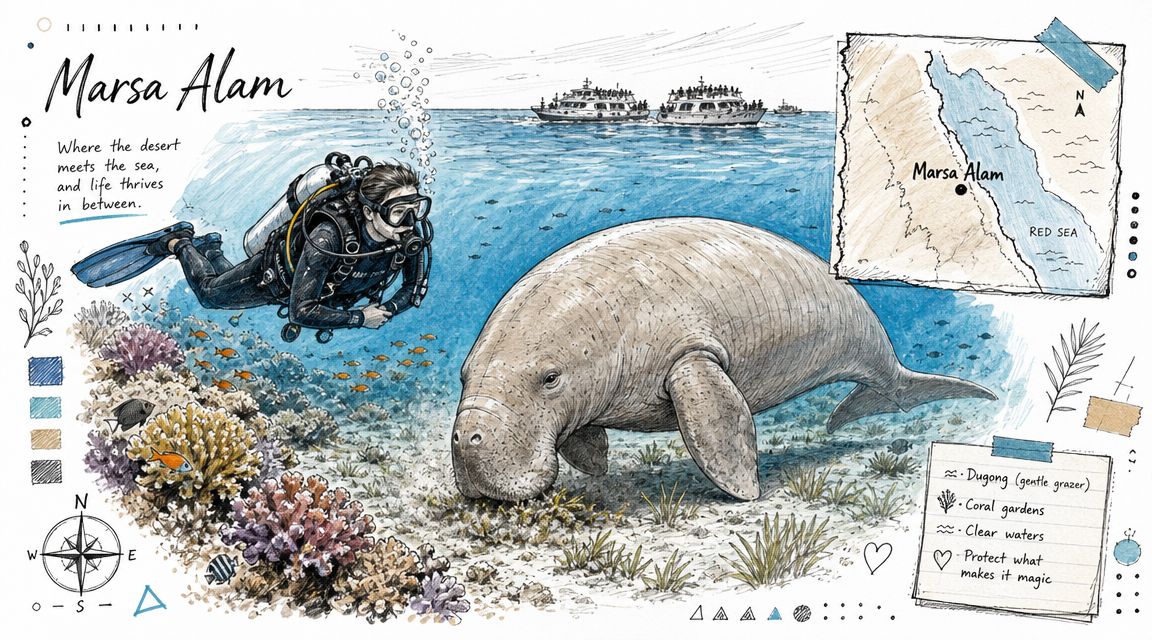
The strongest argument is the wildlife. Marsa Alam has earned its reputation for dugongs, turtles, reef sharks, dolphins, and healthier-feeling coral areas than many busier resort zones. The key trade-off is that the best encounters here are never something we promise.
That unpredictability is part of the value. You may spend a dive on seagrass hoping for a dugong and come back talking instead about a giant turtle, a clean reef edge, or how quiet the site felt compared with northern day-boat traffic. Divers who need guaranteed action every dive sometimes leave underwhelmed. Divers who appreciate wild conditions usually understand why this coast has such a loyal following.
Quieter infrastructure suits some divers and frustrates others
Marsa Alam is calmer on land. For some travelers, that is a major advantage. Photographers, couples, experienced recreational divers, and people booking a dive-first holiday usually settle in quickly.
There is a cost to that calm.
- Less nightlife and less town atmosphere: Evenings are quieter, and some guests find that limiting after several dive days.
- Longer transfer logic for certain sites: You may spend less time in busy marinas, but more time planning around distance, wind, and pickup schedules.
- More dependence on choosing the right operator: In a dive-focused destination, a good center improves the whole trip, and a mediocre one is felt immediately.
This is also why Marsa Alam is not automatically “better” than other Red Sea resorts. It is better for a specific kind of diver.
It still feels like a diver's base, not a general beach resort with diving added on
That difference shows up in the daily rhythm. Early departures make sense here. House reef dives are often treated as part of the core holiday, not just an extra. Surface intervals are quieter. Guests tend to compare conditions, entries, and marine life, not beach bars.
We local guides value that because it helps us place people more accurately. A cautious newer diver can still have an excellent week here without being pushed onto exposed sites. An experienced diver can build a more ambitious schedule without feeling stuck in beginner-friendly routines the whole time.
Some Red Sea destinations are overpraised because they are easier to sell. Marsa Alam deserves its reputation, but only if you choose it for the right reasons. If your priority is diving quality matched to your certification level and confidence in the water, it is one of the strongest bases in Egypt.
Marsa Alam's Signature Dive Sites and Who They Are For
A diver arrives asking for Elphinstone because they have seen the name everywhere. Two days later, they come back from a calmer reef smiling after the best dive of the week. We see that pattern often in Marsa Alam.
Site choice here should follow certification, recent experience, gas consumption, current comfort, and boat tolerance. Famous names matter less. A newer Advanced diver with shaky buoyancy and little drift experience needs a different plan from an Advanced diver with solid blue-water habits. Marsa Alam rewards honest matching.
Conditions stay attractive through much of the year, and some signature sites are restricted to divers with stronger training and experience, as outlined in this detailed Marsa Alam guide with conditions and certification notes. Start with the table, then use the notes below to judge where you will enjoy the diving.
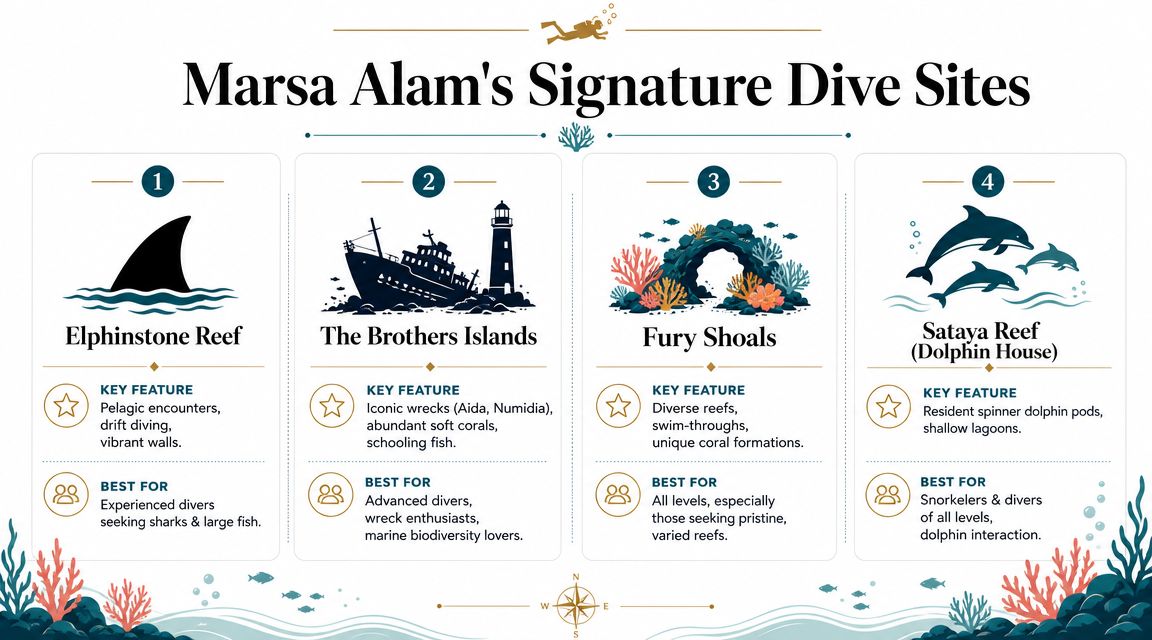
Marsa Alam Dive Site Comparison
| Dive Site | Best For | Required Certification | Key Encounters |
|---|---|---|---|
| Elphinstone Reef | Experienced divers who enjoy exposed reef profiles | Advanced Open Water, commonly with substantial logged experience | Pelagics, reef walls, strong current diving |
| Fury Shoals | Divers wanting reef variety without only hard-core conditions | Varies by exact site, often suitable across levels with proper briefing | Coral gardens, swim-throughs, varied reef life |
| Sataya Reef | Mixed groups, easy-going divers, snorkel-and-dive trips | Accessible to all levels depending on activity | Dolphin encounters, shallow reef scenery |
| The Brothers Islands | Advanced divers and liveaboard-focused travelers | Advanced profile, usually for experienced divers only | Walls, wreck interest, schooling fish, pelagic potential |
Elphinstone Reef
Elphinstone is the site everyone asks about first. For the right diver, it earns that reputation.
It is an exposed offshore reef with fast decisions, prompt descents, and little patience for hesitation. Current can shift, the blue can pull attention away from the reef, and the dive rewards people who can control depth and trim without effort. Divers who are newly certified at Advanced level often assume the card alone is enough. It usually is not.
A practical local rule helps here. If a diver still struggles on drift dives, still chases the group up and down the water column, or burns gas under stress, Elphinstone should wait. A relaxed pass at Abu Dabbab or a well-chosen Fury site gives more pleasure than a tense Elphinstone drop.
The payoff is real. Strong walls, pelagic potential, and a proper Red Sea offshore feel. The trade-off is that some days the site is more work than fun for people who are not ready.
A quick look at the site gives a useful feel for the terrain and why it demands respect.
Fury Shoals
If I am planning a week for recreational divers with mixed confidence levels, Fury Shoals wins more often than the headline sites.
That is because Fury is an area, not a single personality. Some reefs are gentle and forgiving. Others give enough structure, swim-throughs, and fish life to keep experienced divers interested. It suits couples and small groups where one diver wants easy profiles and the other still wants quality reef diving.
This is also where many travelers get better value from a land-based schedule or from combining diving with other Marsa Alam tours and day trips. You are not building the whole holiday around one exposed offshore drop.
Who tends to do well at Fury Shoals:
- Open Water divers with decent buoyancy who want to build experience calmly
- Advanced divers who care more about reef quality than bragging rights
- Underwater photographers who prefer coral, light, and longer relaxed observation
- Mixed-ability groups that need flexibility without wasting the day
The only real downside is psychological. Some travelers want a trophy site to talk about. Fury Shoals is less dramatic in name, but week after week it gives more divers better underwater time.
Sataya Reef
Sataya is easy to misunderstand. Divers hear "dolphins" and file it under soft or touristy. That misses the point.
Sataya is one of the best choices for families, newer divers, snorkelers, and mixed groups who want a marine-life day without technical pressure. The reef is accessible, the day is usually social, and the experience can be memorable even for people who are not chasing depth or current. For many holidaymakers, that is exactly the right call.
For experienced divers, the question is simple. Are you looking for challenge or enjoyment? If you want walls, exposure, and a stricter dive rhythm, Sataya will probably feel light. If you want an easy day with a genuine chance of wildlife encounters and low stress in the water, it can be excellent.
We local guides use Sataya carefully. It is not where we send advanced divers who want hard diving. It is where we send people who want a good day that matches their actual comfort level.
The Brothers Islands
The Brothers are serious diving. They are also the site pair that gets oversold to people who like the idea more than the actual experience.
These islands suit divers who are already comfortable with blue water, current, negative entries when needed, and the discipline that remote offshore diving demands. They also suit divers who know they can handle boat life well. Seasickness, fatigue, and sloppy basic skills show up fast on this kind of trip.
For the right diver, the Brothers are world-class. Wall diving, strong fish life, exposed conditions, and the sense that you are far from the easy circuit. For the wrong diver, the trip turns into stress management.
The mistake is treating the Brothers as a normal Marsa Alam add-on. In practice, they make more sense for experienced divers already leaning toward a liveaboard-style week or a very specific advanced plan. A diver still refining buoyancy, still nervous in open water, or still inconsistent with gas control should leave this one for a later trip.
That is the core rule across Marsa Alam. Choose the site that fits how you dive now, not the version of yourself you hope to be by day three.
Liveaboard vs Land Based The Two Ways to Dive Marsa Alam
Most planning mistakes happen here, not underwater. People choose the wrong format for the holiday they want, then blame the destination.
The split is usually simple. If your priority is flexibility, comfort, and diving that can be scaled up or down, stay land based. If your priority is immersion and access to more remote, advanced-focused routes, look hard at liveaboards. This matters even more because easy shore options such as Abu Dabbab suit all levels, while advanced-only offshore sites such as Elphinstone often drive divers toward boat-based planning, as explained in this breakdown of Marsa Alam diving styles and site access.
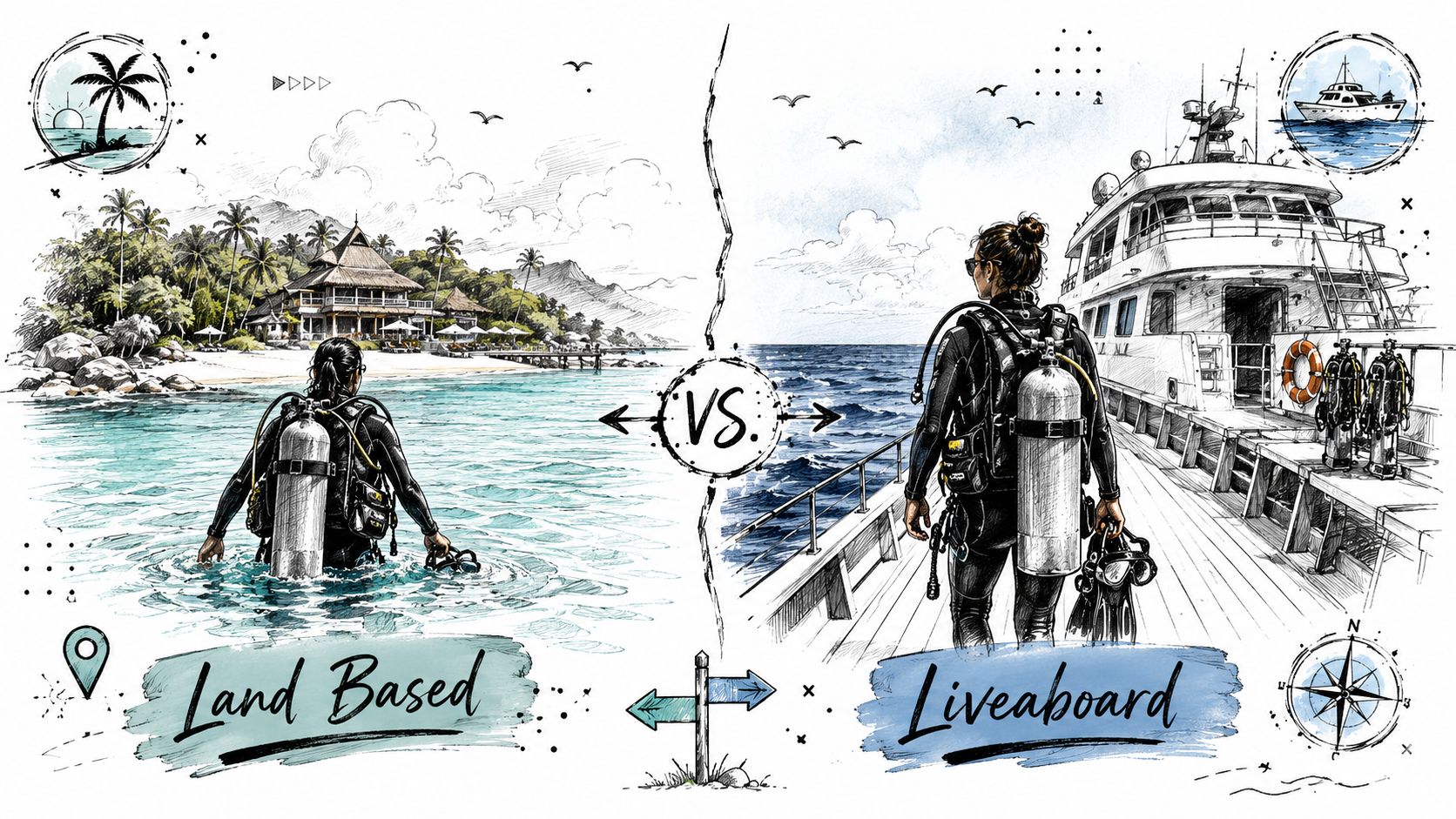
If you're comparing trip formats and activity options around the coast, these Marsa Alam tours and day trips show the kind of land-based flexibility many travelers want around their dive schedule.
Who should stay land based
Land-based Marsa Alam works best for people who don't want every day controlled by a boat itinerary. You can dive, skip a day if weather turns, rest properly, and make room for non-diving partners or family members.
It also suits:
- Newer certified divers: House reefs and easier day trips let you build confidence.
- Couples with different priorities: One can dive while the other relaxes or snorkels.
- Photographers who like repetition: Diving the same reef more than once often improves results.
- Divers who value routine: Better sleep, easier gear management, and less motion fatigue.
The downside is access. Some of the most talked-about offshore routes aren't the same from a resort base. You can still have an excellent trip, but it may be a different trip from the one you imagined when reading liveaboard reports.
Who should book a liveaboard
A liveaboard makes sense when the boat is the holiday, not just transport. You wake up on site, dive with other committed divers, and spend your energy on diving instead of transfers.
That works best for:
- Advanced divers chasing exposure and offshore sites
- Groups with the same diving appetite
- Travelers who don't mind compact cabins and boat rhythm
- Divers who want several demanding days in a row
Choose a liveaboard because you want the diving style, not because you think it sounds more serious.
What doesn't work is booking one for status. A lot of divers would have a much better week on land with selected boat days, especially if they need recovery time between stronger dives or if their partner doesn't dive at all.
There's also a social trade-off. Liveaboards can be fantastic if you enjoy a group of like-minded divers. They can feel claustrophobic if you need personal space or quiet evenings. We've seen both outcomes many times.
How to Plan Your Marsa Alam Diving Trip
The first thing to understand is that Marsa Alam rewards clear planning. Not rigid planning, but smart planning. The people who enjoy it most usually arrive knowing whether they want easy shore diving, advanced offshore diving, or a mix.
For advanced divers, the area also supports more than standard recreational profiles. Red Sea Diving Safari identifies Marsa Shagra as the first TDI facility in the southern Red Sea, which is why Marsa Alam should be taken seriously as a technical-diving-capable base in the southern Red Sea.
When to go and what conditions to expect
Season matters less here in the broad sense than many travelers expect. Marsa Alam is one of the more reliable year-round Red Sea options for diving, but the type of trip you'll enjoy most can still vary by month, sea state, and your comfort level.
A practical consideration is this:
- Warm-water holiday divers: You can usually build a comfortable trip in most seasons.
- Wildlife-focused travelers: Ask operators what's been active recently instead of relying on old trip reports.
- Advanced offshore divers: Stay flexible. The right site on the wrong day becomes the wrong site.
We local guides always tell divers the same thing. Don't plan around guarantees. Plan around probabilities, sea conditions, and your real skill level.
Trip planning by length of stay
A short stay needs discipline. A longer stay lets you build intelligently.
For a 3-day trip Choose simplicity. One or two easy-to-moderate dive days and one day with room to rest or snorkel works far better than trying to cram every famous name into a rushed schedule.
For a 5-day trip This is a strong sweet spot for many divers. You can combine house reef or nearshore diving with one or two more ambitious boat days, then leave margin for weather, fatigue, and surface interval sanity.
For a 7-day trip A week gives you enough space to dive properly rather than greedily. That means you can balance easier reef enjoyment with a serious site or offshore day, then still have enough energy to appreciate the later dives instead of dragging yourself through them.
The best itineraries in Marsa Alam build from easy to demanding, not the other way around.
A few planning habits work especially well:
- Book for your weakest diver, not your strongest one. Mixed groups function better that way.
- Leave one flexible day. Weather, fatigue, and sea state always have the final say.
- Be honest about recovery. Repetitive dives and travel fatigue can catch people fast in the Red Sea.
- Ask operators how they group divers. A strong diver and a nervous diver on the same plan often means nobody gets the best version of the day.
If you have technical training, ask detailed questions early. Gas options, support procedures, and profile limits need proper conversation before arrival, not at the dive center desk.
Choosing a Safe and Reputable Dive Operator
You feel the difference before you hit the water. One boat leaves the marina with a calm, orderly crew, clear grouping, and a guide who asks about your last ten dives. Another loads fast, gives a generic briefing, and promises Elphinstone to everyone on board. In Marsa Alam, those two operators can be selling the same destination and delivering completely different levels of safety.
This is where experience on the ground matters. We local guides do not judge a dive center by its social media or the size of its boat. We judge it by how it matches divers to sites, how it reacts when conditions change, and whether the staff are willing to disappoint a guest in order to make the right call.
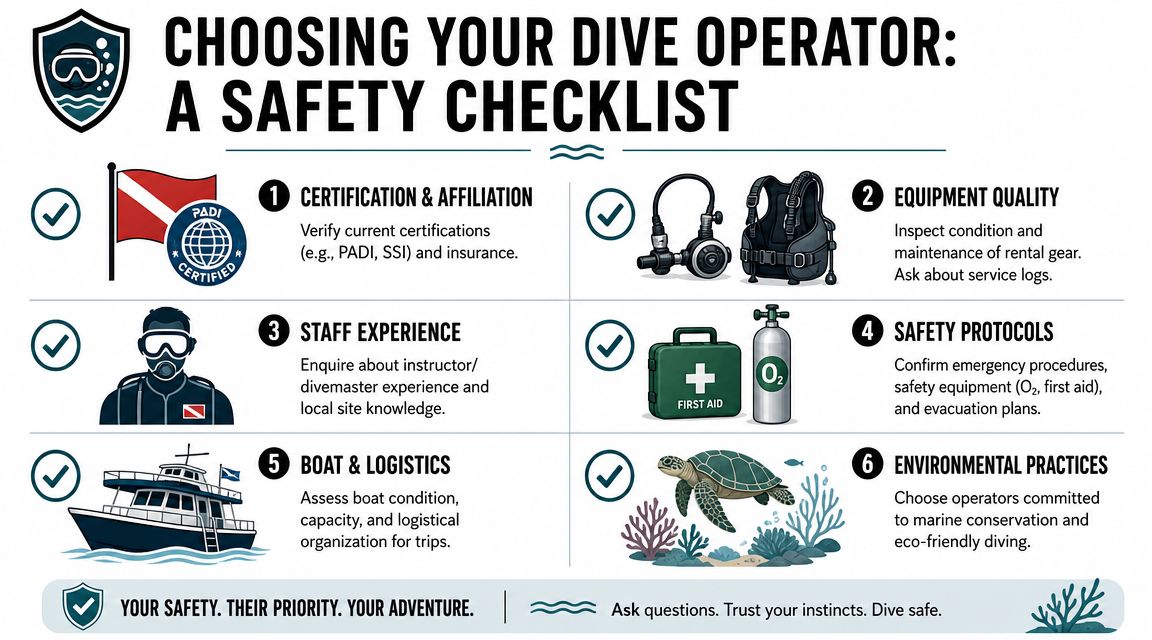
What to ask before you book
Skip broad questions. Ask the ones that reveal how the operator runs the day.
- How do you group divers? The right answer mentions certification, recent experience, air use, confidence in current, and comfort from RIB or zodiac pickup if relevant.
- Who chooses the site on the day? Good operators leave that decision to the dive manager, skipper, and guide team based on sea state and the group in front of them.
- What does the briefing include? It should cover entry, exit, max depth, current direction, reef orientation, lost buddy procedure, and pickup plan.
- What safety kit is on the boat? Ask about oxygen, first aid, communications, and who on board is trained to use them.
- How is rental gear maintained? A serious center can explain its service routine without sounding defensive.
- What happens if I am not right for a famous site? The best answer is simple. They offer an alternative instead of pushing you in.
That last question tells you a lot.
A good operator also asks questions back. If nobody asks about your certification level, your logged dives, your last dive date, or whether you are comfortable in current, they are selling seats, not planning dives.
Signs of a professional operation
The strongest dive centers in Marsa Alam are usually less theatrical than visitors expect. The boat may not be flashy. The process is what stands out.
You see it in small details. Cylinders are analyzed and labeled properly when needed. Roll call is consistent. Briefings are site-specific. The guide explains why the plan changed instead of pretending conditions are fine. Divers with very different skill levels are split, even if that means more work for staff.
Good operators also build around the diver in front of them. An Open Water diver with twenty easy resort dives should not be treated like an Advanced diver who is comfortable with blue water descents and negative entries. A center that understands this will usually have better route planning across the whole week, not just on one boat day.
If you are packing for a mixed trip with diving, boat days, and shore time, this Red Sea packing guide for Egypt travelers helps with the non-diving basics.
Warning signs we'd walk away from
Some problems are obvious. Frayed straps, half-working inflators, rushed paperwork, or a briefing you can barely hear are enough on their own.
The more serious red flags are often operational. Everyone gets offered the same itinerary. Nobody checks recent experience. The guide talks about a difficult site as if it is guaranteed, regardless of wind or current. Questions get brushed aside with vague confidence.
A few warnings matter more in Marsa Alam than in easier resort areas:
- Famous sites are used as sales bait. Elphinstone is the classic example. It can be excellent, but it is not the right dive for every certified diver.
- The briefing stays generic even after the site is confirmed. That usually means the guide is repeating a script, not preparing the group.
- There is pressure to "just try it." Good staff know the difference between encouraging a diver and overruling their hesitation.
- The operator cannot explain pickup procedures clearly. On exposed sites, that is not a minor detail.
- Mixed-level groups are kept together for convenience. The weaker diver gets stressed, and the stronger diver gets a poor dive.
Overhyped operators usually have one thing in common. They sell the postcard version of Marsa Alam. The world-class operators sell the dive that fits your skill level that day.
The best compliment you can pay a center here is not "they took us everywhere." It is "they chose the right sites for our ability, and every decision on the boat made sense."
Diver's Checklist and Conservation Best Practices
A good Marsa Alam trip usually comes down to two things. Bring the gear that makes you self-sufficient, and dive in a way that leaves the reef exactly as you found it.
What to pack for Marsa Alam diving
Your operator can supply the basics, but relying on rental for everything rarely gives the smoothest week.
Use this as a practical base list:
- Core personal kit: Mask, computer, fins, and whatever exposure suit you know you're comfortable in.
- Safety essentials: SMB and an audible signaling device if you use one regularly.
- Small utility items: Torch, save-a-dive bits, and any straps or mouthpieces you don't want to replace on holiday.
- Surface comfort: Hat, sun protection, hydration gear, and dry clothes for windy boat rides.
- Trip basics beyond diving: This Egypt packing guide for Red Sea travelers is useful if you want a wider holiday checklist as well.
If you take medication, pack it in your carry-on. Don't trust checked baggage with anything you need for the first dive day.
How to dive these reefs without damaging them
The best conservation divers aren't the ones who talk about conservation most. They're the ones who control their body position, finning, and distance instinctively.
Keep the rules simple:
- Don't touch anything: Not coral, not turtles, not resting dolphins, not the bottom for balance.
- Fix buoyancy before chasing sightings: A rushed diver damages more reef than they realize.
- Don't feed marine life: It changes behavior and turns wild encounters into bad tourism.
- Respect guide spacing rules: They're there to protect both animals and divers.
- Decline the crowd if needed: Sometimes the most responsible choice is skipping a chaotic in-water interaction.
Marsa Alam still feels special because parts of it remain relatively intact. Divers help keep it that way, or they help ruin it. There isn't much middle ground.
Marsa Alam Diving FAQs
Is Marsa Alam good for beginners?
Yes, parts of it are. The mistake is assuming the whole destination is beginner territory. Some shore and easy reef dives suit newer divers very well, while offshore sites are much better left for experienced divers.
Can I guarantee dolphins or dugongs?
No. You can improve your chances by choosing the right trip and season, but nobody reputable should promise wild animal sightings.
Is Marsa Alam better as a dive-only holiday?
For many divers, yes. But it also works for mixed groups if the non-divers are happy with beach time, snorkeling, or relaxed day excursions rather than busy nightlife.
Should I choose Marsa Alam or a liveaboard route elsewhere in Egypt?
Choose Marsa Alam if you want a southern Red Sea feel with the option to scale effort up or down. Choose a dedicated liveaboard if your whole trip is about remote offshore diving and you're comfortable living on a boat.
What if my partner doesn't dive?
That's common. Land-based Marsa Alam is usually the better answer because it gives both people a decent holiday instead of forcing one person into a dive schedule they don't enjoy.
If you want help building a Marsa Alam trip that matches your certification level, travel style, and the kind of Red Sea experience you're after, Oh Yes Tours can connect you directly with local people who know the coast, the logistics, and what's worth doing. No middleman, no inflated package talk. Just practical Egypt planning from guides who live here. Egypt? Oh Yes!