Egypt travel
Egyptian Belly Dancing: Discover Authentic Performances
Discover the mesmerizing world of authentic Egyptian Belly Dancing. Our guide helps you find the best performances and understand their cultural significance

By Mohamed Hassan · Senior Local Guide · 12 years
Most travel advice about Egyptian belly dancing gets the order wrong. It tells you to book the first Nile dinner show you see, arrive hungry, clap politely for ten minutes, and tick the box. You can do that. Plenty of visitors do. But if that's your only experience, you'll leave Egypt thinking this art is all sparkle, buffet lighting, and a short routine squeezed between dessert and the singer.
That version exists, but it isn't the whole story. The form Egyptians value is deeper, more musical, more grounded, and much harder to fake than many visitors realize. When the dancer understands the orchestra, when the room is watching the hips answer the tabla, when the movement comes from the torso instead of big dramatic posing, you're not watching a tourist add-on. You're watching a real Egyptian performance tradition.
If you want the glossy postcard version, it's easy to find. If you want the version locals respect, you need a bit more context and a better eye.
Table of Contents
- Beyond the Dinner Show What Egyptian Belly Dancing Truly Is
- The Soul of the Dance Understanding Raqs Sharqi and Baladi
- How to Spot an Authentic Performance A Viewer's Guide
- Where to See Belly Dancing in Cairo Luxor Hurghada and Sharm
- The Perfect Belly Dance Experience for Your Travel Style
- How to Book Shows and Private Lessons Safely
- Frequently Asked Questions about Belly Dancing in Egypt
Beyond the Dinner Show What Egyptian Belly Dancing Truly Is
A standard hotel show usually follows a familiar pattern. Loud entrance music. Quick costume reveal. Big smiles for the room. A few crowd-pleasing shimmies. Then it's over before the audience has had time to understand what they were looking at.
That performance can still be fun. It just shouldn't be mistaken for the full artistic picture.
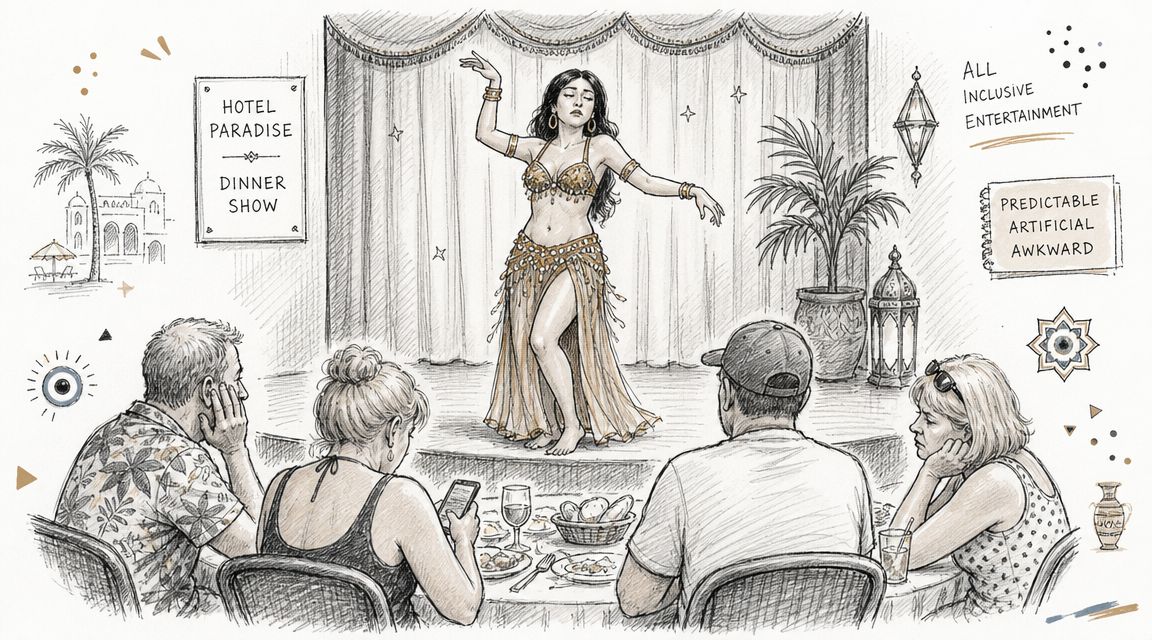
Egyptian belly dancing is a living Egyptian art form, not only a tourist entertainment slot. At its best, it carries social memory, urban style, musical intelligence, and a very Egyptian sense of emotional presence. A strong dancer doesn't just execute moves. She listens, responds, teases the rhythm, and holds the room without needing frantic speed.
What travelers often miss
Visitors often arrive looking for “belly dance” as if it were one universal package. That's where confusion starts. In Egypt, the same broad label can cover a polished stage act, a social style seen at celebrations, a resort-friendly adaptation, or a folkloric-flavored number shaped for mixed audiences.
A traveler who only sees the buffet version often says, “It was entertaining.” A traveler who catches a proper performance usually says, “I didn't expect it to feel so musical.”
Practical rule: Judge the show by the dancer's relationship to the music, not by sequins, props, or how loudly the audience cheers.
What the real experience feels like
Authentic Egyptian belly dancing has weight to it. The dancer looks connected to the floor. The torso leads. The hips speak clearly. Even stillness matters. There's glamour, yes, but there's also restraint, timing, and confidence.
That's why I always tell travelers not to ask only, “Where is the show?” Ask, “Who is the audience for this show?” If the answer is “mainly tour groups who want something quick after dinner,” keep your expectations realistic. If the answer is “people who came specifically to watch the performance,” your chances improve immediately.
The Soul of the Dance Understanding Raqs Sharqi and Baladi
The most useful thing a traveler can learn is this. Egyptian belly dancing is not one single style.
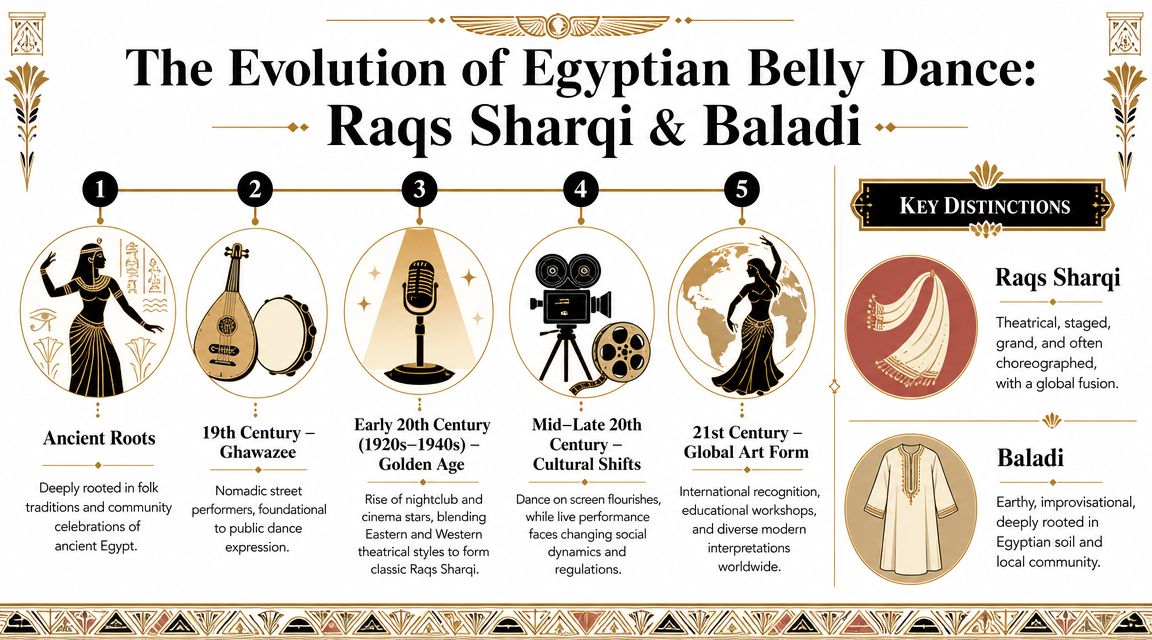
The historical split matters. As Al Jadid's overview of the dance's development notes, Egyptian belly dance, also called raqs sharqi, has roots reaching back at least to ancient Egypt, with female dancers shown on temple and tomb walls. In modern public life, the dance became especially visible from the 1920s, when it moved beyond weddings into dedicated cabarets and nightclubs. That shift matters because the older baladi social form remained part of family celebrations, while staged sharqi developed for urban performance spaces.
Raqs Sharqi on stage
Raqs Sharqi is the theatrical form most travelers hope to see when they imagine a classic Egyptian performance. This is the cabaret and nightclub lineage. It belongs to the city, the stage, the orchestra, and the cultivated star presence that came with modern entertainment venues.
When it's done well, it feels expansive without becoming generic. The costume, orchestra, entrance, and polish all support the performance, but the dance still needs Egyptian musicality underneath the glamour.
Baladi in social life
Baladi sits closer to everyday Egyptian feeling. It carries the flavor of local celebrations, family spaces, and grounded social movement rather than stage architecture. It can look simpler to an untrained eye, but it's often harder to fake because it needs honesty and internal rhythm.
A traveler expecting constant spectacle may overlook baladi. That would be a mistake. Some of the most Egyptian moments happen when the dance feels earthy, direct, and almost conversational.
| Form | Best understood as | Typical setting | Feeling |
|---|---|---|---|
| Raqs Sharqi | Staged performance art | Cabarets, nightclubs, formal shows | Glamorous, musical, theatrical |
| Baladi | Social and culturally rooted dance | Weddings, family celebrations, local gatherings | Grounded, intimate, earthy |
The easiest way to think about it is simple. Sharqi performs outward to the room. Baladi grows upward from the floor and inward from lived culture.
For travelers, the distinction changes how you book. If you want the full classic show, look for venues that take the performance seriously as an evening event. If you want a more local texture, pay attention to smaller settings and social context, not just famous hotel names.
How to Spot an Authentic Performance A Viewer's Guide
A lot of visitors assume authenticity means older music, a traditional costume, or a more serious facial expression. It doesn't. You can watch a dancer in a luxurious setting and still be seeing excellent Egyptian style. You can also watch a “traditional” themed show and see movement that has very little Egyptian character.
The body tells the truth first.
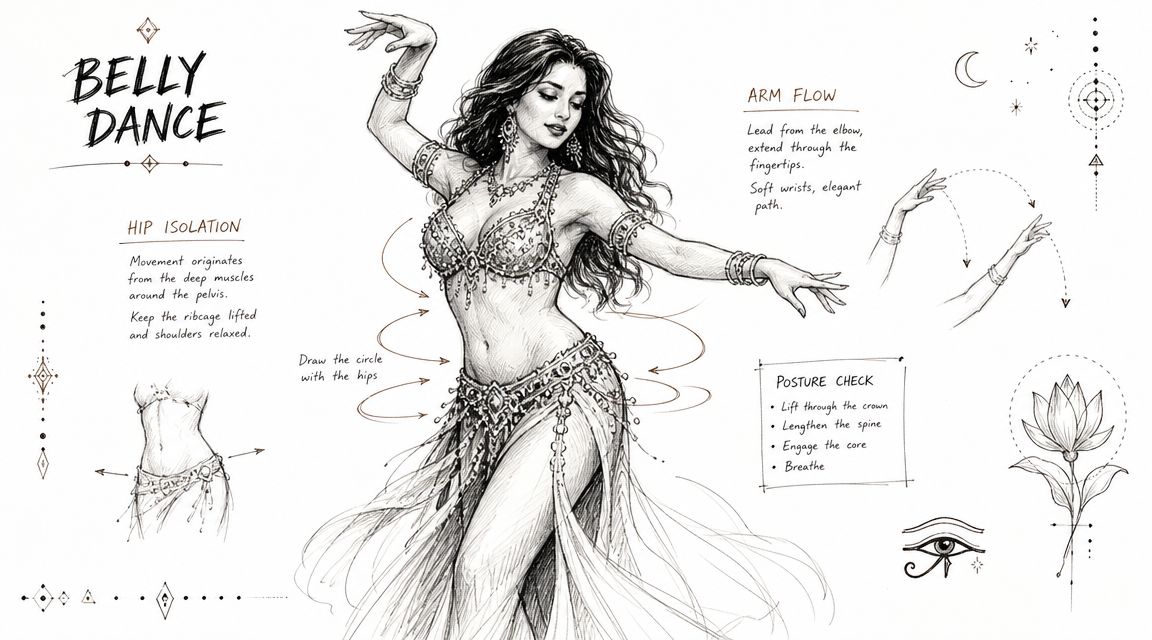
According to this technical discussion of Egyptian raqs sharqi style, Egyptian raqs sharqi is defined by grounded footwork and torso-led isolations. Dancers typically stay on the balls of the feet with soft, never-locked knees, and they generate movement through intricate hip articulations and shimmies. The same discussion explains why this matters stylistically. Egyptian movement emphasizes “inward” motion from the core, so a dancer who relies on upright posture or Western-style ballet carriage will look off to trained eyes.
What the body should be doing
Look first at the lower body. The feet should feel connected to the floor, not prancing over it. The knees stay soft. The hips and torso do the main work.
Then watch the upper body. In strong Egyptian belly dancing, the arms support the dance. They don't dominate it. If the arms are always large, extended, and decorative while the core stays comparatively inactive, the style is drifting away from Egyptian aesthetics.
A quick checklist helps:
- Grounded stance: The dancer looks rooted rather than floaty.
- Torso-led movement: The center initiates the phrase.
- Hip clarity: Circles, drops, accents, and shimmies read clearly without looking forced.
- Musical response: The dancer seems to answer the orchestra, not count through a preset routine.
- Controlled changes: Speed rises and falls with intention.
What often gives a tourist version away
The tourist version often leans on surface signals. More veil. More posing. Bigger smiles for every table. Sometimes more traveling steps and dramatic presentation than actual Egyptian technique.
That doesn't make it worthless. It just means you should call it what it is. Entertainment designed for broad appeal.
A useful comparison is singing. A folk singer and an opera singer both sing well, but they use the body differently and serve different spaces. Egyptian style has its own physical grammar. Once you see it, you can't unsee it.
Watch a performance clip with that in mind:
If the dancer's center stays alive even during simple steps, you're probably watching someone who understands the form. If the show depends mostly on costume effects and audience teasing, it may be pleasant but thinner.
Where to See Belly Dancing in Cairo Luxor Hurghada and Sharm
Where you watch matters almost as much as who you watch. The same dance can feel electric in one setting and forgettable in another.
Travelers often ask for the “best” city. That's the wrong question. The better question is which setting matches your priorities: stage quality, convenience, atmosphere, family comfort, or cultural depth. If you're building a broader itinerary, this guide to things to do in Egypt helps place a dance night within the rest of your trip.
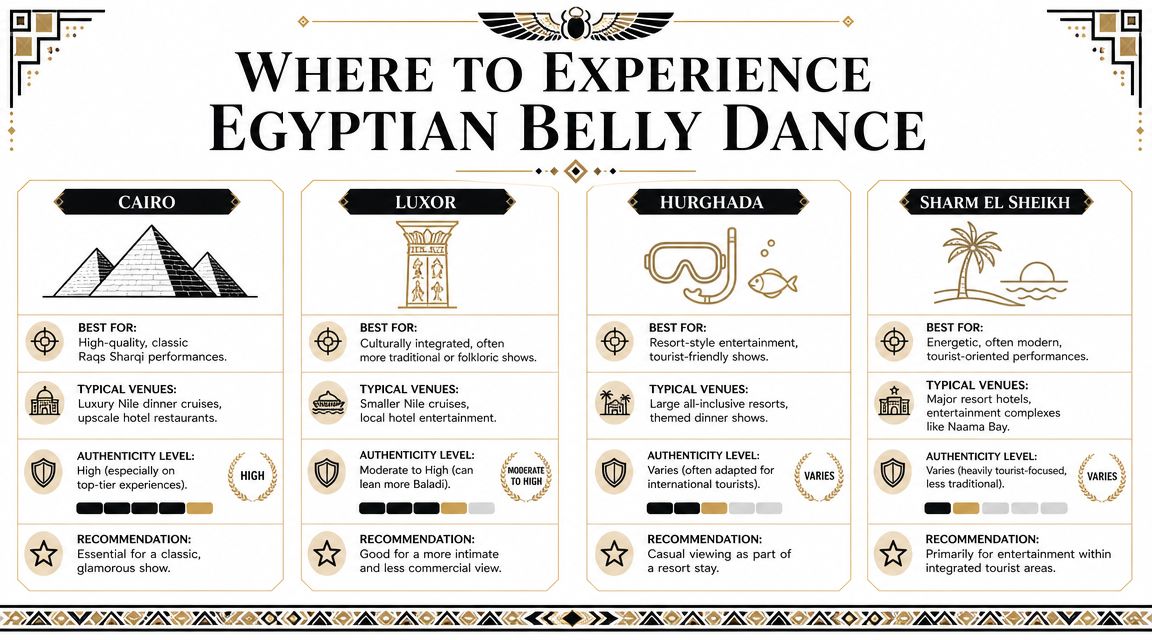
Cairo for the strongest stage tradition
Cairo is the city for travelers who want the most convincing raqs sharqi experience. The performance ecosystem is larger, the audience often knows what it's watching, and the standard for stage presence is usually higher. High-end Nile dinner cruises can be enjoyable, but the quality varies a lot. Some feel elegant and well-paced. Others feel mass-market and rushed.
If you're choosing in Cairo, prioritize venues known for live entertainment rather than only buffet volume or river views. A serious dance night is best for couples, adults, and travelers who don't mind a later evening.
Best fit in Cairo
- Classic seekers: Choose a proper evening performance over a generic cruise package.
- Music lovers: Live musicians make a big difference.
- Travelers who dislike crowds: Avoid heavily promoted bus-group options.
Luxor for a softer cultural setting
Luxor rarely competes with Cairo in pure stage intensity, and that's fine. Its strength is context. Many visitors are already in a more reflective mood after temples, tombs, and Nile views. In that rhythm, a smaller show can land well.
Shows in Luxor often work best when they're part of a thoughtfully chosen Nile cruise or a good hotel evening, not when they're sold as a headline spectacle. Expect a gentler frame, sometimes with more folkloric flavor and less nightclub energy.
A good Luxor performance can feel more intimate than Cairo. A bad one can feel like filler. Venue choice matters more than city branding.
Hurghada and Sharm for convenience over depth
Hurghada and Sharm El Sheikh are practical choices, not usually the strongest artistic ones. Resort shows are built for mixed international audiences, easier schedules, and family-friendly nights. That means convenience goes up, but local character may thin out.
In both cities, some hotels do a perfectly enjoyable evening program. Just don't arrive expecting the same atmosphere you'd chase in Cairo. For many travelers, that trade-off is acceptable.
| Location | What it does well | Main trade-off | Best for |
|---|---|---|---|
| Cairo | Strongest classic stage environment | Later nights, more planning | Couples, culture-focused travelers |
| Luxor | Good atmosphere in the right setting | Less consistent as a headline show | Cruise guests, slower itineraries |
| Hurghada | Easy, accessible resort entertainment | Often shaped for tourists first | Families, beach holiday visitors |
| Sharm El Sheikh | Lively resort nightlife | Less traditional character | Casual viewers, short stays |
The tourist trap version usually has one or more of these signs:
- Hard sell at the hotel desk: If the pitch is louder than the artistic description, be careful.
- No clear venue details: If nobody can tell you who performs or what kind of audience attends, expectations should stay low.
- Overstuffed evening program: If the dance is one tiny segment inside a long variety show, it may not be the reason to book.
- Only “VIP” language: Fancy wording doesn't guarantee a good performance.
The Perfect Belly Dance Experience for Your Travel Style
A smart choice depends less on the dance itself and more on how you travel. Some people want romance and polish. Others want ease, early finish times, or a chance to learn movement instead of only watching it. If your trip already leans premium, these luxury Egypt tours are the kind of itinerary where a good performance night fits naturally.
Quick match table
| Traveler Type | Best Option | Pros | Cons |
|---|---|---|---|
| Couples | Elegant Cairo evening or refined Nile dinner show | Atmospheric, memorable, dress-up friendly | Can run late, quality varies by venue |
| Families | Resort or hotel show in Hurghada | Easy logistics, simple evening, kids can enjoy music and costume | Often less nuanced artistically |
| Solo travelers | Small-group show or private lesson | Flexible, social, easier to ask questions | A poor venue choice feels more obvious when alone |
| Retirees | Comfortable seated show through a premium itinerary | Less hassle, smoother transport, easier pacing | May be less spontaneous |
What works best for each traveler
Couples usually do best with a setting that feels like an event, not a side activity. In Cairo, that means choosing a venue where the performance is central to the night. On a Nile cruise, it means selecting one with a calmer atmosphere and not treating the show as background noise while everyone queues for dessert.
Families often need something different. A child usually won't care whether the technique is classically Egyptian. The child cares whether the room is welcoming, the music is lively, and the evening ends before exhaustion takes over. In Hurghada, resort entertainment often wins on convenience.
Solo travelers have the widest range of good options. If you enjoy nightlife, a quality show can be a strong evening out. If you're more curious than social, a private lesson can be the richer experience. You stop being only a spectator and start feeling the mechanics of Egyptian movement in your own body.
Retirees and slower-paced travelers often enjoy a dance night most when transport, seating, and timing are sorted in advance. The mistake here is choosing the “most famous” option rather than the easiest comfortable option. A polished, well-run evening beats a chaotic hot spot every time.
A few honest trade-offs
Not every traveler should chase “maximum authenticity.” Sometimes the right answer is the show that fits your energy level.
- Choose Cairo if you care most about the stage tradition and can handle a fuller evening.
- Choose Luxor if you want the dance folded into a broader cultural trip.
- Choose Hurghada or Sharm if your holiday is mainly beach-based and you want one easy night out.
- Choose a lesson if you'd rather understand the form than watch a crowded program.
The best belly dance experience is the one that fits your trip well enough for you to stay relaxed and pay attention.
How to Book Shows and Private Lessons Safely
Booking well starts with one question: are you buying a dance performance, or are you buying a tourist package that happens to include dancing? Those are not the same thing.
The safest route is always clarity. You want to know the venue type, transport plan, start time, whether dinner is included, and whether the evening is mainly for international tour groups or a mixed crowd. If you're weighing practical concerns before committing, this overview of travel safety in Egypt is a useful starting point.
How to choose a show without getting the watered-down version
Ask direct questions before paying. Good operators answer them easily. Weak sellers dodge them.
Use this quick filter:
- Ask who the show is for: A room built only for fast turnover usually feels that way.
- Ask about the format: A dedicated performance is different from a long variety night with a short dance slot.
- Ask about transport: Late returns and vague pickup plans are where hassle starts.
- Ask about seating: Bad sightlines can ruin even a strong dancer.
If you can't get straight answers, skip it.
Private lessons and basic etiquette
Private lessons are often the most authentic entry point for travelers who want more than photos. A good teacher will focus on posture, rhythm, grounded movement, and musical response. That gives you a better understanding of Egyptian belly dancing than a random resort show ever could.
For etiquette, keep it simple:
- Dress respectfully: Comfortable clothes are fine, but this is still Egypt.
- Follow photo rules: Some venues allow photos freely. Others prefer no flash or no filming. Ask first.
- Show appreciation appropriately: Warm applause is always right. In some environments, local customs around tipping may differ, so watch the room and follow the venue's norms.
- Don't interrupt the performance: If you want a selfie, wait until the dancer is clearly finished and available.
A final practical point. Don't book based only on a glossy poster or one dramatic costume photo. A reliable evening comes from the venue, the audience, and the planning around it as much as from the dancer herself.
Frequently Asked Questions about Belly Dancing in Egypt
Is it safe for a solo female traveler to attend a show?
Usually yes, if you choose a reputable venue, arrange clear transport, and avoid vague last-minute invitations from strangers. Hotel-based shows and well-organized evenings are the simplest option.
Is belly dancing appropriate for children to watch?
Often yes in resort and hotel settings. Family-friendly shows are common in beach destinations. Late-night club-style venues in Cairo are a different environment and are better for adults.
Should I tip the dancer?
Applause is always appropriate. Beyond that, customs vary by venue. If you're unsure, ask staff discreetly or observe what local guests do.
Can I take photos or video?
Sometimes. Some places are relaxed about phone photos, while others are stricter, especially if flash or long filming gets distracting. Always ask before recording.
If you want an Egyptian belly dancing experience that feels well-chosen instead of random, Oh Yes Tours can help you build it into a wider Egypt trip with local guidance, honest advice, and the kind of planning that keeps the evening smooth. Egypt? Oh Yes!