Egypt travel
Your Egypt Itinerary 7 Days: Unforgettable 2026 Adventure
Craft your perfect egypt itinerary 7 days with our expert 2026 guide. Discover day-by-day plans, custom options for couples & families, and insider booking

By Mohamed Hassan · Senior Local Guide · 12 years

You've probably done what most first-time Egypt travelers do. Open one tab for Cairo, another for Luxor, a third for Nile cruises, then fall into forum threads arguing about trains, internal flights, Abu Simbel, guides, and whether one week is enough at all.
That confusion is normal. Egypt is easy to over-plan and just as easy to plan badly.
The best week in Egypt isn't the one that tries to do everything. It's the one that matches your pace, your interests, and your tolerance for early mornings, heat, and hotel changes. For most travelers, the smartest starting point is a classic backbone, then a few careful swaps. If you're still deciding when to go, this short guide on the best time to visit Egypt helps you line up weather and sightseeing comfort before you lock anything in.
Table of Contents
- Planning Your 7 Days in Egypt Without the Stress
- The Core Itinerary A 7-Day Pharaonic Journey
- Customize Your Itinerary One Trip Five Ways
- Essential Logistics Budget Transport and Booking
- Insider Tips Packing Safety and Culture
- Frequently Asked Questions About a 7 Day Trip
Planning Your 7 Days in Egypt Without the Stress
You land in Cairo full of energy, open three saved itineraries, and suddenly the trip starts to feel harder than it should. One plan tells you to add Aswan no matter what. Another pushes a Nile cruise. A third squeezes in overnight trains and four hotel changes. That is how a good holiday turns into a week of packing, checking out, and rushing.
The first decision is not which temple comes on which day. It is what kind of week you want.
A couple celebrating a honeymoon, parents traveling with children, a solo traveler who wants freedom with backup, and a retiree who values comfort will not enjoy the same pace. Egypt rewards clear priorities. In seven days, every added stop costs time, energy, and usually one good evening that could have been spent on a rooftop in Cairo or by the Nile in Luxor.
From years of building these trips, the classic first-timer shape is clear. Travelers usually start with Cairo, then continue to Luxor, and sometimes add Aswan if they are happy with early starts and more transfers. That route exists for a reason. It covers the names people dream about before they arrive. But the best version is rarely the most crowded version.
Timing matters too. Heat, daylight, and domestic flight schedules all change how comfortable this plan feels, so it helps to check the best time to visit Egypt for a 7-day trip before locking in the order.
My advice is simple. Start with one strong backbone, then adjust it to your travel style. That is why I prefer a private, flexible plan over a fixed group schedule. If you love archaeology, we can protect more museum and temple time. If you want a lighter pace, we cut a transfer instead of forcing it. If your child is tired or you want an extra sunset felucca ride, the day can bend without the whole trip falling apart.
That is the difference between seeing Egypt and enjoying it.
The Core Itinerary A 7-Day Pharaonic Journey
Seven days in Egypt goes fast. The travelers who enjoy it most usually do less, not more.
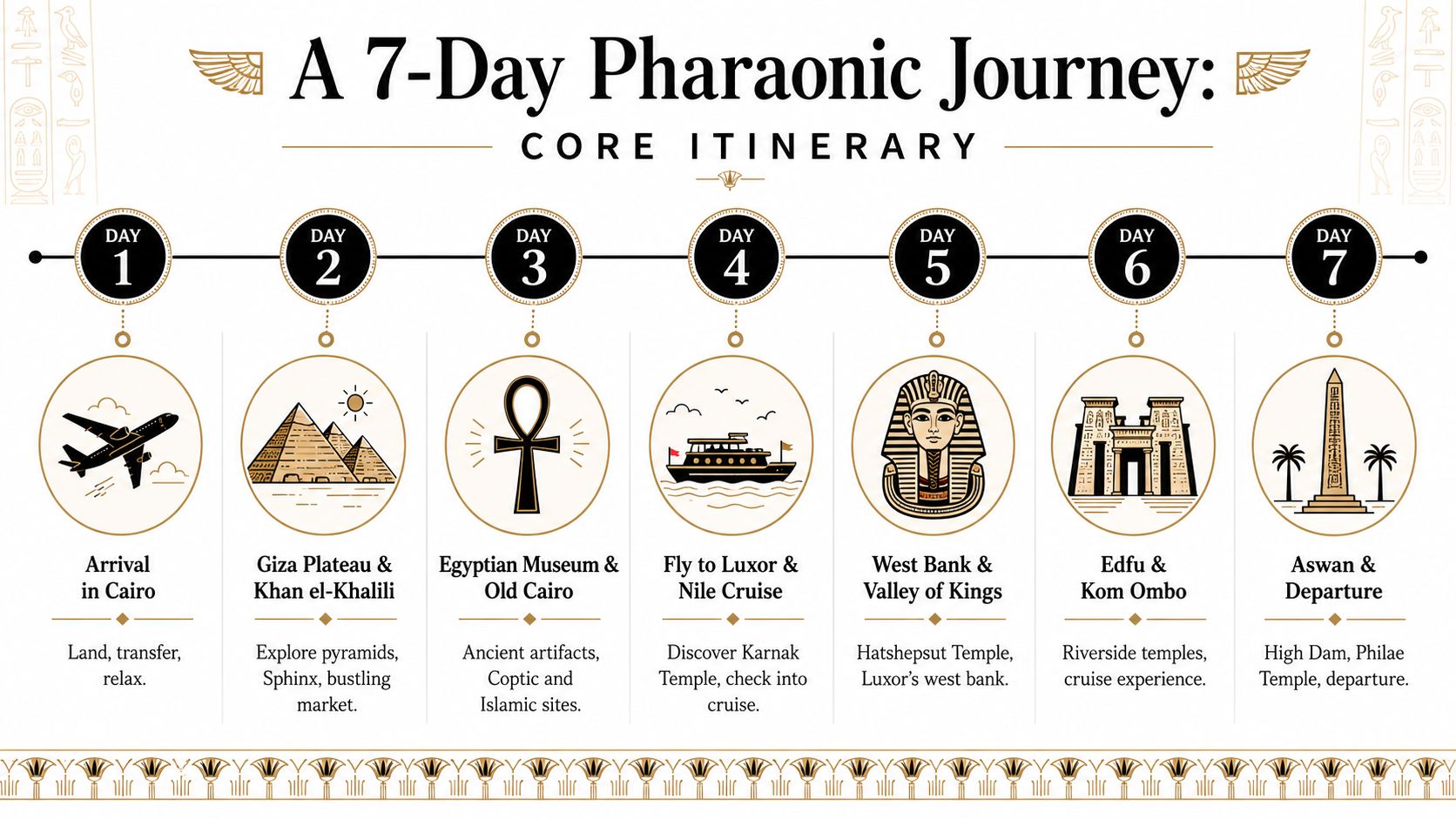
This is the route I recommend to first-time visitors who want the big Pharaonic sites without spending half the week in airports, hotel lobbies, and transfer vehicles. It keeps the backbone in Cairo and Luxor, with one smart flex day in Luxor so the trip can match your energy, interests, and pace. If you later decide to push farther south, that becomes a customization choice, not a default mistake.
Here's the visual shape of the classic journey many travelers imagine before they start refining it.
Why this route works
A first visit to Egypt usually comes down to one practical question. Do you want to collect more stops, or enjoy the headline sites properly?
Cairo and Luxor give the strongest return on a one-week trip. You cover the Great Pyramid of Giza, the museum collections, the old quarters of Cairo, Karnak, Luxor Temple, Hatshepsut, and the Valley of the Kings. That already fills a week well. Adding Aswan can be excellent, but in seven days it often means one more flight, one more hotel change, and less time at the places people came to see.
That trade-off matters on the ground. A private tour handles it better because the route can bend around your priorities. Archaeology lovers can spend longer at Karnak or add a special tomb. Families can shorten a museum block and keep the afternoon easy. Couples can protect one slow Nile evening instead of turning every day into a checklist.
A short video can help you picture the pace before reading the daily flow.
Day by day plan
Day 1 Arrival in Cairo
Keep arrival day light.
Land, clear formalities, transfer to the hotel, eat something simple, and sleep early. If your flight arrives by midday and you still feel fresh, add a short rooftop dinner in Giza or a gentle evening walk nearby. Do not put the pyramids or a museum on this day unless your flight timing is unusually kind.
Cairo rewards clear-headed visitors. Traffic, heat, and the sheer noise of the city feel much heavier when you try to sightsee straight off a long-haul flight.
Day 2 Giza Plateau first, then a softer evening
Start at the Pyramids of Giza as early as possible. Morning gives better light, cooler temperatures, and a calmer site. Spend real time with the plateau. The best visits are not rushed from photo point to photo point. Walk enough to understand the scale. Stop at the Sphinx. Leave time for the viewpoints.
By late afternoon or evening, go to Khan el-Khalili if you want the market atmosphere. It works better later in the day, when the streets feel more alive and the heat has dropped. Go slowly, and do not feel pressured to buy. A tea stop is often more memorable than shopping.
Day 3 Museum day and historic Cairo
Use this day to understand context.
Pair the Egyptian Museum with Old Cairo. One gives the royal objects, statues, sarcophagi, and the long line of dynasties. The other gives you churches, older streets, daily life, and a different rhythm after the size and spectacle of Giza. That contrast helps the trip feel balanced.
This is also a good day to pace gently. Sit down for lunch. Build in one quiet café stop. Cairo is easier to enjoy when every hour is not overplanned.
Day 4 Fly to Luxor and start on the East Bank
Take a morning domestic flight to Luxor. In a seven-day trip, flying is usually the right call. The train has its place, but it takes too much time if your goal is to protect sightseeing hours.
After check-in, begin with Karnak Temple. Give it proper time. Karnak is not a quick stop. It is a huge ceremonial complex, and it rewards visitors who move through it with a guide who can connect the pylons, columns, sanctuaries, and later additions into one story instead of a blur of stone.
If energy is still good, visit Luxor Temple near sunset or after dark. It is one of the few major sites that often feels better later in the day.
Day 5 West Bank and the royal tombs
Start early again. The West Bank is your heaviest sightseeing day, and the timing matters.
Go first to the Valley of the Kings, before the heat builds and the tour buses thicken. Then continue to Hatshepsut Temple. If time and interest allow, add one or two nearby stops based on your style. Some travelers want another tomb. Others prefer a lighter finish with time back at the hotel.
For this reason, a private day really helps. The West Bank can become exhausting if it is handled like a fixed bus schedule. With a flexible setup, you can spend longer in the places that interest you and cut the ones that do not.
Day 6 Luxor flex day
This day improves the whole itinerary.
Removing it to squeeze in another city often looks efficient on paper and feels tiring in real life. Keep it open and use it according to your travel style:
- For history-focused travelers: revisit a temple, add a museum, or book extra tomb access
- For couples: take the morning slowly, then do a sunset felucca or Nile-side dinner
- For families: leave room for pool time and one lighter outing
- For photographers: use the softer morning or late afternoon light at a favorite site
- For bucket-list travelers: book a sunrise hot-air balloon, then keep the rest of the day easy
A fixed group tour rarely handles this day well. A private plan does, because you do not need to decide every detail months in advance.
Day 7 Departure with buffer, not stress
Your final day depends on your flight pattern. Some travelers depart from Luxor. Others need to fly back to Cairo first for the international connection.
Keep this day protected. If your ticket routes you through Cairo, leave enough buffer for delays and airport procedures. If you have spare time, use it for one short, low-risk visit or a relaxed meal, not a packed final sightseeing block.
A good last day feels organized and calm.
What makes this blueprint strong
This plan respects how Egypt feels on the ground. Distances are real. Early starts are common. Great sites deserve more than a quick pass. In one week, every extra transfer takes time from somewhere else.
It also leaves room to customize. That is the point of a strong seven-day Egypt itinerary. You start with a classic Pharaonic backbone, then adjust it for the traveler. Couples usually want more atmosphere and less rushing. Families often need shorter sightseeing blocks. Solo travelers may want more freedom with reliable support behind the scenes. Retirees usually benefit from fewer hotel changes and better pacing.
The best week in Egypt is not the one that tries to do everything. It is the one that gives you the right highlights, at the right pace, with enough flexibility to enjoy them.
Customize Your Itinerary One Trip Five Ways
A perfect Egypt itinerary 7 days doesn't exist as one universal answer. What exists is a smart core plan, then smart edits.
The big decision is usually whether to push south to Aswan and Abu Simbel or stay longer in Cairo and Luxor. That trade-off matters more than people think. According to Divergent Travelers' Egypt itinerary discussion, the best fit depends on the traveler. History-focused visitors can justify the southern extension, while families, honeymooners, and older travelers often do better with fewer internal flights and more time in one base.
For couples who want romance not a race
Couples usually enjoy Egypt more when the itinerary feels spacious. Swap one heavy sightseeing block for a slower Nile-side lunch, a better hotel, or a late afternoon with no plan at all.
If you're celebrating something, don't let logistics eat the trip. Cairo plus Luxor is strong enough. The romance in Egypt often comes from atmosphere, not volume. Sunset over the Nile, temple light at the right hour, a quiet dinner after an early start. Those moments disappear when every day starts before dawn.
For families who need easier days
Families should cut friction first. Keep hotel changes low, avoid stacking multiple major sites in one day, and give children one simple win every day. That might be open space at Giza, a carriage ride in Luxor, a pool break, or a market snack stop.
Museum time is where many family plans go wrong. Adults often want the full deep dive. Children usually want a shorter version. A flexible itinerary lets one long museum become one shorter museum plus downtime.
For solo travelers who want freedom with backup
Solo travelers often want independence, but they also don't want to spend their whole trip negotiating transport, timing entrances, and dealing with constant approach culture around major sites.
The best solo version is a strong framework with room inside it. Keep the Cairo and Luxor core, but leave one half-day open in each city. That gives you structure without making every minute fixed. You still get support where it matters most, especially on transfer days and at the major archaeological sites.
For retirees who want depth and comfort
Retirees usually benefit from a slower Luxor stay. Luxor rewards patience more than speed. Karnak, the West Bank, and temple visits land better when they aren't compressed into one giant push.
Skip unnecessary hotel changes. Choose comfort over bragging rights. If mobility or heat tolerance matters, fewer transfers almost always produce a better week.
For history-first travelers tempted by Aswan and Abu Simbel
This is the one group I'd seriously consider sending farther south in just a week. If ancient Egypt is your main reason for coming, Aswan and Abu Simbel may feel worth the effort.
But go in with open eyes. You're trading depth in Cairo and Luxor for range. That's not wrong. It's a choice.
| Traveler Type | Swap This Core Activity | For This Custom Experience |
|---|---|---|
| Couples | Full extra sightseeing block in Cairo | Slower evening, rooftop dinner, relaxed market visit |
| Families | Long museum session | Lighter sightseeing plus rest or pool time |
| Solo travelers | Fully fixed every-day plan | Structured transfers with open half-days |
| Retirees | Extra hotel move | Longer stay in Luxor with gentler pacing |
| History-focused travelers | Flex day in Luxor | Add Aswan, and consider Abu Simbel if pace is acceptable |
Abu Simbel is spectacular, but in a short week it's an ambition, not a default.
Essential Logistics Budget Transport and Booking
A 7-day Egypt trip usually feels either efficient or expensive. The difference is rarely the hotel alone. It comes from how well the route is built, how many flights and transfers you add, and whether your days are arranged around opening hours and traffic instead of wishful timing.

What a realistic week costs
Budget from the route backward.
A Cairo and Luxor week can be very good value if you keep the plan focused. Costs rise fast once travelers start adding extra cities, upgrading every transfer at the last minute, or trying to squeeze Aswan into a schedule that was already full. The mistake I see most often is pricing Egypt as hotels plus food, then acting surprised by site tickets, airport transfers, domestic flights, tipping, and guide days.
For a practical mid-range trip, expect three main cost buckets:
- Hotels: your nightly rate changes sharply by season, location, and whether breakfast is included
- Transport: domestic flights save time, but they are one of the biggest line items in a one-week itinerary
- Sightseeing: major museums, pyramid-area entries, tombs, and temple tickets add up quickly, especially if you choose premium sites
Private touring usually costs more upfront than joining a shared group, but it often wastes less money overall. You avoid paying for weak detours, forced shopping stops, and badly timed days that leave you too tired to enjoy the places you came to see.
Before paying for flights, check the current Egypt visa requirements and application process. Visa timing is simple when handled early and annoying when left to the final week.
Transport choices that help or hurt
For a one-week trip, time matters more than transport romance.
Cairo to Luxor is the decision that shapes the whole itinerary. I usually recommend flying. It protects sightseeing hours, lowers fatigue, and gives families, older travelers, and couples a much easier start in Upper Egypt. The sleeper train still has a place for travelers who actively want that experience, but it is rarely the best use of a short schedule. You trade a hotel night for weaker sleep, limited privacy, and a less energetic arrival.
Inside Cairo and Luxor, private transport makes a visible difference. Sites like Giza, Karnak, and the West Bank reward early starts and clean handoffs between stops. A flexible driver and guide can shorten dead time, shift lunch around heat, and adjust the order if one site is crowded or a traveler needs a slower pace. That matters even more in a choose-your-own-adventure week, where a family, a solo traveler, and a retiree may all want the same route handled differently.
Booking without locking yourself into a bad week
The best booking strategy for seven days is simple. Reserve the pieces that affect availability first, then keep the rest flexible enough to match your travel style.
Book these early:
- International flights
- Domestic flights
- Hotels in Cairo and Luxor
- Guide and vehicle for your core sightseeing days
Keep some flexibility in:
- Your final evening plans
- Optional market visits or dinner cruises
- Any add-on day that depends on energy, weather, or your real interest level once you arrive
A rigid package can look cheaper online and still cost more in practice. If pickup times are poor, hotel locations are weak, or the itinerary is padded with low-value stops, you lose hours that a short Egypt trip cannot spare.
Direct booking with a local operator gives you more control over the week. You can keep the Classic Pharaonic Journey intact, then adjust the pace for children, add downtime for couples, leave room for solo wandering, or slow the route for retirees without rebuilding the whole trip from scratch. That flexibility is a key advantage of a private tour. It is not about extravagance. It is about using seven days well.
Insider Tips Packing Safety and Culture
The difference between a smooth Egypt trip and a draining one is often not the itinerary. It's preparation. The travelers who feel comfortable here usually aren't braver. They're just better set up.

What to pack so the trip feels easier
Start with clothes that breathe well and shoes you trust on uneven ground. Temple floors, tomb entrances, and city pavements all ask different things from your feet, and flimsy holiday sandals usually lose that argument quickly.
Bring layers, not because Egypt is cold, but because your day may swing between strong sun, air-conditioned vehicles, breezy evenings, and covered religious sites. This helpful Egypt packing guide is close to what I recommend in practice.
A small day bag matters too. Water, tissues, sunscreen, sunglasses, and a light scarf solve more problems than travelers expect.
How to move through Egypt comfortably
Most safety concerns become smaller when you move confidently and keep your day organized. Know where you're going next. Don't flash valuables. Avoid getting drawn into long street negotiations when you're already tired or overheated.
Families and solo women often ask the same question in different ways. The honest answer is that Egypt feels much easier when logistics are handled well. Major tourist routes are well worn. The stress usually comes from friction, not mystery. Unclear transport, persistent sellers, confusion at entrances, and trying to improvise while tired. That's why guided days or pre-arranged transfers help so much.
Calm travelers make better decisions. In Egypt, that starts with shade, water, and not overloading the day.
Small cultural habits that make a big difference
Dress respectfully, especially in mosques and traditional neighborhoods. You don't need to erase your style. You just need to avoid making your day harder than it needs to be.
Learn a few basic Arabic greetings. Even simple politeness changes the tone of many interactions. Be patient in markets. Bargaining is normal, but it should feel like conversation, not combat.
And understand baksheesh, or informal tipping. You'll encounter it. The key is staying polite and clear. Don't promise what you don't want to give, and don't let every small request derail your mood. Egypt is warmer and easier when you accept that some social rhythms here work differently from home.
Frequently Asked Questions About a 7 Day Trip
Is 7 days enough for Egypt
Yes, if you accept that it's a first introduction, not a complete survey. A week can cover the major ancient highlights well. It becomes stressful only when travelers try to force too many stops into it.
Should I do Cairo Luxor and Aswan in one week
You can, and many classic itineraries do. But it's a busy version of Egypt. For most first-timers, Cairo and Luxor done properly feel better than adding Aswan just to say you covered more ground.
Is a Nile cruise worth it in a 7-day trip
Sometimes. If the cruise experience itself matters to you, it can be a highlight. If your priority is maximizing time at the strongest headline sites with less motion, a land-based Cairo and Luxor plan is often more efficient.
Should I add Abu Simbel
Only if ancient history is your clear priority and you're comfortable with a tighter schedule. It's one of the most tempting add-ons in Egypt, but it works best for travelers who already know they're willing to trade comfort for reach.
Private tour or group tour
For Egypt, private usually wins if your budget allows it. The advantage isn't only comfort. It's timing, flexibility, and the ability to adjust the day when energy, weather, or interest changes.
If you want help turning these ideas into a trip that fits your style, Oh Yes Tours makes that easy. You book directly with local guides in Egypt, not through a reseller. That means flexible planning, English-speaking support, pay-on-the-day convenience, and free cancellation up to 48 hours before. For travelers who want Egypt without the usual planning chaos, that direct local approach is hard to beat. Egypt? Oh Yes!