Egypt travel
Colossi of Memnon: A 2026 Luxor Visitor's Guide
Planning a trip to the Colossi of Memnon? Get a local guide's tips on history, visiting hours, photography, and how to combine them with a Luxor West Bank tour.

By Mohamed Hassan · Senior Local Guide · 12 years
The first time of day is often the best. I've watched sleepy travelers step out of the car on Luxor's West Bank, look up at the Colossi of Memnon in the soft morning light, and go quiet before anyone even reaches for a camera.
Table of Contents
- Your First Glimpse of the Giants of Thebes
- History and Legends of the Colossi
- Planning Your Visit Logistics and Timings
- A Guide to Photographing the Colossi of Memnon
- Building Your Luxor West Bank Itinerary
- What to Expect On-Site
- Frequently Asked Questions
Your First Glimpse of the Giants of Thebes
If you visit at dawn, you're standing in the same kind of light that once fed one of the strangest legends in ancient Egypt. After damage to the northern statue in antiquity, travelers in the Greco-Roman period reported a dawn sound from it, and that “singing” turned the site into a stop for important visitors, including emperors.
That old story still shapes the mood of the place. Even travelers who know the legend in advance usually expect a quick roadside stop, then arrive and realize the Colossi of Memnon feel more like a threshold. They don't stand in isolation. They announce the West Bank, the Theban Necropolis, and the larger world of royal tombs and mortuary temples behind them.
I usually tell people not to rush their first minutes here. Walk a little. Look from the front, then slightly off to one side. Notice how the statues sit in open space rather than being boxed into a tight temple court the way many first-time visitors imagine.
The best first view isn't always the first photo. Give yourself a minute to look before you start shooting.
If you're still getting your bearings on the West Bank, this Luxor map from Oh Yes Tours helps place the Colossi in relation to the rest of the day's route. That matters because these statues make the most sense when you see them as gatekeepers to a much larger sacred expanse, not as a stand-alone box to tick.
History and Legends of the Colossi
I often watch visitors arrive, look up, and assume they are seeing a pair of isolated monuments beside the road. A guide who knows the West Bank well reads them differently. These statues only make full sense when you place them back at the front of Amenhotep III's vanished mortuary temple.
Who these statues are
The Colossi were carved for Amenhotep III, one of the strongest rulers of Egypt's 18th Dynasty. They represent the king seated, facing east toward the Nile and the rising sun. If you know that before you arrive, the stop becomes more than a photo break. You start to read the statues as part of a ceremonial entrance, with the rest of the sacred complex once stretching behind them.
They are also a reminder of New Kingdom logistics on a huge scale. The stone came from far north of Luxor, and the effort needed to quarry, transport, shape, and place blocks of that size says as much about royal power as the finished statues do. Journey to Egypt's overview of the Colossi gives a clear summary of their material, scale, and original setting.
That is one reason I advise travelers to pair the Colossi with at least one major West Bank temple site instead of treating them as a stand-alone stop. If you are choosing between a rushed pass-by and a fuller route, these Luxor West Bank tour options show the difference between a quick look and a day that gives the statues proper context.
How Amenhotep became “Memnon”
The name confuses many visitors. “Memnon” was not the original Egyptian name of the king shown here. It comes from the Greek and Roman world, when later travelers connected the northern statue with Memnon, a legendary figure from classical tradition.
So the clean way to remember it is simple. Amenhotep III commissioned the statues. Later Greek and Roman visitors gave them the name commonly used today.
That distinction matters on site. It helps you separate Egyptian history from the later layer of storytelling that made the monuments famous far beyond Luxor.
The “singing” statue legend
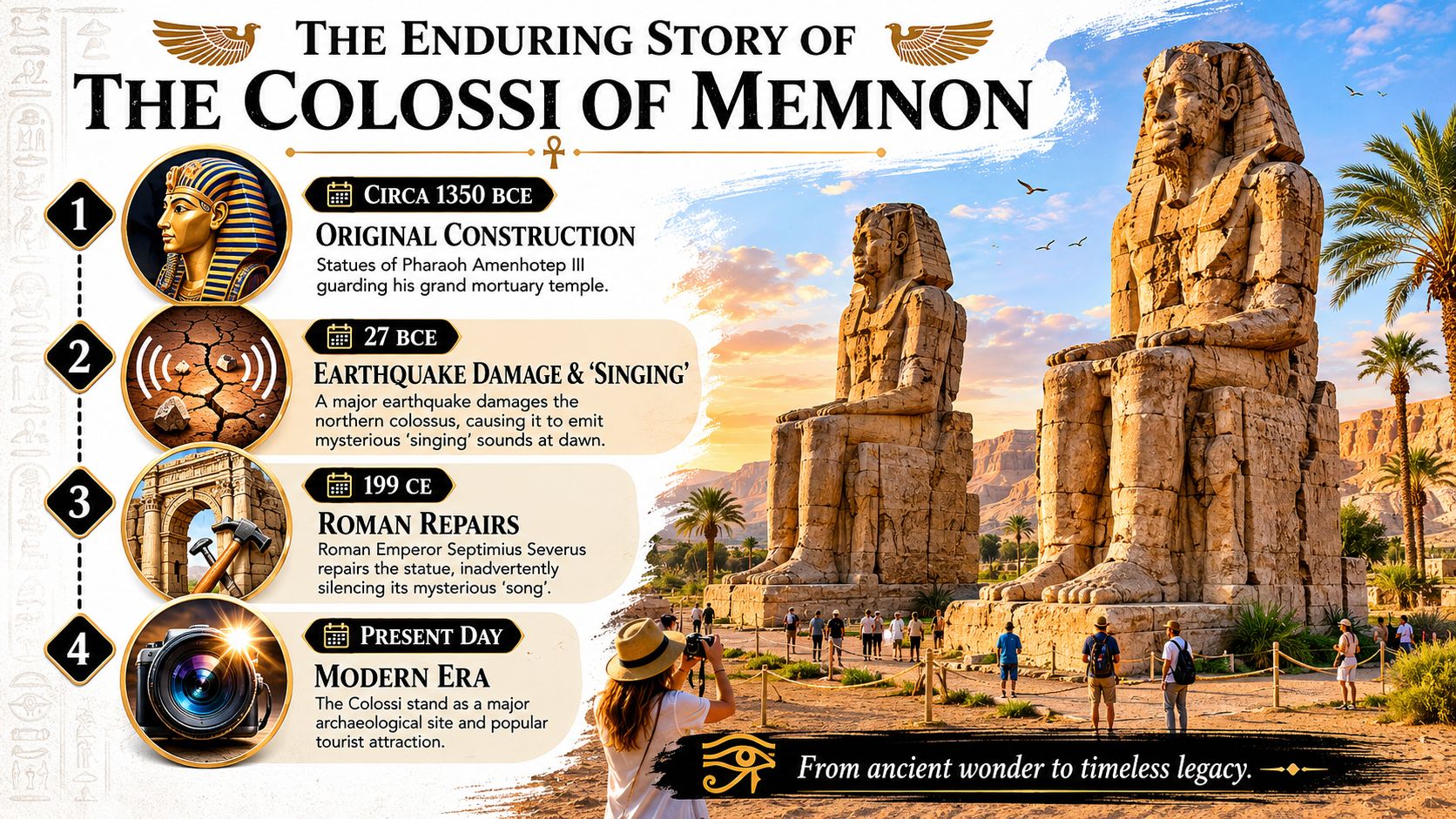
The best-known legend grew out of damage to the northern colossus in antiquity. After it was cracked by an earthquake, Greek and Roman visitors reported a sound at dawn and took it as a sign that the statue was “singing.” That story turned the site into a destination for high-status travelers, including Roman elites.
From a guide's point of view, this is one of the useful trade-offs in how you explain the site. Some travelers love the myth first and the archaeology second. Others prefer the engineering and political history. Both approaches work, but the best visits combine them. The legend explains why the statues became famous in the classical world. The history explains who built them and why they stood here in the first place.
Later Roman repairs are usually linked to the end of that dawn sound. Once the damaged sections were restored, the reports of the “voice” stopped. Visitors still ask whether the story was invented. Maybe some ancient travelers embroidered what they heard, but a damaged stone surface reacting to early morning conditions is a more practical explanation than anything supernatural.
Why this background changes the visit
Good context changes what you notice on the ground. Without it, travelers often ask why there is so little left around the statues. With it, they start asking better questions. How large was the original temple? Why were these seated figures placed here? What survived, and what was lost to flood damage, earthquakes, reuse, and time?
Those are the questions that turn this stop from ten minutes into a meaningful part of a West Bank day.
I usually put it this way for my groups: the Colossi are survivors, not leftovers. If you read them that way, the open space around them stops feeling empty and starts feeling historical.
Planning Your Visit Logistics and Timings
For a practical visit, the Colossi of Memnon are one of the easiest major sites on the West Bank to include. That doesn't mean every approach works equally well.
How to fit them into a West Bank day
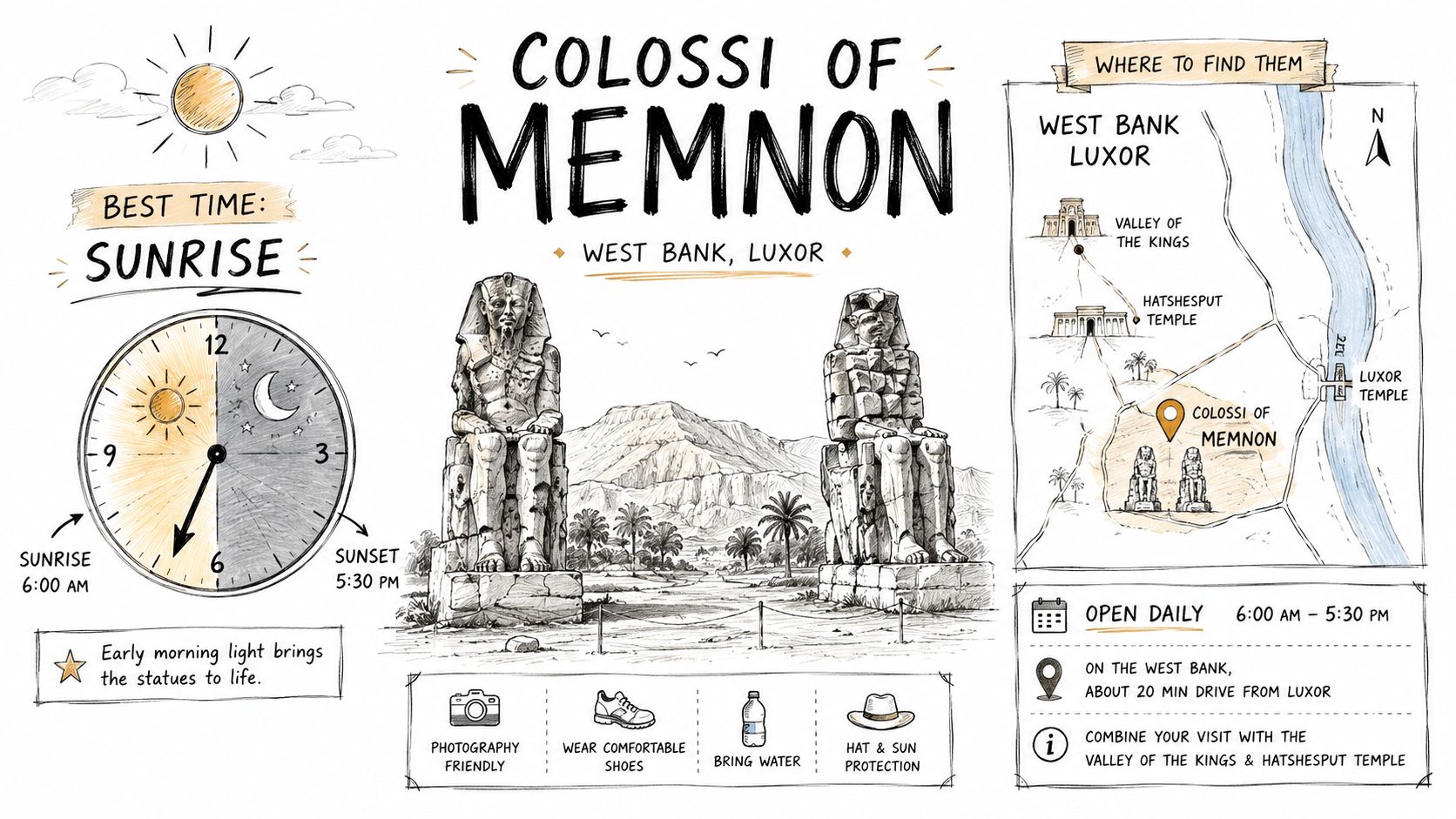
Most travelers see the Colossi at the beginning of a West Bank route. That's usually the smartest order. You get an open-air stop first, you ease into the history, and you're not arriving exhausted after tombs and temples.
Common ways to visit include:
- Private car with driver or guide: Best if you want control over pace, photo time, and the order of the day.
- Taxi from the ferry side: Fine for independent travelers who already know their route and don't mind handling timing themselves.
- Part of a longer West Bank circuit: Usually the most comfortable option if you're also seeing tombs and temples on the same day.
If you're comparing formats, the range of Luxor tour options listed by Oh Yes Tours gives a useful sense of how travelers usually bundle the West Bank into a half-day or full-day plan.
A detail many visitors appreciate once they arrive is that the site is open-air and free to visit. That surprises people because so many Luxor highlights run on a ticketed entry system. The trade-off is that because it's easy to access, the flow of visitors can feel less controlled than at enclosed temple sites.
When to go and what works best
The best timing depends on your priorities.
If photos matter most, go early. The light is softer, the stone reads better on camera, and the visit feels calmer. If you care more about convenience than atmosphere, the Colossi work well as a short stop at almost any point in a West Bank route. They don't require a long on-site commitment.
Mobility is another practical point. This is one of the simpler major Luxor stops for travelers who prefer limited walking. You can get a strong view without covering much ground. That said, the ground surface and roadside environment still reward careful footing and sensible shoes.
A short visual preview helps many travelers decide how much time they want to give the stop:
The biggest planning mistake is squeezing the Colossi into a rushed checklist. If you only want proof you were there, a quick stop works. If you want the place to land properly, give it breathing room and place it at a calm point in your day.
A Guide to Photographing the Colossi of Memnon
The Colossi are easy to photograph badly. They're enormous, exposed, and set in a place where traffic, people, and uneven light can distract from the statues themselves.
The angles that usually work
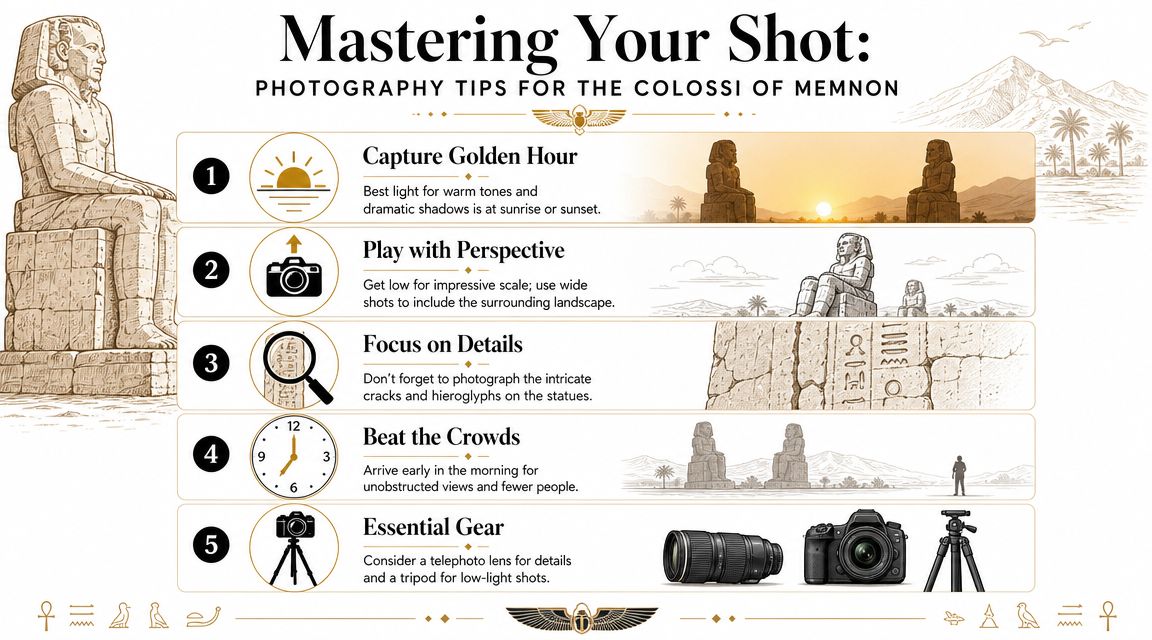
The simplest strong shot is not always dead center. Front-on gives you symmetry, and that's good for a first frame. But slightly off-center often gives the statues more depth and makes the spacing between them feel more dramatic.
A few approaches usually work well:
- Go low for scale: A lower camera position makes the seated figures feel heavier and taller.
- Use a person carefully: One traveler standing well forward can give scale without cluttering the frame.
- Try both wide and tight: Wide shots explain the setting. Tighter frames isolate weathered details and facial structure.
If you're using a phone, step back before switching to a wider setting. Very close wide-angle shots can distort the base and make the statues look less balanced than they do in real life.
If the first ten photos all look flat, change your height before you change your lens.
How to handle light crowds and road-side distractions
Morning light is usually the friendliest. Harsh overhead sun can wash out texture and deepen shadows in awkward places. When the light is gentle, the stone shows more character and your photos need less correction later.
Crowds come in waves. That's the good news. If one group has just arrived, don't fight it immediately. Wait a little, move to a side angle, or take detail shots first.
A practical photography sequence I often recommend is:
- Start wide before people spread out.
- Take a mid-range portrait-style frame of one statue.
- Look for details once the main front area gets busier.
- Finish with one scale shot including a person or open ground.
Don't ignore the less obvious frames. The cracks, worn surfaces, and layers of repair often tell a better story than another standard social-media pose.
Building Your Luxor West Bank Itinerary
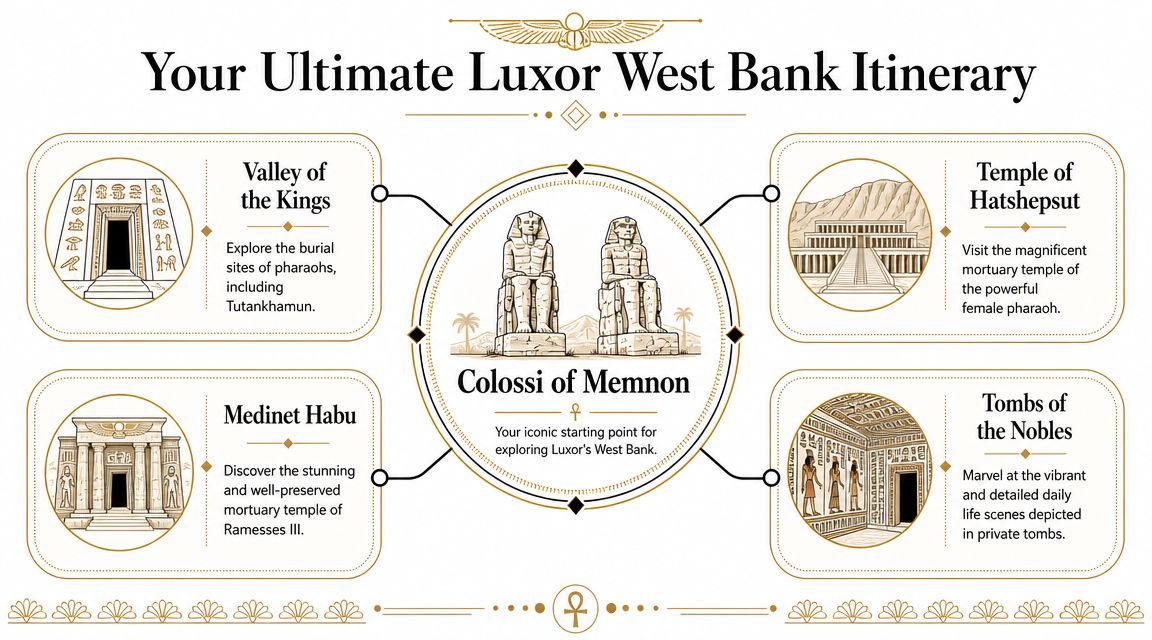
The Colossi make the most sense when they anchor a route rather than float as a detached stop. Travelers who enjoy the West Bank most usually build the day around rhythm: one easy outdoor start, one or two major headline sites, then one place with a slower atmosphere.
The mistake many visitors make
The most common itinerary error is trying to do every famous site at the same pace. The West Bank doesn't reward that. Tombs demand attention. Temple courtyards reward lingering. The Colossi, by contrast, are often best as a shorter, well-timed stop that sets the tone.
A stronger route often pairs the Colossi with a mix like this:
- A headline tomb zone: Valley of the Kings for travelers who want royal burial history.
- A major temple statement: The Temple of Hatshepsut if architecture matters most to you.
- A quieter reward later in the day: Medinet Habu for visitors who prefer atmosphere and relief carving over crowd energy.
If you want a wider overview of how these places sit within Luxor's historical panorama, the Luxor attractions guide from Oh Yes Tours is a useful planning reference.
Sample Luxor West Bank Private Tour Itineraries
The best plan depends less on age and more on travel style. Some couples want a sharp, elegant half-day. Families often do better with fewer stops and more flexibility. Serious history travelers usually prefer a full day with fewer rushed transitions.
| Feature | Half-Day West Bank Express (4-5 hours) | Full-Day West Bank Explorer (7-8 hours) |
|---|---|---|
| Best for | First-time visitors, cruise schedules, travelers with limited energy | History-focused travelers, couples, slow-paced cultural days |
| Typical flow | Colossi of Memnon, one major temple, one tomb area | Colossi of Memnon, major tomb area, major temple, additional temple or noble tombs |
| Pace | Efficient, selective, lighter walking overall | Broader, deeper, with more time to pause |
| Main advantage | Covers signature West Bank highlights without fatigue | Gives the Colossi proper context within the wider necropolis |
| Main trade-off | Less room for detours and slow looking | Requires earlier start and stronger stamina |
| Who usually likes it most | Families, retirees who prefer fewer transitions, short-stay travelers | Egypt enthusiasts, photographers, travelers who dislike rushed sightseeing |
| Example pricing style | from €X | from €X |
Who each style suits best
The express version works when logistics are tight. If you're arriving from another city, traveling with kids, or don't want a long archaeological day in the sun, a half-day plan can be the right decision. The key is choosing depth in one or two places instead of skimming everything.
The fuller version works best when history is a reason for the trip, not just a background activity. In that case, the Colossi become a prologue. They prepare your eye for the mortuary world of the West Bank.
A good West Bank day isn't the one with the most stops. It's the one where each stop still means something by the end.
My practical advice is simple. If the Colossi are only one photo among many, keep them brief. If you care about how Luxor's monuments connect to one another, put them first and build the rest of the day around that opening.
What to Expect On-Site
The visit itself is usually short, but that doesn't mean it's trivial. Visitors often spend their time in a few clear phases: first the wide look, then the photos, then a slower moment when they start noticing the wear in the stone and the open setting around the statues.
The real atmosphere at the statues
This is a popular roadside stop, so the atmosphere changes in bursts. A quiet few minutes can suddenly become busy when vehicles arrive together. The good part is that the same thing happens in reverse. If a cluster forms, waiting briefly often improves the view.
Expect an active but manageable tourist environment. You may also find souvenir sellers nearby. A polite “no, thank you” usually works better than getting pulled into long explanations if you're not interested.
For many visitors, the surprise isn't the scale. It's how exposed the site feels. There's no theatrical buildup. The statues are just there in the open, which is part of their power.
Comfort etiquette and preservation
The statues are also massive engineering objects, not just visual icons. Each statue weighs about 720 metric tons and rests on a 600-ton pedestal, bringing the total weight to over 1,300 tons, which is why preservation work focuses strongly on base integrity and controlled access, as noted in Wikipedia's summary of the monument's structural scale.
That helps explain why visitors don't get free physical access to the stone itself. Distance is part of conservation here. It protects the site and keeps ground conditions more stable.
Bring what you'd bring for any exposed West Bank stop:
- Sun protection: Hat, sunglasses, and water matter more than people expect for a “quick stop.”
- Stable shoes: You don't need hiking boots, but flimsy footwear isn't ideal.
- Patience for timing: A few extra minutes often improve both the view and the photos.
Frequently Asked Questions
Are the Colossi of Memnon worth visiting
They are, if you visit with the right expectations.
I tell travelers to treat the Colossi as a smart first stop on the West Bank, not the main event. They give you scale, orientation, and a sense of how vast Amenhotep III's funerary complex once was. If you only hop out for two rushed photos, the stop can feel thin. If you spend even 10 to 15 minutes looking carefully, checking both angles, and hearing the backstory, the visit lands much better.
They suit first-time visitors, photographers, and anyone who wants to start the morning with an open-air site before heading into tombs and temples.
Can you touch the statues
No. Access is controlled, and that is the sensible policy.
These statues have survived earthquakes, rebuilding, flooding, and centuries of exposure. Keeping visitors at a distance protects the stone and keeps the site easier to manage during the busy morning window. Expect to view and photograph them from the designated area, not from the base.
What happened to the singing sound
The northern statue was damaged in antiquity, and after that, ancient visitors reported a sound at dawn. Greek and Roman writers turned that into the famous “singing Memnon” story.
The sound stopped after Roman-period repairs, as noted earlier in the history section. Today, what remains is the legend. It is one of those Luxor stories that matters because it shows how later cultures reinterpreted an older Egyptian monument.
Why do the statues look so presentable today
Because what you see is the result of survival and repair across a very long timeline.
Parts of the original temple complex vanished long ago, but the Colossi kept their place at the edge of the cultivation, and later restoration helped stabilize them. That matters for visitors. You are not looking at untouched stone frozen in one moment of history. You are looking at a monument that has been damaged, patched, studied, and protected by different generations.
That is also why I recommend pairing this stop with at least one major West Bank site on the same morning. The Colossi make more sense when you see them as the doorway to a bigger story, not just two giant statues beside the road.
If you want to see the Colossi of Memnon as part of a well-paced Luxor day, Oh Yes Tours can help you arrange a private Egypt experience directly with local guides who live here. That means honest timing, flexible pacing, English-speaking support, and no middleman layer. Egypt? Oh Yes!