Egypt travel
Cairo Pyramids Tour: A Local's Guide (2026)
Plan the perfect Cairo Pyramids tour. This insider's guide covers private vs group tours, real prices, logistics, and booking tips from a local Egyptian guide.

By Mohamed Hassan · Senior Local Guide · 12 years

Most advice about a cairo pyramids tour starts with the dream photo. The three pyramids. The Sphinx. Maybe a camel in the frame. That part is real, but it skips the piece that decides whether your day feels smooth or exhausting.
The biggest mistake travelers make is thinking the hard part is choosing which monument to see. It isn't. The hard part is choosing a tour structure that doesn't waste half your day in traffic, queues, awkward add-ons, and badly planned routing. At Giza, the monuments are fixed. Your experience isn't.
A good pyramids day feels calm, efficient, and surprisingly easy. A bad one feels like a chain of little frictions that steal time from the actual site. That's what most glossy travel guides miss, and it's exactly what matters most when you're booking.
Table of Contents
- What Most Cairo Pyramids Tours Get Wrong
- Decoding Your Tour Options Private vs Group Tours
- Anatomy of a Perfect Pyramids Day Trip
- The Real Cost of a Cairo Pyramids Tour
- Your Guide and Ride Logistics Explained
- Planning for Everyone Accessibility, Kids, and Seniors
- Booking Your Tour The Smart Way
What Most Cairo Pyramids Tours Get Wrong
The usual advice says, “Book a full-day tour and you'll see everything.” That sounds reassuring, but on the ground it often means very little. A “full day” can shrink fast once hotel pickup loops, city traffic, security lines, and shopping detours start eating into your schedule.
According to a Tripadvisor tour listing and traveler context for Giza visits, one of the most under-discussed issues is how much of a tour is spent on logistics rather than sightseeing, and travelers are often caught off guard by add-on costs for things like interior pyramid tickets or even drinks with lunch. That's the primary hidden tax of a cairo pyramids tour. Not just money, but attention and time.
What goes wrong is usually simple. The tour is built around the operator's convenience, not the visitor's day. Big groups need fixed stops. Shared transport needs broad pickup windows. Some itineraries pad the schedule with low-value stops because they look good on paper.
Practical rule: Don't judge a pyramids tour by the list of highlights. Judge it by how it handles pickup, routing, waiting time, and extras.
The site itself is unforgettable. The frustration comes from everything wrapped around it.
Three common problems show up again and again:
- Too much transit: You book the pyramids, but spend a big chunk of the day getting there, getting parked, or getting reassembled with the rest of the group.
- Too many “optional” costs: The base price looks tidy until interior access, camel rides, lunch details, or small comfort items appear as extras.
- Bad pacing: You arrive late, hit the busiest flow, rush the best viewpoints, then spend time where you didn't need to.
A strong cairo pyramids tour fixes those issues before the day starts. That's what separates a memory you'll talk about for years from one where you mainly remember heat, waiting, and being herded around.
Decoding Your Tour Options Private vs Group Tours
Choosing a pyramids tour is a bit like choosing where to eat in a new city. Some travelers want the flexibility of ordering exactly what they like. Others are happy with the simpler, cheaper set menu. Neither is automatically wrong. The problem starts when people book one style and expect the experience of the other.
The Giza Plateau receives around 2.5 million visitors a year, and the site was overhauled through a US$30 million renovation project that introduced a bus system and other visitor-flow improvements, as reported in this South China Morning Post feature on the revamped Giza visitor experience. That matters because crowd management isn't a side issue. It's part of the tour product.
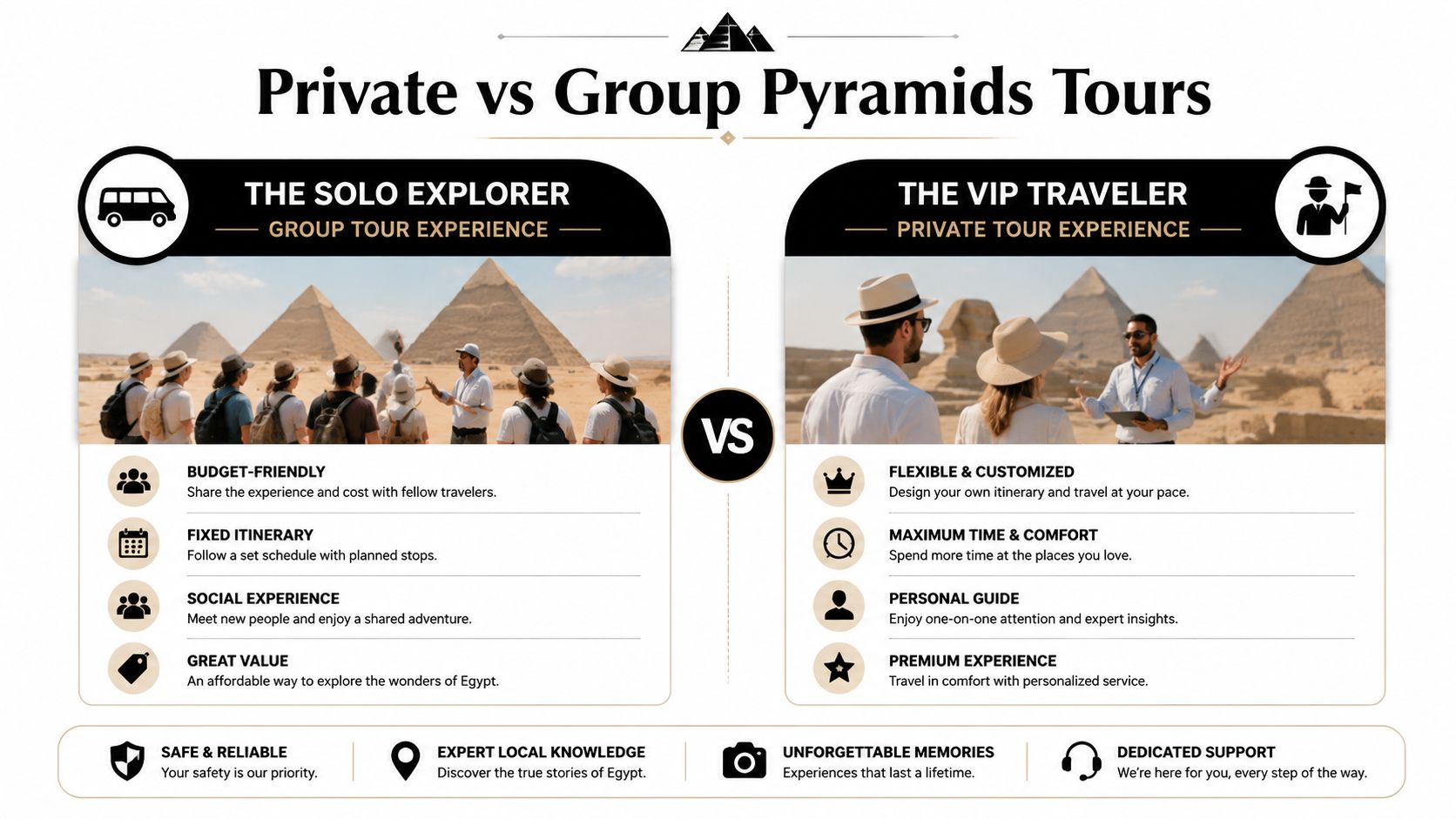
Private tours for travelers who care about pace
A private cairo pyramids tour is usually the best fit for couples, families, older travelers, and anyone who hates being rushed. You control the rhythm. If you want longer at the panoramic point and less time at a souvenir stop, that can happen. If someone in your group needs shade, a restroom break, or a slower walking pace, the day doesn't fall apart.
Private tours also handle uncertainty better. Cairo traffic changes the day. Site flow changes the day. A private setup adapts.
Typical strengths of private tours:
- Flexible routing: You can change the order of stops based on the morning.
- Better comfort: Your own vehicle, your own timing, fewer waiting points.
- Easier customization: Better for photographers, history lovers, and travelers with specific needs.
The trade-off is obvious. Private tours usually cost more than shared tours.
Group tours for travelers who value price first
Group tours work best when your top priority is budget and you're comfortable with compromise. They can be social, straightforward, and perfectly fine if your expectations are realistic.
But group tours have built-in limits. You move when the group moves. If one traveler is late, everyone waits. If the guide needs to keep the bus schedule intact, some stops feel rushed while others run long.
A group tour often suits:
| Tour type | Best for | Main upside | Main downside |
|---|---|---|---|
| Private | Couples, families, retirees, history-focused travelers | Control and comfort | Higher price |
| Group | Solo travelers, budget-conscious visitors | Lower upfront cost | Less flexibility |
| Shore excursion | Cruise passengers | Return-to-ship focus | Tight schedule |
| Flight day trip | Red Sea visitors | Sees Cairo in one day | Long, logistics-heavy day |
A cheap tour can still be good. It just won't behave like a private one once the day starts bending.
Shore excursions and flight-based day trips
These two categories need special handling because the logistics drive everything.
Shore excursions are built around one non-negotiable fact. You must get back to the ship on time. That makes them useful for cruise passengers, but they tend to be strict on pacing. There isn't much room for wandering, slow lunches, or spontaneous changes.
Day trips by flight are common for travelers staying on the Red Sea who want to see Cairo without changing hotels. They can be worth it if the pyramids are a must-see and your vacation base is elsewhere. But the day is long, airport-heavy, and less forgiving. When people imagine “a quick cairo pyramids tour,” this is usually the version that surprises them most.
If you're deciding between tour types, use this simple filter:
- Choose private if comfort, flexibility, or family logistics matter.
- Choose group if price matters most and you don't mind a fixed plan.
- Choose shore excursion if ship timing is the whole game.
- Choose flight-based day trip only if you're happy trading ease for convenience from another city.
Anatomy of a Perfect Pyramids Day Trip
A good pyramids day isn't about cramming in the maximum number of stops. It's about hitting the plateau at the right moment, entering from the right side, and leaving enough breathing room that the day still feels like travel, not transport.
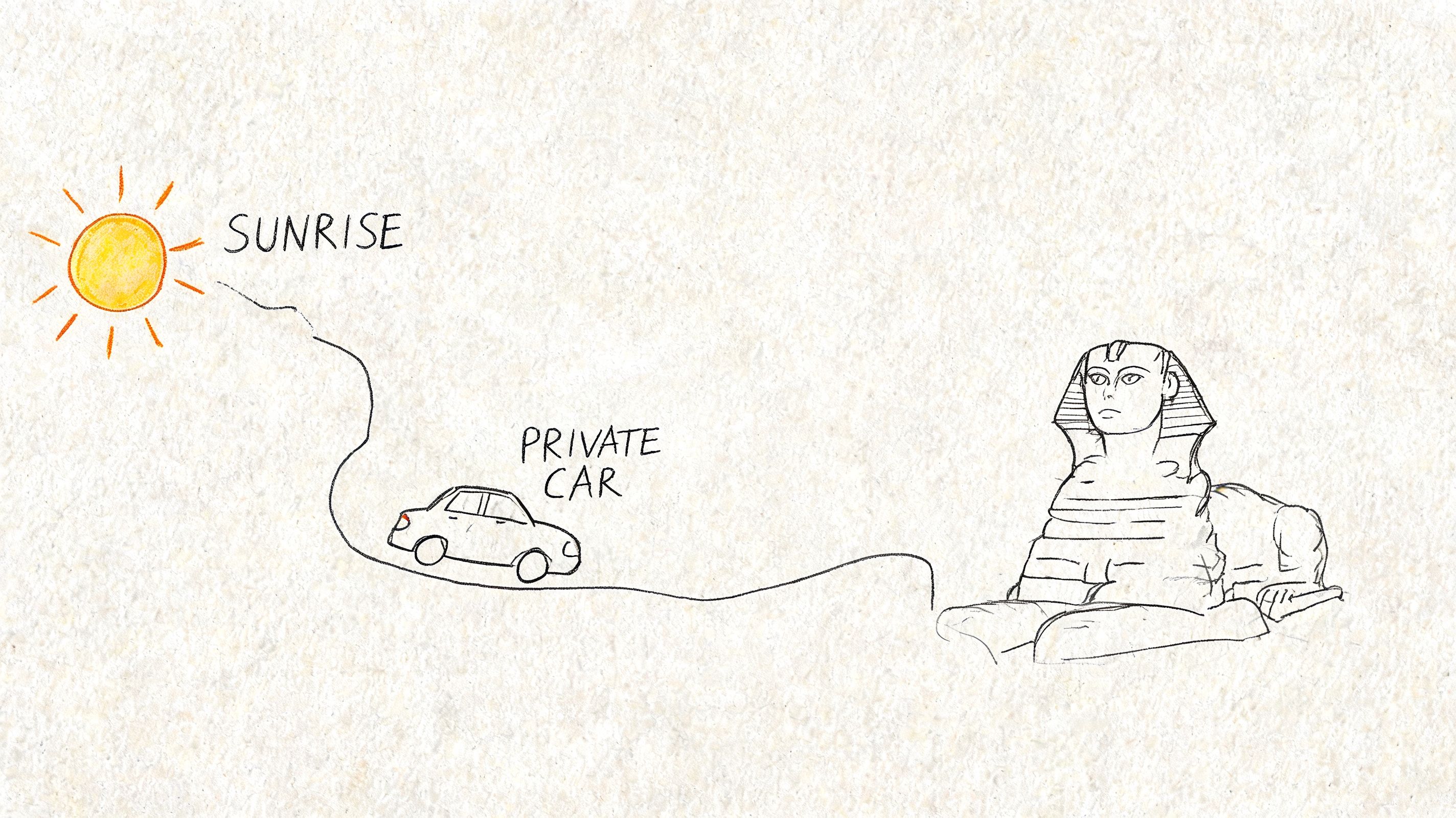
Official visitor guidance places Giza about 15 km from central Cairo, notes two main entrances, and lists opening hours as 8:00 AM to 5:00 PM with last entry at 4:00 PM, as summarized on this planning guide for visiting the Pyramids of Giza. The practical lesson is simple. Start early and think about entry strategy before you think about selfies.
Start with the entrance, not the highlight
The best private days usually begin with hotel pickup early enough to arrive close to opening. Not because early starts are romantic, but because they work. You avoid part of the queue, part of the heat, and part of the midday slowdown that catches late departures.
For many travelers, the smarter opening move is the Sphinx side. It gives a guide room to shape the route properly instead of forcing unnecessary backtracking across a large site.
A well-run morning often looks like this:
- Early hotel pickup: Leave before the city fully clogs up.
- Enter from the side that suits the day's flow: Often the Sphinx entrance works better for routing.
- See the Sphinx first: You get one of the most iconic views without saving it for the hottest part of the day.
- Move up onto the plateau: Then work toward the major pyramid viewpoints and panoramic stops.
What doesn't work is arriving late, entering without a plan, and zigzagging across the plateau because the itinerary was written from a desk instead of from experience on site.
Build the middle of the day carefully
The middle of the day is where tours start to split into good and bad versions. A rigid schedule pushes people too hard when the site is hottest and busiest. A thoughtful schedule slows down and chooses quality over pointless mileage.
If the morning runs well, the rest of the day gets easier. If the morning starts late, guides spend the rest of the tour trying to recover lost time.
A comfortable private itinerary usually leaves room for:
- Exterior viewing and explanation first: Many travelers get more from the site when they understand what they're seeing before any optional add-ons.
- A measured decision on interior access: Only if someone really wants it and can handle the physical conditions.
- Lunch without a hard sell: Better to stop somewhere relaxed than burn time in a place built around commission stops.
Later in the day, a private tour can still add another major Cairo stop without making the day miserable. Common choices are the Egyptian Museum or Khan el-Khalili, depending on whether you want archaeology or atmosphere. The trick is not adding both blindly if the group is already tired.
A short video gives a feel for how the plateau moves in real life:
The best cairo pyramids tour doesn't feel packed. It feels well judged. You finish having seen the essentials properly, not having rushed past them just to say you covered more ground.
The Real Cost of a Cairo Pyramids Tour
Most travelers don't mind paying fairly. What they hate is not knowing the actual cost until the day is underway. That's why the advertised tour price matters less than the inclusion list.
The usual confusion comes from one basic issue. Two tours can sound identical in a search result and still be priced very differently once tickets, lunch, interior entry, and extras are separated out. If you're comparing offers, compare the total experience, not just the headline figure.
What usually is included
In a standard Cairo setup, the base tour price often covers the core service side of the day rather than every site expense.
That commonly means:
- Guide service: Sometimes private, sometimes shared.
- Vehicle and driver: Usually with air conditioning for the transfer and city movement.
- Hotel pickup and drop-off: Often included when you're staying in the main service area.
If you're booking a flight-based Cairo day trip from the Red Sea, the package may also include flights and airport coordination. On the premium end of the market, operators may bundle more to keep the day simple.
One transparent market example is that some operators advertise Cairo day trips with flights from €499. That's useful as a starting point for understanding how much more complex a flight-based day becomes compared with a hotel-based city departure.
What often shows up as an extra
Here, people often get tripped up. A lot of the “surprises” aren't hidden exactly. They're just buried.
Watch for these line items:
- Entrance fees: Sometimes included, sometimes not.
- Great Pyramid interior ticket: Frequently separate from general touring.
- Camel ride or carriage option: Usually optional and often priced outside the main package.
- Lunch details: Included lunch doesn't always mean drinks are included.
- Tips: Travelers often forget to budget for them.
If you're unsure how tipping works locally, this Egypt tipping guide is a useful planning reference before you book.
A simple comparison table helps:
| Cost item | Often included | Often extra |
|---|---|---|
| Guide | Yes | Sometimes upgraded language requests |
| Private vehicle and driver | Yes on private tours | Rarely |
| General site entry | Varies | Often |
| Great Pyramid interior | No | Usually |
| Lunch | Varies | Drinks may be separate |
| Camel ride | No | Usually |
| Tips | No | Yes |
The right question isn't “How much is the tour?” It's “What will I spend from pickup to drop-off if I do the day the way I actually want to do it?”
That one question saves a lot of disappointment.
Your Guide and Ride Logistics Explained
Some travelers focus almost entirely on tickets and landmarks. Fair enough. But on a cairo pyramids tour, your guide and your vehicle shape the day as much as the site itself.
You can see the pyramids with weak logistics. People do it every day. The problem is that weak logistics drain energy from the parts you traveled for.
Why the guide matters more than people think
The Great Pyramid was built for Khufu around 2600 to 2500 BC, making it roughly 4,600 years old, and commonly cited estimates put its construction at about 20 years with around 20,000 laborers. Egypt also has over 100 pyramids, though the exact count is uncertain. Those details appear in this detailed guide to the Pyramids of Giza and their historical context.
That context is where a licensed Egyptologist earns their place. A general tour leader can move you from stop to stop. A strong Egyptologist can explain why Khufu matters, why the pyramid form evolved, and why Giza is more than a postcard image.
The difference shows up in small moments:
- At the base of the Great Pyramid: One guide says, “This is Khufu's pyramid.” A better guide explains what made it a state-level feat.
- At the panoramic point: One guide takes the photo. A better guide also helps you interpret the surroundings.
- Near the Sphinx: One guide recites trivia. A better guide builds a coherent story.
If you love history, this isn't an upgrade. It's the product.
Why a dedicated vehicle changes the whole day
The ride matters because Cairo isn't a city where a multi-stop sightseeing day works best as a chain of improvised taxi rides. It can be done, but it adds friction almost every time.
A dedicated private vehicle changes several things at once:
- You keep your pace: No repeated app bookings, no searching for the next car, no splitting the group.
- You keep your comfort: Air conditioning, a place to reset, and a predictable pickup point matter more than many first-time visitors expect.
- You keep your focus: You're thinking about the site, not about whether the next driver understands the route.
For older travelers, families, or anyone doing a long day with museum and market add-ons, this matters a lot. Even a very good guide becomes less effective if the transport side is disjointed.
Good transport is quiet value. You notice it most when you don't have it.
A professional guide with a proper driver and vehicle doesn't just make the day nicer. It makes the day hold together.
Planning for Everyone Accessibility, Kids, and Seniors
The pyramids are not a one-size-fits-all site. Families with younger children need pacing. Older travelers need honest guidance about walking and uneven ground. Some people want the inside of the Great Pyramid no matter what. Others will enjoy the day much more if they skip it.
That's normal. A good cairo pyramids tour adapts.
When going inside the pyramid makes sense
Inside the Great Pyramid, visitor information describes three chambers, with the common visitor route leading through the Grand Gallery toward the King's Chamber, and guides often estimate the visit at about 30 minutes. The route is narrow and steep, according to this complete guide to the Pyramids of Giza tour experience.
For some travelers, that's a highlight. For others, it's the part they regret.
The interior is a poor fit if someone in your group has:
- Mobility concerns
- Claustrophobia
- Very young children who won't enjoy a tight, stair-heavy route
- Low tolerance for heat or enclosed spaces
Before you go, it also helps to review a practical Egypt packing list for day trips so the basics are handled properly.
Better ways to plan for comfort
Families usually do best when adults stop trying to “cover everything.” Children rarely remember the longest explanation. They remember the shape of the pyramid, the Sphinx, the scale of the stones, and whether the day felt fun or draining.
Seniors and slower walkers usually enjoy the site more with fewer forced transitions. Focus on the major exterior views, strategic vehicle positioning, and a guide who knows where to save steps.
A few comfort-first strategies work well:
- Keep the route selective: One great viewpoint is better than too much walking between average ones.
- Choose exterior focus if needed: The plateau gives plenty without forcing an interior climb.
- Use the vehicle intelligently: Rest between site segments matters.
- Be realistic about attention spans: For kids and tired adults alike.
Sometimes the best-value pyramids tour is the one that skips the hardest add-on and leaves everyone with energy to enjoy the rest of the day.
The best family and senior itineraries don't try to prove anything. They match the site to the people visiting it.
Booking Your Tour The Smart Way
Smart booking starts with one attitude. Don't book the most exciting description. Book the clearest operation.
A polished tour page can hide a messy day. A simpler offer with direct answers is often the better buy. What matters is whether the operator can tell you, plainly, how the day runs.
Questions worth asking before you pay
Before booking a cairo pyramids tour, ask these questions directly:
- What's included in the price? Ask specifically about entry fees, lunch, drinks, and interior tickets.
- Is the tour private or shared? Never assume from the photos.
- Who is the guide? Ask whether you'll have a licensed Egyptologist or a general escort.
- What vehicle is used? Comfort matters more than many travelers expect.
- How is pickup handled? That's where timing issues often begin.
- Are there shopping stops? Better to know in advance than feel trapped in one.
If an operator answers vaguely, that's already useful information.
What smart booking looks like
The best bookings usually share a few traits. Communication is direct. Pricing is explained in normal language. Cancellation rules are clear. Payment terms don't feel slippery.
For travelers who prefer dealing directly with the people running the day, browsing a focused local operator's Cairo tours collection can be a practical way to compare styles and ask specific questions before committing.
A strong booking setup often includes:
| Booking factor | What to look for |
|---|---|
| Communication | Direct answers, not copy-paste replies |
| Inclusions | Clear list of what is and isn't covered |
| Flexibility | Reasonable cancellation terms |
| Payment | Transparent timing and method |
| Tour design | Realistic pacing, not inflated sightseeing lists |
Local operators often do this better than large resellers because you're closer to the actual guide team and day-to-day logistics. That doesn't guarantee quality on its own, but it usually gives you clearer answers and fewer layers.
The smartest travelers don't just ask, “Is this tour good?” They ask, “Will this tour run the way I want my day to feel?” That's the question that gets you the right booking.
If you want a cairo pyramids tour that feels unhurried, honest, and properly local, Oh Yes Tours is worth a look. You book directly with guides on the ground in Egypt, not through a reseller, and the approach is simple: clear communication, fair pricing, pay on the day in cash, and free cancellation up to 48 hours before. Egypt? Oh Yes!